Orthodontics · Braces
Parts of fixed braces and what they do
This article is for general information and does not replace advice from a doctor. Medical disclaimer
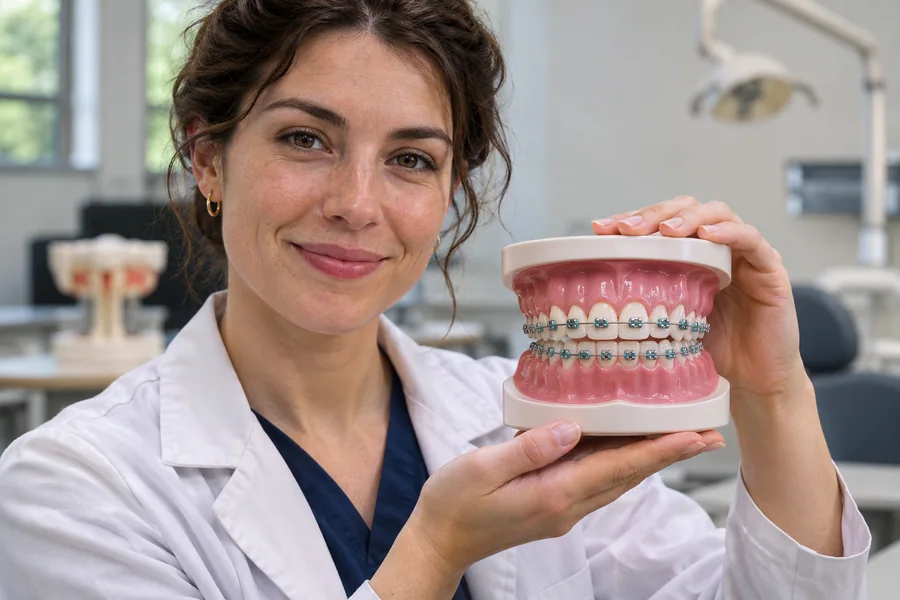
A bracket is a small detail on the surface of a tooth. The arch passes along the row and transmits force to the teeth through the brackets. In addition, an orthodontist can use rings, tubes, and rubber bands. If any detail has shifted, it is helpful to describe whether it is on one tooth, along the row, or connects the jaws.
| Detail | Where it is located and what it does |
|---|---|
| Ligature | A small rubber band or wire around one bracket. It holds the arch in place. In a self-ligating design, this function is performed by an integrated lock. |
| Ring | The gum margin, usually lateral. It can serve as a support for details. Sometimes, a separator is temporarily placed between teeth before installation. |
| Moler tube | A detail on the lateral tooth or ring with a slot for the archwire. |
| Elastic chain | Connects multiple braces along a row. Can transmit force to close the gap. |
| Mandibular thrust | The elastic band between the specified points in the upper and lower rows. The direction of action depends on where it is fixed. |
How to describe the problem when calling an orthodontist
If the wire is scratching the cheek near the last tooth, check if the wire end is protruding or if the wire itself is moving. If a small rubber band has come off one of the brackets, please specify which one. A broken chain is usually noticeable over a section of several teeth. When a bracket comes loose, it is helpful for the dentist to know if it is still attached to the wire and whether it is interfering with closure. The clinic will use these signs to determine when you need to come in.
Why does the doctor change details during treatment
Different stages of treatment require different directions of force. Replacing the archwire, adding attachments, and placing intermaxillary elastics can address specific issues independently. If the attachment point has changed, consult with the orthodontist for clarification. Moving the attachment to a different point changes the direction of force, even if the elastic itself looks the same.
Related terms
- Bracket ligature
- Orthodontic band
- Orthodontic separator
- Molar tube
- Orthodontic power chain
- Interarch elastics
Further reading
- A braces bracket came loose: when to get help
- Power chains on braces: why orthodontists use them
- Rubber bands for braces: what orthodontic elastics do
Sources
- How Braces Work: Parts & Their Functions. American Association of Orthodontists
- Orthodontic Glossary. American Association of Orthodontists
- Orthodontic Elastics. American Association of Orthodontists
- Conventional Fixed Braces. British Orthodontic Society
- Braces on dental crowns: what the orthodontist checks
How crown material affects bonding and why a crown on a natural tooth is treated differently from an implant crown. - Ceramic braces: visibility, care and trade-offs
See which parts of ceramic braces stay visible, what affects bracket choice, and how to compare ceramic and metal options. - Getting Braces Removed and What Happens Next
What happens when braces come off, what removal can feel like, and what to ask before you leave with a retention plan. - How Much Do Braces Cost in the U.S.?
Published U.S. braces fees and what to check in a quote, from records and adjustments to removal and retainers. - Lingual braces: how they work and what to expect
Learn how behind-the-teeth braces affect speech and cleaning, and what to find out before choosing a lingual appliance. - Rubber bands for braces: what orthodontic elastics do
Learn how interarch elastics differ from elastic ties, why your pattern is individual, and what to ask if you run out or a hook breaks.