Orthokeratology: Overnight Ortho-K Lenses and Myopia Control
How overnight lenses work and how they differ from glasses and daytime contacts.
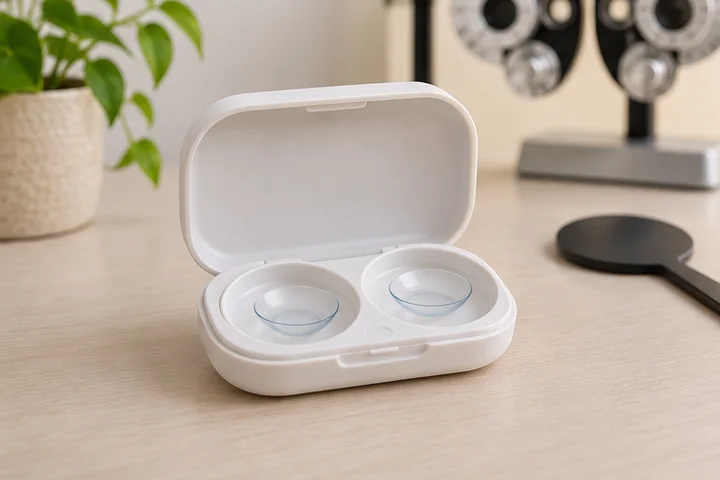
Orthokeratology, or ortho-k, uses rigid gas-permeable lenses worn during sleep to reshape the cornea and temporarily reduce nearsightedness. The FDA describes overnight lenses as commonly worn for at least eight hours a night and removed on waking. The effect lasts only as long as the lenses are worn on schedule, and the FDA requires eye care professionals to be trained and certified to fit them. How the reshaping works is explained in how orthokeratology works, and who qualifies in who can wear ortho-k lenses.
Ortho-k and myopia in children
Ortho-k is also used to try to slow myopia in growing children. The 2025 Cochrane review pooled the randomized trials. Compared with children in single-vision glasses or contact lenses, children wearing ortho-k had eyes that grew 0.18 mm less after one year (12 trials) and 0.30 mm less after two years (4 trials). For context, eyes in the control groups of all the trials it reviewed grew by a median of 0.33 mm in one year. The reviewers rated this evidence as moderate certainty: the true effect is probably close to these figures, but it could be substantially different.
An earlier assessment by the American Academy of Ophthalmology, published in 2019, found that ortho-k typically cut eye growth by about half over two years in the 13 studies it reviewed. Most of those studies were not randomized and most enrolled children of Asian ethnicity, and the panel concluded that ortho-k may be effective. Whether the effect lasts beyond two years and what happens after stopping remain uncertain. The details are in does ortho-k slow myopia and myopia control options compared, with background in myopia in children.
Safety
The main risk is infection of the cornea. A 2013 study estimated 13.9 cases per 10,000 years of lens wear in children, with a wide margin of uncertainty around that figure. Lens care, especially keeping tap water away, is covered in ortho-k safety and eye infections and how to care for ortho-k lenses. If an eye becomes red, painful or unusually sensitive to light, the FDA advises taking the lenses out at once and contacting an eye care professional right away.
Articles
Lenses
-
How Orthokeratology Works: Reshaping the Cornea Overnight
Ortho-k lenses thin the center of the cornea's surface layer during sleep, reducing myopia for the day. How fast it works, how long it lasts and its limits.
-
Ortho-K for Adults: Results, Comfort and Alternatives
In an FDA trial of mostly adults, about 95% of eyes saw 20/40 or better unaided after 6 months. What else to expect and how ortho-k compares with LASIK.
-
What Happens When You Stop Ortho-K?
After ortho-k stops, the cornea returns to its original shape within days to weeks. In children, eye growth may speed up again, so timing matters.
-
Who Can Wear Ortho-K Lenses? Prescription, Age and Eye Health
Two ortho-k lenses the FDA approved in 2026 are labeled for myopia up to 4.00 and 6.00 D with limited astigmatism. Eye health and a nightly routine matter too.
Myopia control
-
Axial Length and Myopia: Why the Length of the Eye Matters
Axial length is the front-to-back length of the eye. It is linked to long-term risk and is the main way to track myopia during ortho-k. What the numbers mean.
-
Does Ortho-K Slow Myopia in Children? What the Studies Show
In the 2025 Cochrane review, children's eyes grew 0.30 mm less over two years with ortho-k than with single-vision lenses (moderate certainty). The caveats.
-
Myopia Control Options Compared: Drops, Lenses and Glasses
Atropine drops, ortho-k, myopia-control soft lenses and special glasses side by side, using Cochrane data, key trials and FDA approvals for US children.
-
Myopia in Children: Causes, Risk Factors and Outlook
Myopia usually starts between ages 6 and 14, and in the US it became far more common over 30 years. Family history raises the odds; time outdoors lowers them.
Safety
-
Ortho-K Safety: Eye Infection Risk and How to Lower It
Corneal infection is the main risk of ortho-k. One study estimated 13.9 cases per 10,000 years of wear in children. Tap water raises the risk of a severe type.
Lens care
-
How to Care for Ortho-K Lenses: A Daily Routine That Cuts Risk
Clean hands, the prescribed solution, no tap water, fresh solution each time and a new case at least every 3 months: CDC and FDA basics for overnight lenses.
Team
- Editorial team
Author, Editor