Orthodontics · Braces
Ceramic braces: visibility, care and trade-offs
This article is for general information and does not replace advice from a doctor. Medical disclaimer
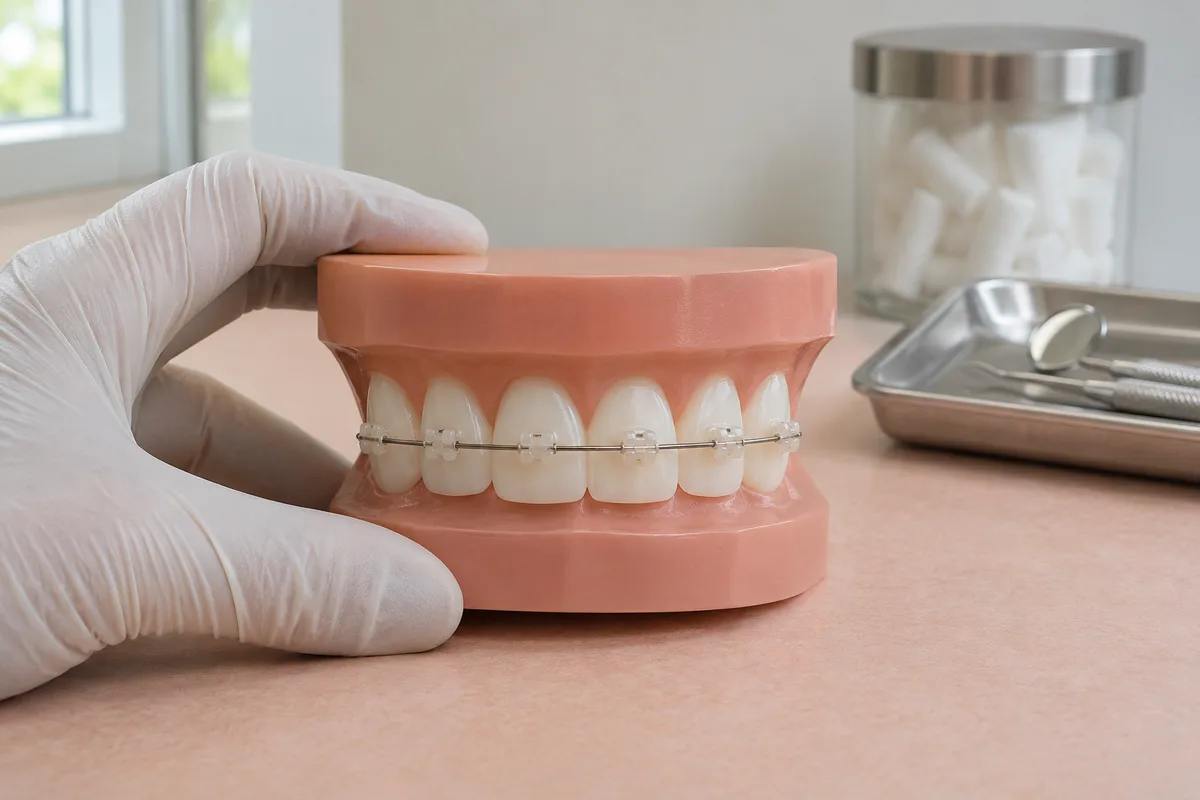
Ceramic braces go on the outside of the teeth. The brackets are usually tooth-colored or translucent, which reduces contrast with the enamel. The archwire may still be metal. Judge the appliance as a whole, with the wire and ties in place, to get a realistic idea of how it will look.
Appearance at different distances
The wire may be easy to see in a close photo even when the brackets blend in at conversation distance. Elastic ties may also change color between appointments. Ask for a demonstration model with the wire and ties your office would actually use. A promotional photo with different components may set the wrong expectation.
A prospective study reported more failures with the ceramic brackets it tested in some areas of the mouth, particularly in lower and back teeth. It compared specific systems in one group of patients. That result cannot predict how often an individual patient will need repairs.
Questions to take to a consultation
Ask how the brackets on your lower teeth would sit when you close your bite. The answer may help explain a mixed ceramic and metal plan. If you have competing estimates, compare what each includes for bracket repairs, follow-up appointments, and retainers. This is more useful than comparing a fee for the initial fitting alone.
Plan for day-to-day care
Plaque can collect along the gumline and around ceramic brackets just as it can around other fixed appliances. Allow time for cleaning around braces. If visibility is a priority, ask about lingual braces as another fixed approach and find out whether your bite is suitable.
Frequently asked questions
Do ceramic braces stain?
Clear elastic ties can discolor. Ask which parts of the exact appliance are likely to show a change in color.
Can ceramic brackets be used on every tooth?
That depends on your bite and the treatment plan. Your orthodontist may recommend different bracket materials on the upper and lower teeth.
Sources
- Treatment & Brace Types. British Orthodontic Society
- Metallic vs Ceramic Bracket Failures After 12 Months of Treatment: A Prospective Clinical Trial. International Dental Journal
- Getting Braces Removed and What Happens Next
What happens when braces come off, what removal can feel like, and what to ask before you leave with a retention plan. - How Much Do Braces Cost in the U.S.?
Published U.S. braces fees and what to check in a quote, from records and adjustments to removal and retainers. - Lingual braces: how they work and what to expect
Learn how behind-the-teeth braces affect speech and cleaning, and what to find out before choosing a lingual appliance. - Rubber bands for braces: what orthodontic elastics do
Learn how interarch elastics differ from elastic ties, why your pattern is individual, and what to ask if you run out or a hook breaks. - How Long Does Orthodontic Treatment Take? What Studies Show
Treatment with braces averaged about 20 months in clinical trials. What makes it longer, and whether vibration, lasers or minor surgery really speed it up. - Types of Braces: Metal, Ceramic, Lingual and Self-Ligating
How metal, ceramic, lingual and self-ligating braces differ, and what systematic reviews show about speed, comfort and hygiene: few differences hold up.