Orthokeratology · Myopia control
Pseudomyopia and Accommodative Spasm
This article is for general information and does not replace advice from a doctor. Medical disclaimer
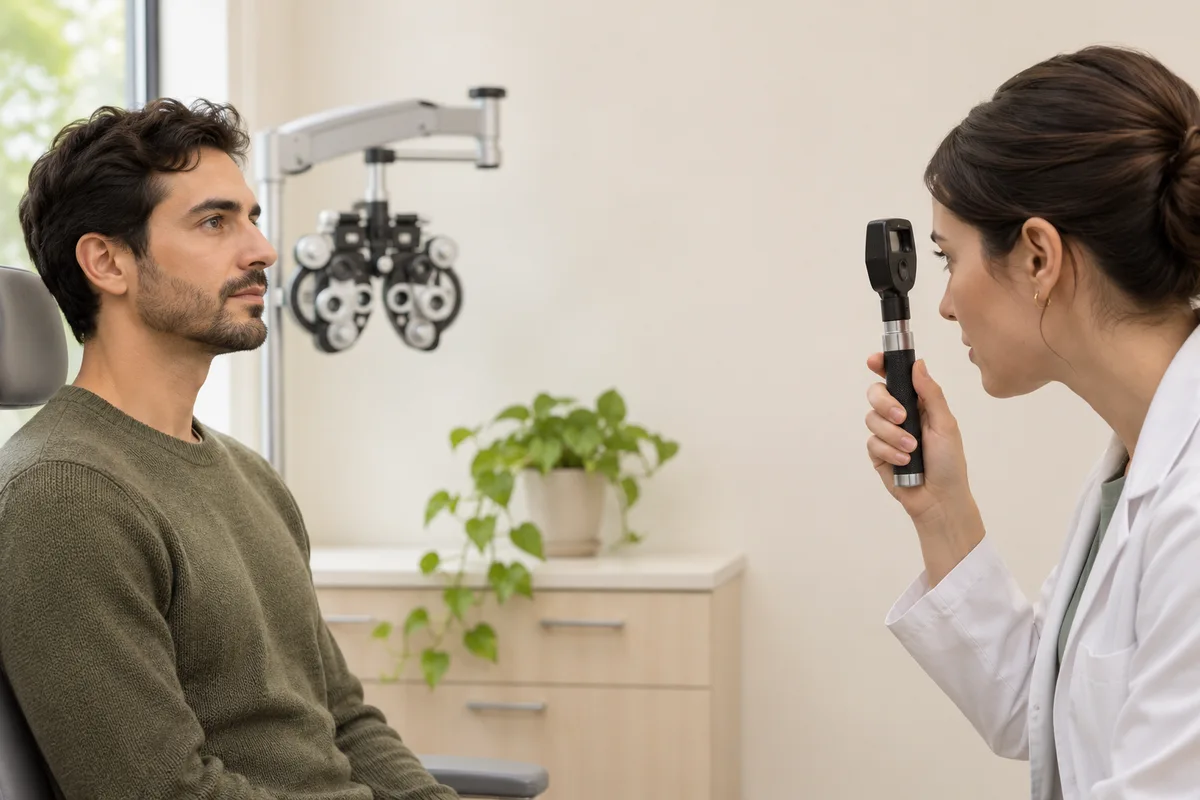
When distance vision comes in and out of focus, the result of an eye test can depend on how relaxed your focusing system is. With accommodative spasm, that system stays too active and can temporarily make the measured refraction The bending of light as it passes through the eye. In an eye exam, refraction also refers to measuring the correction needed for clear focus. more minus. This effect is called pseudomyopia.
What the eye exam can tell you
Accommodation changes the focus of the eye for near objects. Focusing effort normally eases when you look into the distance. When it stays active, distant objects may look blurred and the prescription readings can fluctuate.
An eye care professional may measure refraction before and after cycloplegia. This is a temporary relaxation of accommodation using eye drops during an examination. A less negative result with the drops suggests that focusing contributed to the earlier reading. The clinician interprets the amount of change alongside symptoms, age, and the rest of the examination. Pseudomyopia can occur in an eye that also has myopia Also called nearsightedness. Distant objects look blurry because light focuses in front of the retina. .
What to describe at your appointment
Describe when distance vision becomes blurry, whether it changes after reading or other close work, and whether it affects one eye or both. Bring previous prescriptions and mention injuries or other new symptoms. The pattern helps the clinician interpret the measurements.
Reviews describe several possible causes and approaches to accommodative spasm. Ask which part of your prescription was affected by focusing and what the exam means for your glasses. For a child whose distance vision is changing, see myopia in children.
Frequently asked questions
Can I recognize pseudomyopia at home?
Several conditions can blur distance vision. An eye exam and refraction measurements help determine whether focusing is contributing.
Why is my vision tested after eye drops?
Drops can temporarily relax the eye's focusing system. The clinician compares the result with the measurement taken before the drops to assess the prescription.
Sources
- Pseudomyopia: A Review. Vision, 2022
- Accommodative spasm and its different treatment approaches: A systematic review. European Journal of Ophthalmology, 2023
← All Orthokeratology articles
- Myopia Control Glasses for Children
How specialized spectacle lenses work, what clinical trials found, and how to monitor childhood myopia over time. - Axial Length and Myopia: Why the Length of the Eye Matters
Axial length is the front-to-back length of the eye. It is linked to long-term risk and is the main way to track myopia during ortho-k. What the numbers mean. - Does Ortho-K Slow Myopia in Children? What the Studies Show
In the 2025 Cochrane review, children's eyes grew 0.30 mm less over two years with ortho-k than with single-vision lenses (moderate certainty). The caveats. - Myopia Control Options Compared: Drops, Lenses and Glasses
Atropine drops, ortho-k, myopia-control soft lenses and special glasses side by side, using Cochrane data, key trials and FDA approvals for US children. - Myopia in Children: Causes, Risk Factors and Outlook
Myopia usually starts between ages 6 and 14, and in the US it became far more common over 30 years. Family history raises the odds; time outdoors lowers them. - How Much Do Ortho-K Lenses Cost in the U.S.?
Compare published U.S. fees for ortho-k fitting, a pair of lenses, follow-up care, and replacements.