Orthokeratology · Myopia control
Axial Length and Myopia: Why the Length of the Eye Matters
This article is for general information and does not replace advice from a doctor. Medical disclaimer
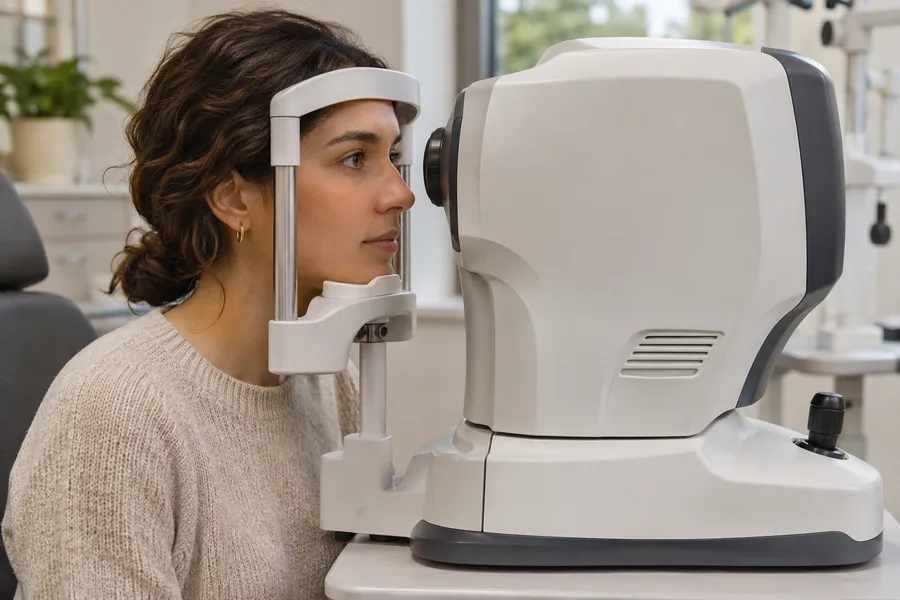
Axial length is the distance from the front to the back of the eye. It moves closely with nearsightedness, and the longer the eye, the higher the risk of vision loss later in life. It can be measured with a non-contact optical scan, and during ortho-k it is the main way to see whether myopia is still progressing.
What axial length is
A study in JAMA Ophthalmology defined axial length as the sum of the depth of the front chamber of the eye, the thickness of the lens and the depth of the vitreous chamber behind it. The IMI-2025 Digest describes axial length and refractive error as highly correlated. Children’s eyes also grow as they get older: in the European data below, by about 0.7 mm on average between ages 6 and 9. Myopia control trials measure whether a treatment slows this growth compared with untreated eyes.
How it is measured
The International Myopia Institute (IMI) reviewed the instruments used in myopia research. Axial length can be measured by contact methods such as ultrasound, or by non-contact optical methods: partial coherence interferometry and optical coherence tomography. The IMI found the optical methods more accurate and repeatable than ultrasound and recommends them.
The optical instruments do not touch the eye. For research protocols, the IMI also advises allowing for daily variation, the eye’s focusing and changes in eye pressure, because they can affect the reading.
What is normal
A Dutch-British study published in 2018 combined data from 12,386 people to build axial length growth curves for European children:
| Age group | Average axial length (standard deviation) |
|---|---|
| 6 years | 22.36 mm (0.75) |
| 9 years | 23.10 mm (0.84) |
| 15 years | 23.41 mm (0.86) |
| Adults, average age 57 | 23.67 mm (1.26) |
The curves were designed to help clinicians spot fast growth early. Of the 354 children whose eyes jumped more than 10 percentile points between ages 6 and 9, 45.8% were nearsighted at age 9. Among the 1,781 children whose eyes did not rise by more than 10 percentile points, 4.8% were.
The IMI-2025 Digest notes that normative growth charts now exist for specific ethnic groups and for boys and girls separately, and that they can identify children whose eyes fall in a higher percentile range, which is associated with more frequent and more severe myopia later in life. That is why the right chart depends on the child.
Why length matters for long-term risk
Eye length is tied to the risk of vision loss in adulthood. The JAMA Ophthalmology study looked at more than 15,000 people in the Netherlands with an average age of 61. By age 75, the estimated share with visual impairment was 3.8% among people with an axial length of 24 to just under 26 mm and more than 90% among those with 30 mm or more. For people with high myopia of -6 diopters or worse, the risk of visual impairment was 5.7% by age 60 and 39% by age 75.
Small reductions add up. Using data from five population studies with 21,000 patients, a 2019 analysis estimated that each additional diopter of myopia is associated with a 67% higher prevalence of myopic maculopathy, a damaging change in the retina. Put the other way, the authors calculated that slowing myopia by 1 diopter should reduce the chance of developing it by about 40%, whatever the starting level of myopia. The IMI-2025 Digest likewise states that the risk of eye disease and visual impairment is highly related to axial length.
Why it matters during ortho-k
For most children, a change in glasses prescription reflects eye growth. Ortho-k breaks that link, because the lenses flatten the cornea every night. The 2025 Cochrane review of myopia control states that refraction is not an appropriate outcome in ortho-k studies and that true progression cannot be judged without stopping lens wear. Ortho-k trials therefore report eye growth. Across all trials in the Cochrane analysis, eyes in the control groups grew a median of 0.33 mm in one year. In the ortho-k trials, treated eyes grew 0.18 mm less than control eyes at one year and 0.30 mm less at two years, with moderate-certainty evidence. The full picture is in does ortho-k slow myopia.
Reading the numbers
When you get results from a clinic, a few points help:
- A single reading is most useful against a growth chart; the change between visits shows how fast the eye is growing.
- Some growth is normal in children: in the European data, average eye length rose by about 0.7 mm between ages 6 and 9.
- The comparison should use a growth chart suited to the child’s background and sex.
- Treatment effects are small in absolute terms: in the Cochrane review, one-year reductions in eye growth ranged from about 0.06 to 0.33 mm, depending on the treatment.
- Not every practice has a biometer. The IMI-2025 Digest notes that axial length and refraction are highly correlated, so lack of a biometer should not stop myopia management.
How the different treatments compare on eye growth is set out in myopia control options compared, and the basics of childhood myopia in myopia in children. More topics are in the orthokeratology section.
Frequently asked questions
How is axial length measured?
Either with contact ultrasound or with a non-contact optical instrument. The International Myopia Institute found optical methods more accurate and repeatable than ultrasound and recommends them for myopia control trials.
What is a normal axial length for a child?
In a large European study, the average was 22.36 mm at age 6 and 23.10 mm at age 9. Growth charts now exist for specific ethnic groups and for boys and girls separately, so the right comparison depends on the child.
Why measure eye length if my child wears ortho-k?
Ortho-k flattens the cornea, so a glasses prescription measured during treatment does not show how the myopia underneath is changing. Eye length does.
Sources
- Axial length growth and the risk of developing myopia in European children. Acta Ophthalmologica, 2018
- Association of Axial Length With Risk of Uncorrectable Visual Impairment for Europeans With Myopia. JAMA Ophthalmology, 2016
- IMI Clinical myopia control trials and instrumentation report. International Myopia Institute, 2019
- IMI-2025 Digest. Investigative Ophthalmology & Visual Science, 2025
- Interventions for myopia control in children: a living systematic review and network meta-analysis. Cochrane Database of Systematic Reviews, 2025
- Myopia Control: Why Each Diopter Matters. Optometry and Vision Science, 2019
← All Orthokeratology articles
- Does Ortho-K Slow Myopia in Children? What the Studies Show
In the 2025 Cochrane review, children's eyes grew 0.30 mm less over two years with ortho-k than with single-vision lenses (moderate certainty). The caveats. - Myopia Control Options Compared: Drops, Lenses and Glasses
Atropine drops, ortho-k, myopia-control soft lenses and special glasses side by side, using Cochrane data, key trials and FDA approvals for US children. - Myopia in Children: Causes, Risk Factors and Outlook
Myopia usually starts between ages 6 and 14, and in the US it became far more common over 30 years. Family history raises the odds; time outdoors lowers them. - How Orthokeratology Works: Reshaping the Cornea Overnight
Ortho-k lenses thin the center of the cornea's surface layer during sleep, reducing myopia for the day. How fast it works, how long it lasts and its limits. - How to Care for Ortho-K Lenses: A Daily Routine That Cuts Risk
Clean hands, the prescribed solution, no tap water, fresh solution each time and a new case at least every 3 months: CDC and FDA basics for overnight lenses. - Ortho-K for Adults: Results, Comfort and Alternatives
In an FDA trial of mostly adults, about 95% of eyes saw 20/40 or better unaided after 6 months. What else to expect and how ortho-k compares with LASIK.