Orthokeratology · Myopia control
Myopia in Children: Causes, Risk Factors and Outlook
This article is for general information and does not replace advice from a doctor. Medical disclaimer
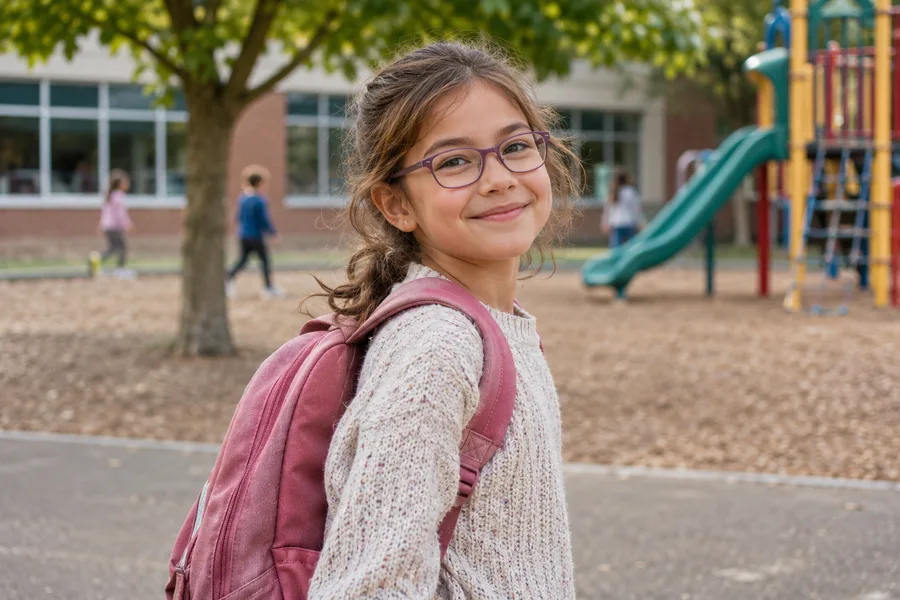
Myopia, or nearsightedness, usually starts between ages 6 and 14 and tends to get worse until the early twenties. In the US it became much more common between the early 1970s and the early 2000s, and having nearsighted parents raises a child’s odds. In a large randomized trial, more time outdoors lowered them.
What myopia is
The National Eye Institute (NEI) describes nearsightedness as a refractive error that makes faraway objects look blurry. It happens when the shape of the eye makes light focus in front of the retina instead of on it.
The NEI lists the most common symptoms as:
- trouble seeing things far away
- squinting to see clearly
- eye strain
- headaches, although these are less common
Mild myopia may cause no symptoms at all, the NEI notes. An eye doctor checks for it as part of a comprehensive eye exam, which is simple and painless. Glasses and contact lenses are the most common ways to correct it.
How common it is
Myopia has become far more common. Researchers at the National Eye Institute compared two national health surveys using a similar method to diagnose myopia. Among Americans aged 12 to 54, the estimated prevalence of myopia rose from 25.0% in 1971–1972 to 41.6% in 1999–2004. In 2025 the FDA put the figure at about 40% of the US population, with prevalence increasing rapidly among children and adolescents.
Worldwide, a 2016 meta-analysis of 145 studies with 2.1 million participants projected a steep rise:
| Measure | Earlier figure | Later figure |
|---|---|---|
| People with myopia worldwide | 1.41 billion in 2000 (22.9% of the world population) | 4.76 billion projected for 2050 (49.8%) |
| People with high myopia worldwide (-5.00 D or worse) | 163 million in 2000 (2.7%) | 938 million projected for 2050 (9.8%) |
| Americans aged 12 to 54 with myopia | 25.0% in 1971–1972 | 41.6% in 1999–2004 |
The global figures come from the 2016 analysis by Holden and colleagues in the journal Ophthalmology; the US figures come from the survey comparison above.
Why progression matters
Myopia itself is usually corrected with glasses or contact lenses. The concern is what happens if it keeps getting worse. The FDA has noted that untreated myopia can progress to high myopia, which can significantly increase the risk of sight-threatening complications later in life, including retinal detachment, myopic maculopathy, glaucoma and cataracts. The authors of the global analysis warned of implications for managing myopia-related complications and vision loss among almost 1 billion people with high myopia by 2050.
This is the concern behind treatments that aim to slow myopia in children. One measure they use is the length of the eye, described in axial length and myopia.
Risk factors
Family history
The NEI notes that a child is at higher risk if family members are nearsighted. In the Orinda Longitudinal Study of Myopia, the number of nearsighted parents was an important predictor of which children would become myopic. Of 514 children followed, 111 (21.6%) became nearsighted.
Time outdoors and near work
The same study found that in third grade, children who later became nearsighted spent about 8 hours a week on sports and outdoor activities, compared with nearly 12 hours for children who stayed free of myopia. Reading hours also predicted myopia at first, but they stopped being a significant factor once outdoor time and parental myopia were taken into account. Low outdoor time raised the odds most in children with two nearsighted parents.
Trial evidence comes from Guangzhou, China, where a randomized trial published in JAMA in 2015 tested more outdoor time at school. Six schools added one 40-minute outdoor class to every school day, and parents were encouraged to take their children outdoors after school, while six schools kept their usual routine. The 1,903 children were in first grade, with an average age of 6.6.
- After 3 years, among children who were not nearsighted at the start, 30.4% in the outdoor schools had developed myopia, compared with 39.5% in the control schools.
- Across all children, refraction shifted slightly less toward myopia over 3 years: -1.42 diopters versus -1.59 diopters.
- Eye growth did not differ significantly between the groups.
The NEI also notes that children who spend more time outdoors are less likely to be nearsighted, though experts are not sure why.
What parents can do
Regular eye checks matter because mild myopia may cause no symptoms. In the Guangzhou trial, more time outdoors at school lowered the share of children who became nearsighted. If a child is already nearsighted and the prescription keeps climbing, several treatments have slowed the change in trials, including special glasses and contact lenses. The FDA authorized the first eyeglass lenses for this purpose in 2025, for children 6 to 12 years old at the start of treatment.
The options and their evidence are compared in myopia control options compared, and overnight lenses specifically in does ortho-k slow myopia. The right choice depends on the child’s age, eye health and how fast the myopia is progressing, so it is a decision to make with a pediatric eye care professional. More topics are in the orthokeratology section.
Frequently asked questions
At what age does myopia usually start?
According to the National Eye Institute, nearsightedness usually starts between ages 6 and 14 and gets worse until the early twenties.
Does time outdoors really help?
In a randomized trial in China, 30.4% of children in schools that added one 40-minute outdoor class to each school day developed myopia over 3 years, compared with 39.5% in schools that did not.
My child does not complain about blurry vision. Could they still be nearsighted?
Yes. The National Eye Institute notes that people with mild nearsightedness may not notice any symptoms, which is one reason for regular eye exams.
Sources
- Nearsightedness (Myopia). National Eye Institute, 2024
- Global Prevalence of Myopia and High Myopia and Temporal Trends from 2000 through 2050. Ophthalmology, 2016
- Increased prevalence of myopia in the United States between 1971-1972 and 1999-2004. Archives of Ophthalmology, 2009
- Effect of Time Spent Outdoors at School on the Development of Myopia Among Children in China: A Randomized Clinical Trial. JAMA, 2015
- Parental history of myopia, sports and outdoor activities, and future myopia. Investigative Ophthalmology & Visual Science, 2007
- FDA Authorizes Marketing of First Eyeglass Lenses to Slow Progression of Pediatric Myopia. U.S. Food and Drug Administration, 2025
← All Orthokeratology articles
Related topics
- Axial Length and Myopia: Why the Length of the Eye Matters
Axial length is the front-to-back length of the eye. It is linked to long-term risk and is the main way to track myopia during ortho-k. What the numbers mean. - Does Ortho-K Slow Myopia in Children? What the Studies Show
In the 2025 Cochrane review, children's eyes grew 0.30 mm less over two years with ortho-k than with single-vision lenses (moderate certainty). The caveats. - Myopia Control Options Compared: Drops, Lenses and Glasses
Atropine drops, ortho-k, myopia-control soft lenses and special glasses side by side, using Cochrane data, key trials and FDA approvals for US children. - How Orthokeratology Works: Reshaping the Cornea Overnight
Ortho-k lenses thin the center of the cornea's surface layer during sleep, reducing myopia for the day. How fast it works, how long it lasts and its limits. - How to Care for Ortho-K Lenses: A Daily Routine That Cuts Risk
Clean hands, the prescribed solution, no tap water, fresh solution each time and a new case at least every 3 months: CDC and FDA basics for overnight lenses. - Ortho-K for Adults: Results, Comfort and Alternatives
In an FDA trial of mostly adults, about 95% of eyes saw 20/40 or better unaided after 6 months. What else to expect and how ortho-k compares with LASIK.