Orthodontics · Basics
Deep bite in adults: when and how it is corrected
This article is for general information and does not replace advice from a doctor. Medical disclaimer
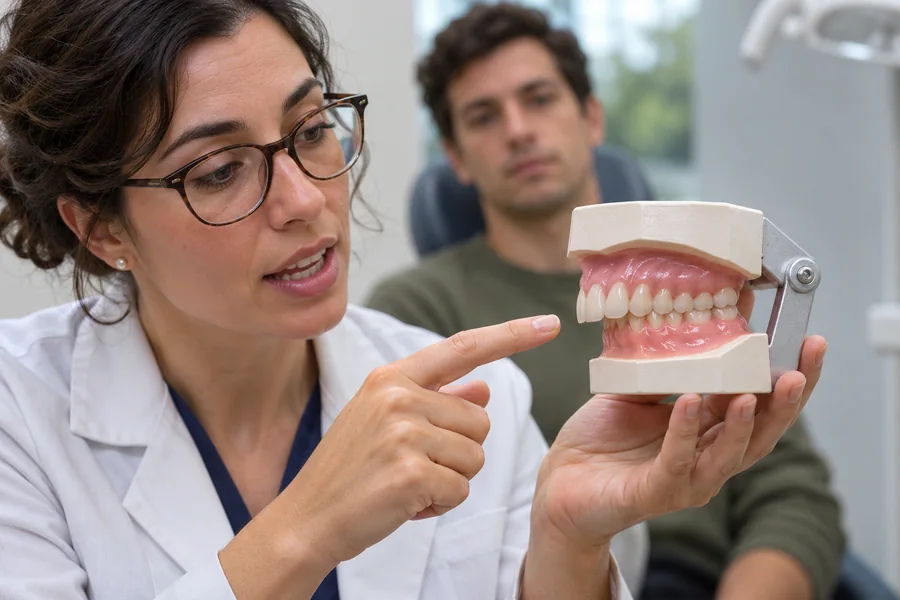
Deep overbite – increased vertical overlap of the incisors. The orthodontist measures how much the upper front teeth overlap the lower teeth when closed, and checks where the contact points are. For example, the lower incisors may touch the palate and leave signs of trauma. This affects the need for treatment, regardless of how noticeable the overbite is from the outside.
Deep overbite and large overjet measure different things
Vertical overlap is assessed by measuring how much the upper incisors cover the lower incisors from above. Horizontal overlap shows the protrusion of the teeth. Both features can coexist, but each requires its own goals. For example, the protrusion of the teeth can be reduced, while the depth of their overlap remains the same. These are different tasks even within a single plan.
It is helpful to ask the orthodontist to show measurements on a photograph, model, or in the mouth. If information is needed about the angle of the incisors and the position of the jaws, the doctor can supplement the examination with a lateral panoramic radiograph. Comparing deep overbite with other variations can be helpful with a review of different types of malocclusion.
When does a patient have a reason to discuss correction?
During the examination, it is important to note any contact marks on the palate or gums, tooth wear, and the individual patient’s needs. One adult comes in due to recurring mucosal injury, while another wants to understand how tooth position will affect planned restorations. The doctor assesses the tissues and the bite as a whole, and explains what may change with treatment. The British Association of Orthodontists considers deep overbite with soft tissue injury when assessing the need for treatment.
Even if there are no complaints, the doctor can still inquire about whether a trauma or progressive wear has occurred. Ask what result is needed specifically in your case: to eliminate the traumatic contact, change the angle of the incisors, or solve multiple problems simultaneously. This helps to compare solutions based on a single criterion of success.
Can deep overbite be corrected with aligners?
Aligners may reduce deep overlap in some cases. A systematic review of 2025 found 18 studies. The authors consider aligners a possible option for mild and moderate cases, where the problem is primarily related to tooth position. The authors assessed the reliability of the evidence as low. In some studies, the achieved reduction in overlap was less than planned, and the advantage of aligners over non-removable systems with a significant skeletal component remains unclear.
The tooth and skeletal components can be combined. By “tooth component,” we mean the position and angle of the teeth, and by “skeletal component,” we mean the relationship between the jaws themselves. If the overlap is the same, two adults may require different adjustments, so the depth of overlap is not a factor in choosing the device.
If aligners are offered, ask the orthodontist to explain how they will check the actual movement and what will happen if it differs from the plan. If braces are offered, ask which contact needs to be changed and how the doctor will assess this.
After active treatment, retainers and maintaining the results are discussed separately. It is helpful to clarify how the doctor will assess the degree of overlap and the condition of the tissues during follow-up visits.
Related terms
Further reading
- What a lateral cephalometric X-ray shows
- Types of Malocclusion: Bite Problems and How Common They Are
- Retainers After Braces: Why Teeth Shift and How Long to Wear Them
Sources
- Orthodontic Glossary. American Association of Orthodontists
- Quick Reference Guide to Orthodontic Assessment and Treatment Need. British Orthodontic Society
- Effectiveness and accuracy of clear aligners in treatment of deep bite: a systematic review. European Journal of Orthodontics
- What a lateral cephalometric X-ray shows
What the orthodontist measures on a lateral cephalometric X-ray and how it differs from a panoramic X-ray and a digital scan. - Digital impressions and photographs in orthodontics
Why orthodontists take dental scans and photographs, what each record shows and when X-rays answer a different question. - Gap between the front teeth: when it is a diastema
Why a gap can appear between the front teeth, when it may close as a child grows and why a new gap in an adult needs assessment. - Open bite and crossbite in children
What an open bite and crossbite look like in children, what dentists check and how tooth position and jaw development affect the plan. - Removable orthodontic plates for children
What a removable plate can do for a child, how it differs from other appliances and what to ask about wearing and cleaning it. - Interproximal reduction: how orthodontists make space
What enamel reduction between teeth means, how it differs from separators, and what to ask before agreeing to it.