Orthodontics · Basics
Types of Malocclusion: Bite Problems and How Common They Are
This article is for general information and does not replace advice from a doctor. Medical disclaimer
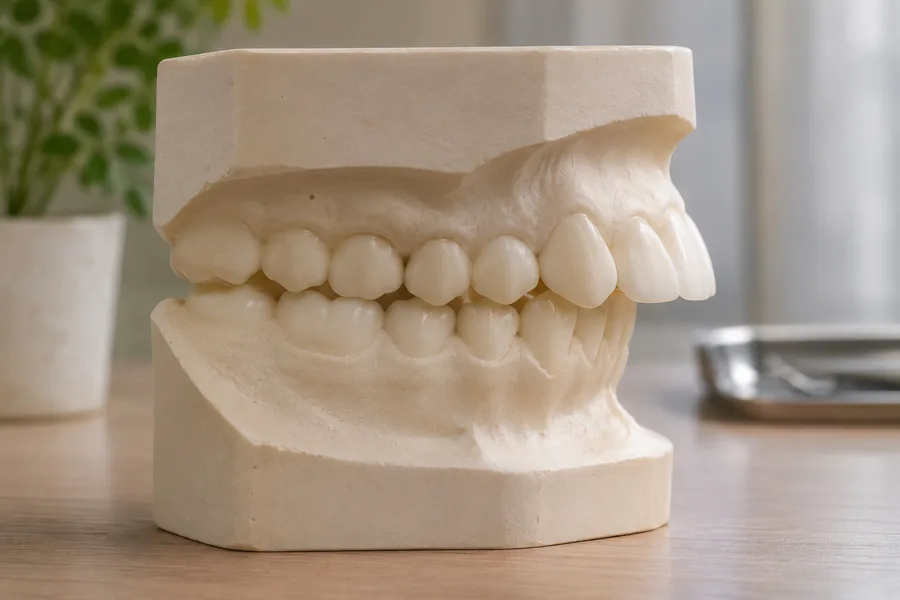
Malocclusion is the dental term for teeth or jaws that do not line up properly. It is very common: in the third US National Health and Nutrition Examination Survey (NHANES III), only 35% of adults had well-aligned lower front teeth. Most bite problems are a matter of degree, and having one does not by itself mean treatment is needed.
How orthodontists describe a bite
A common way to describe a bite starts with the front-to-back relationship between the upper and lower jaws and teeth. This is the basis of the Angle classification, which splits bites into three classes:
- Class I. The front-to-back relationship of the jaws is normal, and any problem lies with individual teeth, such as crowding, gaps or a single tooth in crossbite. MedlinePlus, the National Library of Medicine’s consumer site, says this is the most common class. The American Academy of Pediatric Dentistry (AAPD) uses a Class I relationship of the back teeth as the reference point for a front-tooth crossbite that is purely dental.
- Class II, or distocclusion. According to the AAPD, the lower jaw or lower teeth sit too far back relative to the upper ones. The cause can be the teeth, the jaws (a lower jaw set back or an upper jaw set forward) or both. It often shows as prominent upper front teeth, which a Cochrane review says affect about a quarter of 12-year-olds in the UK.
- Class III, or mesio-occlusion. The lower jaw or lower teeth sit too far forward, according to the AAPD. MedlinePlus describes this as an underbite, where the lower jaw juts forward and the lower teeth overlap the upper ones.
Each bite is also described by its vertical and sideways features, covered below.
Common bite problems
Crowding and spacing
Crowding happens when there is not enough room in the jaws for the teeth to come in straight, according to a 2021 Cochrane review. It can affect baby teeth, adult teeth or both. Losing baby teeth early to decay or injury can lead to crowded permanent teeth, and crowding tends to increase with age, especially in the lower jaw. Spacing is the opposite problem, with more room than the teeth need. In NHANES III, front-tooth irregularity was severe enough in 15% that both how socially acceptable the teeth looked and how they worked could be affected.
Overjet
Overjet is how far the upper front teeth sit in front of the lower ones. The global review described below counted an overjet of more than 3 mm as increased. The AAPD links an overjet above 3 mm with a higher risk of injury to the front teeth.
Deep bite and open bite
These are vertical problems. In a deep bite, the upper front teeth cover too much of the lower front teeth; the review used an overlap of more than 2.5 mm as its cut-off. In an open bite, the front teeth do not meet when the back teeth are closed. The AAPD says long-term sucking habits are associated with an open bite at the front, and that breathing through the mouth may contribute but is not the sole or major cause.
Crossbite
A crossbite is any abnormal sideways relationship between upper and lower teeth, according to the AAPD. In a back, or posterior, crossbite the upper back teeth bite inside the lower ones. If the lower jaw slides to one side to make the teeth meet, this is called a functional shift. The AAPD separates a front crossbite caused by a tipped tooth from one caused by the position of the jawbones in a Class III bite, because the two are managed differently.
How common each problem is
A 2018 systematic review pooled 53 studies from around the world. The figures below are for people with permanent teeth:
| Trait | Worldwide | Studies from the Americas |
|---|---|---|
| Class I | 74.7% | 78.5% |
| Class II | 19.6% | 15.3% |
| Class III | 5.9% | 6.2% |
| Increased overjet, more than 3 mm | 20.1% | 16.7% |
| Deep bite, more than 2.5 mm overlap | 22.0% | 11.1% |
| Open bite | 4.9% | 5.0% |
| Posterior crossbite | 9.4% | 7.1% |
The range between individual studies was wide. Class II, for example, ranged from under 2% to 63% depending on the population.
US data come from NHANES III, published in 1998. About 20% of the population had deviations from the ideal bite relationship, and in 2% these were severe enough to be disfiguring and at the limit of what orthodontic treatment can correct. Using a standard index of treatment need, 57% to 59% of each racial and ethnic group had at least some need for orthodontic treatment. Treatment was far more common in higher-income groups.
What causes malocclusion
MedlinePlus says malocclusion is most often hereditary. Other contributing factors it lists are:
- childhood habits such as thumb sucking, tongue thrusting, pacifier use beyond age 3 and long use of a bottle
- extra, lost, impacted or unusually shaped teeth
- poorly fitting fillings, crowns, appliances, retainers or braces
- jaw fractures that heal out of line, and tumors of the mouth and jaw
- a mismatch in size between the upper and lower jaws or between the jaws and the teeth, the shape of the jaws, and birth defects such as cleft lip and palate
Signs listed by MedlinePlus include teeth that look out of line, an unusual appearance of the face, difficulty or discomfort when biting or chewing, mouth breathing and, in an open bite, being unable to bite into food properly. Speech problems such as a lisp are possible but rare.
When a bite problem needs attention
MedlinePlus notes that very few people have perfectly aligned teeth and that most problems are minor and do not need treatment. Whether a bite should be treated depends on how severe it is, how it affects chewing, speech and the risk of injury, and how the person feels about it. Sorting this out takes an orthodontic exam, often with X-rays. For children, the timing of a first check-up is explained in when to see an orthodontist. Which problems benefit from treating early is covered in early orthodontic treatment, and the main options for correcting a bite are compared in types of braces. More guides are in the orthodontics section.
Frequently asked questions
Is a Class I bite normal?
In Class I the upper and lower jaws relate normally from front to back. People in Class I can still have crowding, gaps or a crossbite of individual teeth.
What causes malocclusion?
MedlinePlus says it is most often hereditary. Childhood habits such as thumb sucking or pacifier use beyond age 3, extra or lost teeth and jaw fractures that heal out of line can also contribute.
Sources
- Prevalence of malocclusion and orthodontic treatment need in the United States: estimates from the NHANES III survey. International Journal of Adult Orthodontics and Orthognathic Surgery, 1998
- Global distribution of malocclusion traits: A systematic review. Dental Press Journal of Orthodontics, 2018
- Malocclusion of teeth. MedlinePlus, U.S. National Library of Medicine, 2026
- Management of the Developing Dentition and Occlusion in Pediatric Dentistry. American Academy of Pediatric Dentistry, 2024
- Orthodontic treatment for crowded teeth in children. Cochrane Database of Systematic Reviews, 2021
- Orthodontic treatment for prominent upper front teeth (Class II malocclusion) in children and adolescents. Cochrane Database of Systematic Reviews, 2018
- Early Orthodontic Treatment for Children: When It Helps
What Cochrane reviews show about two-phase treatment for protruding teeth, underbites, crossbites and thumb sucking, and why it is not right for every child. - Orthodontics for Adults: Gum Health, Timing and Options
The AAO says one in three orthodontic patients is an adult. How adult treatment differs: gum health, treatment time, aligners versus braces and retainers. - When to See an Orthodontist: The Age 7 Check-Up
The AAO advises a first orthodontic check-up no later than age 7. What the visit involves, signs to go sooner and why some children can still wait. - How to Clean Your Teeth With Braces: A Daily Routine
A step-by-step cleaning routine for braces based on AAO guidance, what to eat and drink, and what trials show about electric brushes and fluoride. - Clear Aligners vs Braces: What the Research Shows
Reviews find braces give a more precise bite on average, most clearly when teeth are extracted, with closer results otherwise. Why DIY aligners are risky. - How Long Does Orthodontic Treatment Take? What Studies Show
Treatment with braces averaged about 20 months in clinical trials. What makes it longer, and whether vibration, lasers or minor surgery really speed it up.