Orthodontics · Retainers
Retainers After Braces: Why Teeth Shift and How Long to Wear Them
This article is for general information and does not replace advice from a doctor. Medical disclaimer
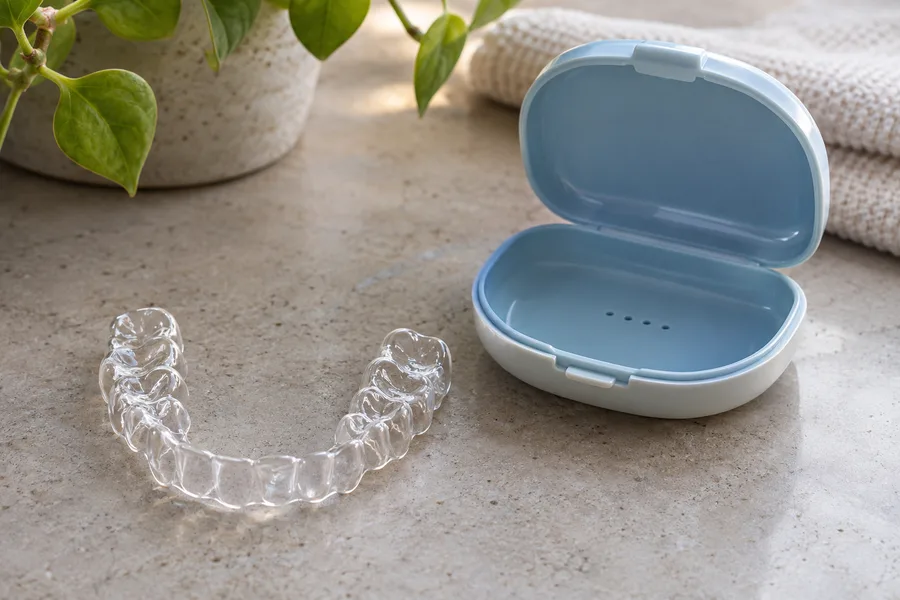
Teeth tend to move back toward their old positions once braces or aligners come off, a process called relapse. A retainer A fixed wire or removable appliance worn after orthodontic treatment to keep the teeth from drifting back. holds them in place. Research has not shown that one type of retainer is clearly better than another, but both American and British orthodontic bodies say some retainer wear is usually needed for life.
Why teeth move after treatment
A 2023 Cochrane review notes that without a period of retention, teeth tend to return toward where they started, and it calls relapse a lifetime risk. The causes are not fully understood. The review links them to recoil of the fibers around the teeth, further growth and the way the teeth meet, and notes that ageing can also make teeth move. The American Association of Orthodontists (AAO) points to the natural tendency of teeth to revert, and the British Orthodontic Society (BOS) says changes in tooth position can continue throughout life as part of normal ageing.
The lower front teeth are especially prone to this. The American Academy of Pediatric Dentistry (AAPD) notes that lower incisors have a high relapse rate for rotation and crowding, and that growth of the ageing skeleton causes further crowding.
Wisdom teeth are often blamed for late crowding. A 2020 Cochrane review found one randomized trial on this, with 77 adolescents analyzed after orthodontic treatment. It found no evidence that removing their wisdom teeth had a clinically significant effect on changes in the dental arch over five years, and the trial was at high risk of bias.
Types of retainers
The AAO describes three common types:
- Fixed, or bonded, retainers: a thin, custom-fitted wire bonded to the inner side of the upper or lower teeth.
- Clear retainers: removable plastic trays that sit over the teeth.
- Hawley retainers: removable retainers that combine acrylic or hard plastic with metal wire.
Removable retainers can be worn full time or part time. The BOS notes that a fixed retainer needs extra care to keep clean, and that speech can sound different for the first few days with a removable one.
What the Cochrane review found
The 2023 Cochrane review included 47 randomized trials with 4,377 participants who had worn braces. It measured relapse with Little’s Irregularity Index, a score for how crooked the front teeth are, and treated a 1 mm difference as the smallest that matters. Most comparisons were tested in a single study at high risk of bias, mostly over less than a year, and the certainty of evidence was low or very low.
| Comparison, lower teeth | Tooth stability | Other findings |
|---|---|---|
| Clear plastic part time vs fixed wire | Slightly more relapse with plastic, 0.92 mm, not clinically important | Plastic was less comfortable but failed less often and gums were healthier |
| Clear plastic full time vs fixed wire | No clinically important difference, 0.60 mm | Plastic had less gum bleeding but failed more often |
| Clear plastic vs Hawley | Similar | Hawley failed less often but was less comfortable at six months |
| Hawley part time vs full time | No difference | None reported |
The authors concluded that no firm conclusions can be drawn about any single approach. They called for studies that follow patients for at least two years and measure retainer durability, satisfaction and side effects such as decay and gum disease.
How long to wear a retainer
There is no single evidence-based schedule, so your orthodontist sets one for your case. The general position of professional bodies is consistent:
- The AAO says a retainer is typically needed for a lifetime, although how often it is worn may decrease over time.
- The BOS leaflet says the only way to have permanently straight teeth is to wear a retainer part time for life, and that your orthodontist will advise you when to wear it.
Looking after a retainer
The AAO and BOS give similar practical advice. Brush a removable retainer daily with a soft toothbrush and water, avoid hot water, and keep it in its case when it is out of your mouth. The BOS advises against cleaning it with toothpaste, which can roughen it. The AAO also suggests soaking it at least weekly in a retainer-cleaning solution and avoiding products with alcohol or bleach.
A retainer that feels tight may mean your teeth have shifted slightly, according to the AAO, and it advises seeing your orthodontist if the tightness causes discomfort or pain. If a retainer breaks or goes missing, the BOS advises calling for an appointment straight away instead of waiting for your next review, because teeth can move while it is out. Replacement retainers may cost extra.
How aligners compare with braces is covered in clear aligners vs braces, and the adult side of treatment is covered in orthodontics for adults. To see where retention fits in the overall timeline, read how long orthodontic treatment takes. More guides are in the orthodontics section.
Frequently asked questions
Is a fixed retainer better than a removable one?
A 2023 Cochrane review found no clinically important difference in how well they hold the teeth. Removable clear retainers were linked with healthier gums in single studies, and failure rates depended on the comparison. The evidence was low or very low in certainty.
Do wisdom teeth cause crowding after braces?
The only randomized trial in a 2020 Cochrane review found no evidence that removing wisdom teeth after orthodontic treatment had a clinically significant effect on changes in the dental arch over five years. The trial was at high risk of bias.
Sources
- Retention procedures for stabilising tooth position after treatment with orthodontic braces. Cochrane Database of Systematic Reviews, 2023
- Orthodontic Retainers: Types, Care, & Life After Braces. American Association of Orthodontists
- Patient Information Leaflet: Retainers. British Orthodontic Society, 2019
- Management of the Developing Dentition and Occlusion in Pediatric Dentistry. American Academy of Pediatric Dentistry, 2024
- Surgical removal versus retention for the management of asymptomatic disease-free impacted wisdom teeth. Cochrane Database of Systematic Reviews, 2020
- How to Clean Your Teeth With Braces: A Daily Routine
A step-by-step cleaning routine for braces based on AAO guidance, what to eat and drink, and what trials show about electric brushes and fluoride. - Clear Aligners vs Braces: What the Research Shows
Reviews find braces give a more precise bite on average, most clearly when teeth are extracted, with closer results otherwise. Why DIY aligners are risky. - Early Orthodontic Treatment for Children: When It Helps
What Cochrane reviews show about two-phase treatment for protruding teeth, underbites, crossbites and thumb sucking, and why it is not right for every child. - How Long Does Orthodontic Treatment Take? What Studies Show
Treatment with braces averaged about 20 months in clinical trials. What makes it longer, and whether vibration, lasers or minor surgery really speed it up. - Types of Malocclusion: Bite Problems and How Common They Are
Class I, II and III bites, crossbite, open bite, deep bite and crowding explained, with prevalence figures from a US survey and a review of 53 studies. - Risks of Orthodontic Treatment: Enamel, Roots, Gums and Pain
White spots on enamel, root shortening, small gum changes and soreness are the main side effects of braces. How common they are and what lowers the risk.