Orthodontics · Basics
Removable orthodontic plates for children
This article is for general information and does not replace advice from a doctor. Medical disclaimer
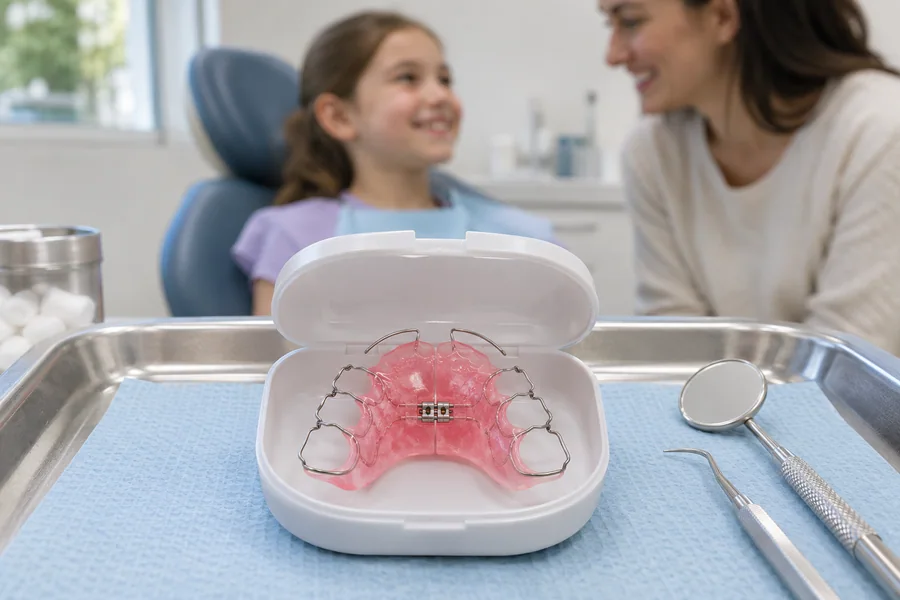
The term “plate” is often used to refer to various removable orthodontic appliances. An active plate uses a spring or screw to apply force to specific teeth. A functional plate works with both sets of teeth and changes the relative position of the jaws during wear. To understand the purpose, ask the doctor to name the specific movement they expect.
How to understand what is being offered during a consultation
If an orthodontist wants to change the position of a single tooth or expand the area of the arch, they can discuss a plate with an active element. It usually relies on one row. Functional appliances are often considered for growing patients when it is necessary to change the relationship between the upper and lower teeth, for example, when there is increased horizontal overlap of the incisors. Sometimes, another device is required after this step. The possibilities depend on the initial bite, growth, and structure.
Not all removable appliances move teeth. A retainer that looks similar serves to maintain the results achieved with braces. If you are told about a “retainer after braces,” clarify the name and purpose. Types of retainers.
What is assessed after issuance?
During a follow-up appointment, the doctor checks whether the appliance is fitting properly and whether the position of the teeth or the contact points in the desired area have changed. If the child is experiencing pain in a specific area, or if the appliance is wobbling or has moved, let the doctor know. If the appliance has become difficult to fit after a tooth has erupted, note the date when you first noticed this. The doctor will decide whether a correction to the appliance is necessary.
Ask the doctor to demonstrate the correct way to wear the appliance and what constitutes a reason to seek immediate attention. The type of appliance and any changes to active components will depend on your orthodontist’s instructions. It is helpful to clarify the available alternatives at this stage and what will change during the next period of orthodontic treatment. When discussing early treatment,
Related terms
Further reading
- Retainers after braces: clear, Hawley and fixed
- Early Orthodontic Treatment for Children: When It Helps
Sources
- Removable appliances. British Orthodontic Society
- Functional appliances. British Orthodontic Society
- Management of the Developing Dentition and Occlusion in Pediatric Dentistry. American Academy of Pediatric Dentistry
- What a lateral cephalometric X-ray shows
What the orthodontist measures on a lateral cephalometric X-ray and how it differs from a panoramic X-ray and a digital scan. - Deep bite in adults: when and how it is corrected
How an orthodontist assesses a deep bite, when it can injure the tissues and what studies say about clear aligners and braces. - Digital impressions and photographs in orthodontics
Why orthodontists take dental scans and photographs, what each record shows and when X-rays answer a different question. - Gap between the front teeth: when it is a diastema
Why a gap can appear between the front teeth, when it may close as a child grows and why a new gap in an adult needs assessment. - Open bite and crossbite in children
What an open bite and crossbite look like in children, what dentists check and how tooth position and jaw development affect the plan. - Interproximal reduction: how orthodontists make space
What enamel reduction between teeth means, how it differs from separators, and what to ask before agreeing to it.