Orthodontics · Basics
Early Orthodontic Treatment for Children: When It Helps
This article is for general information and does not replace advice from a doctor. Medical disclaimer
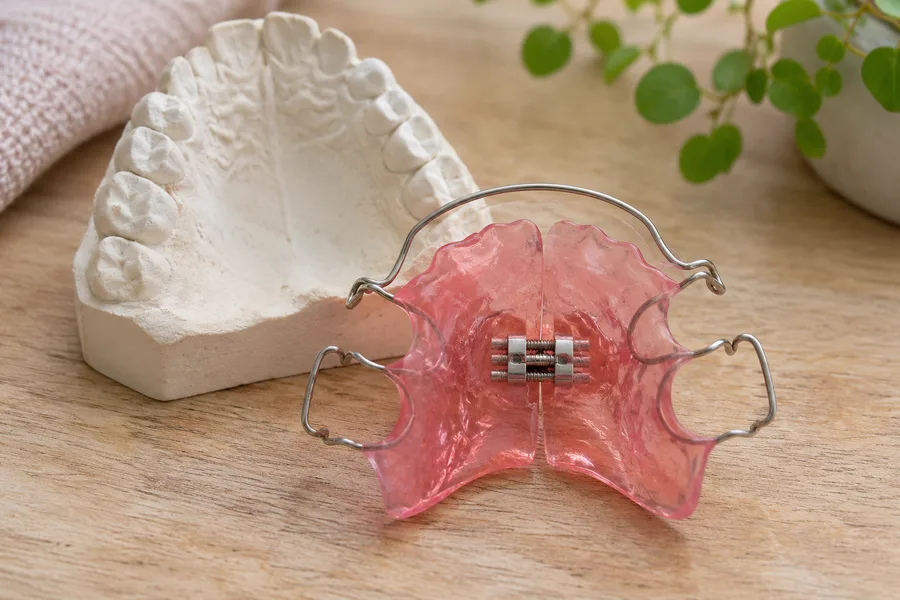
Early orthodontic treatment, often called two-phase treatment, means a first round of treatment while a child still has some baby teeth, followed by a second round once the permanent teeth are in. Cochrane reviews support it for some specific problems, such as crossbites of the back teeth and the higher injury risk of protruding front teeth. For protruding upper teeth, though, a single course in adolescence gave the same final result in trials, and two-phase treatment takes longer overall.
What early treatment is
The American Association of Orthodontists (AAO) describes early treatment as treatment done while some baby teeth are still present, which can guide the growth of the jaws and make more room for permanent teeth. In the Cochrane review on protruding upper teeth, early treatment meant starting at 7 to 11 years, in two phases, and late treatment meant a single course at around 12 to 16.
Writing about protruding upper teeth, the American Academy of Pediatric Dentistry (AAPD) notes that two-phase treatment results in a significantly longer total treatment time, although the time spent in full braces later can be shorter. The question for each child is whether the benefits outweigh that extra time.
Protruding upper front teeth
The 2018 Cochrane review included 27 randomized trials with 1,251 participants. When children treated early with a functional appliance were compared with children treated later, there was no difference in the final position of the teeth or the jaw relationship once both groups had finished.
The difference was in injuries. New injuries to the front teeth occurred in 19% of children treated early and 30% of those treated later, which the reviewers judged clinically important, based on moderate-quality evidence. Early treatment with headgear also reduced injuries, with low-quality evidence. The review found no other advantage of early treatment.
The AAPD adds context on risk. An overjet of more than 3 mm, meaning the upper teeth sit that far in front of the lower ones, is linked with a higher risk of injury, and with overjets over 8 mm more than 40% of children have had trauma to the front teeth. It says early treatment for an overjet of 5 mm or more has the potential to reduce the risk of injury.
Underbite
In an underbite, or Class III bite, the lower front teeth sit ahead of the upper ones. The 2024 Cochrane review included 29 randomized trials with 1,169 children aged 5 to 13. Non-surgical treatment, most often a facemask that pulls the upper jaw forward, gave a substantial improvement in the bite straight after treatment, with moderate-certainty evidence.
Only one study followed children for longer. The benefit was smaller three years after treatment and was no longer found at six years. In that study, however, clinicians judged that future jaw surgery was more likely to be needed in children who had not had facemask treatment. The certainty of these long-term findings was low.
The AAPD notes that early treatment for this problem, starting in the baby-teeth or early mixed-teeth stage, has long been advocated. It also notes that children with Class III bites tend to grow for longer and less predictably, so for some of them jaw surgery combined with orthodontics may be the best option.
Crossbite of the back teeth
In a posterior crossbite, the upper back teeth bite inside the lower ones. The 2021 Cochrane review included 31 studies with about 1,410 participants. In children aged 7 to 11, two kinds of expanders that widen the upper jaw, the fixed quad-helix and removable expansion plates, corrected crossbites far more often than simply observing, based on high-certainty evidence. The quad-helix was more effective than expansion plates and finished about three months sooner.
The AAPD says a jaw that shifts to one side to make the teeth meet should be corrected as early as possible, to avoid jaw joint problems and uneven growth, and that early correction largely removes the asymmetry of the lower jaw.
Thumb sucking and other habits
Sucking on a thumb, finger or pacifier is normal in babies and young children, according to the AAPD. Long-term habits have been linked with an open bite at the front and a crossbite at the back, and some changes can remain after the habit stops.
A 2015 Cochrane review found six small trials with 252 children, all on thumb or finger sucking. Both orthodontic appliances fitted to the roof of the mouth and psychological approaches, such as rewards for not sucking, helped more children stop than no intervention. All the trials were at high risk of bias and the evidence was low in quality.
Early treatment by problem
| Problem | What early treatment achieved in trials | Certainty |
|---|---|---|
| Protruding upper teeth | Fewer front-tooth injuries; same final bite as later treatment | Moderate for injuries |
| Underbite | Big improvement right after treatment; benefit faded by 6 years in one study | Moderate short term, low long term |
| Back-tooth crossbite, ages 7 to 11 | Much higher correction rate than observation | High |
| Thumb or finger sucking | More children stopped with appliances or psychological approaches | Low |
Questions to ask if early treatment is suggested
- What problem would early treatment fix, and what happens if we wait?
- Will my child still need braces later, and for how long overall?
- What does each phase cost?
- How much does success depend on my child wearing the appliance?
The right time for a first check-up is covered in when to see an orthodontist, and the bite types mentioned here in types of malocclusion. How the overall length of treatment adds up is explained in how long orthodontic treatment takes. More guides are in the orthodontics section.
Frequently asked questions
Does early treatment mean my child will not need braces later?
Often it does not. In the trials on protruding upper teeth, early treatment was the first of two phases, and a Cochrane review found the final result was the same whether treatment started early or in adolescence.
What is the main benefit of early treatment for protruding front teeth?
Fewer injuries to those teeth. In the Cochrane review, 19% of children treated early had a new injury to their front teeth, compared with 30% of those treated later.
Sources
- Orthodontic treatment for prominent upper front teeth (Class II malocclusion) in children and adolescents. Cochrane Database of Systematic Reviews, 2018
- Orthodontic treatment for prominent lower front teeth (Class III malocclusion) in children. Cochrane Database of Systematic Reviews, 2024
- Orthodontic treatment for posterior crossbites. Cochrane Database of Systematic Reviews, 2021
- Interventions for the cessation of non-nutritive sucking habits in children. Cochrane Database of Systematic Reviews, 2015
- Management of the Developing Dentition and Occlusion in Pediatric Dentistry. American Academy of Pediatric Dentistry, 2024
- The Right Time: When Should Your Child See an Orthodontist?. American Association of Orthodontists, 2020
- Types of Malocclusion: Bite Problems and How Common They Are
Class I, II and III bites, crossbite, open bite, deep bite and crowding explained, with prevalence figures from a US survey and a review of 53 studies. - Orthodontics for Adults: Gum Health, Timing and Options
The AAO says one in three orthodontic patients is an adult. How adult treatment differs: gum health, treatment time, aligners versus braces and retainers. - When to See an Orthodontist: The Age 7 Check-Up
The AAO advises a first orthodontic check-up no later than age 7. What the visit involves, signs to go sooner and why some children can still wait. - How to Clean Your Teeth With Braces: A Daily Routine
A step-by-step cleaning routine for braces based on AAO guidance, what to eat and drink, and what trials show about electric brushes and fluoride. - Clear Aligners vs Braces: What the Research Shows
Reviews find braces give a more precise bite on average, most clearly when teeth are extracted, with closer results otherwise. Why DIY aligners are risky. - How Long Does Orthodontic Treatment Take? What Studies Show
Treatment with braces averaged about 20 months in clinical trials. What makes it longer, and whether vibration, lasers or minor surgery really speed it up.