Orthodontics · Retainers
Retainers after braces: clear, Hawley and fixed
This article is for general information and does not replace advice from a doctor. Medical disclaimer
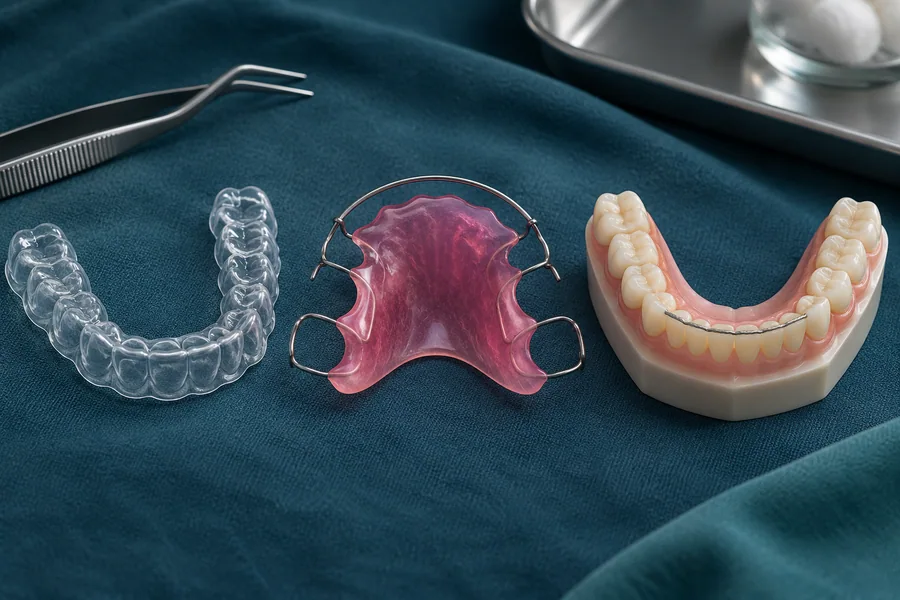
During the retention period, the device’s primary function is to maintain the position of the teeth after active treatment. During the consultation, the dentist discusses which teeth need to be maintained, how the device will fit, and whether it can be cared for properly. The orthodontist may recommend a single type or combination of appliances.
| Type | What keeps the teeth in place | What to consider in everyday life |
|---|---|---|
| Bonded wire retainer | Wire is attached to the teeth on the inside. It holds the fixation area. | The device remains in the mouth, and the area around the wire requires careful care and examination. |
| Clear vacuum-formed retainer | Transparent plastic adheres to tooth surfaces. | The removable lens is worn as directed. If there is a crack or change in fit, it is important to report this. |
| Hawley retainer | A plastic base rests on the side of the palate or tongue, and a thin wire surrounds the front teeth. | It is removed and can affect speech at the beginning. If the plate no longer fits, the doctor checks the base and the wire part. |
Why an orthodontist may recommend both a clear tray and a fixed wire
The wire secures the teeth attached to it, while the removable device can cover a larger portion of the arch. The doctor chooses the coverage based on the initial tooth position and the desired outcome. Ask to demonstrate on your model which teeth each device secures and what will be checked during follow-up appointments.
What should be done if the fit has changed?
A clear tray may stop fitting if it has distorted or your teeth have moved. A bonded wire can detach from one tooth and stay in place on the others. A Hawley retainer can crack in the acrylic or bend at the wire. Tell the orthodontist where the fit changed and when you noticed it. Call the clinic if a bonded retainer comes loose. Your orthodontist can advise on wear, repair or replacement. Sometimes, one point on the wire detaches, while the others remain intact. A patient with Howell may notice a crack or change in the position of the arc. Describe where the fit changed and after what event. If a removable retainer detaches, contact the clinic for an examination. The duration of wear and the replacement of the appliance are determined by the orthodontist. Retention and risk of tooth displacement.
Related terms
Further reading
- A fixed retainer came loose: what to do
- Retainers After Braces: Why Teeth Shift and How Long to Wear Them
Sources
- Retainers. British Orthodontic Society
- Orthodontic Glossary. American Association of Orthodontists
- A fixed retainer came loose: what to do
How to identify a loose bonded retainer, what the office needs to know, and why your orthodontist checks tooth position. - Retainers After Braces: Why Teeth Shift and How Long to Wear Them
Teeth tend to drift after braces or aligners. What a Cochrane review says about fixed and removable retainers, and why long-term wear is advised. - What a lateral cephalometric X-ray shows
What the orthodontist measures on a lateral cephalometric X-ray and how it differs from a panoramic X-ray and a digital scan. - Deep bite in adults: when and how it is corrected
How an orthodontist assesses a deep bite, when it can injure the tissues and what studies say about clear aligners and braces. - Digital impressions and photographs in orthodontics
Why orthodontists take dental scans and photographs, what each record shows and when X-rays answer a different question. - Gap between the front teeth: when it is a diastema
Why a gap can appear between the front teeth, when it may close as a child grows and why a new gap in an adult needs assessment.