Orthokeratology · Lens care
How to Care for Ortho-K Lenses: A Daily Routine That Cuts Risk
This article is for general information and does not replace advice from a doctor. Medical disclaimer
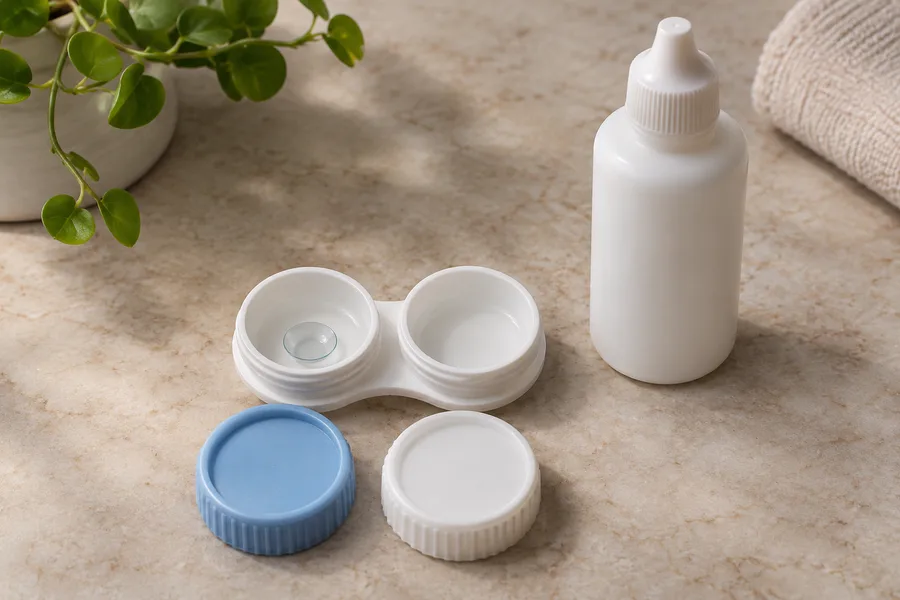
Ortho-k lenses spend every night on the eye, so lens care has a direct effect on infection risk. The core routine is short: wash and dry your hands, use only the solution your eye care professional prescribes, keep water away from lenses and case, never reuse solution, and replace the case at least every three months. The specific products and steps for your lenses come from your eye care professional and the lens labeling.
What you need
Before the first night, make sure you have:
- the care solution or disinfection system prescribed for your lenses
- a clean lens case, plus a date to replace it
- soap and a clean cloth for drying hands
- written instructions from the fitting visit
The care system matters. The FDA summary for one ortho-k lens approved in 2026 states that the lenses may only be disinfected with a chemical disinfection system. The FDA’s advice is to use only the products and solutions your eye care professional recommends, so do not swap products without asking.
The routine, step by step
- Wash your hands thoroughly with soap and water, then dry them completely with a clean cloth before touching the lenses. The CDC recommends this before handling lenses.
- Look at your eyes before putting the lenses in. The FDA advises never putting a contact lens into an eye that is red.
- In the evening, take the lenses out of the case, check them as you were taught and put them in at bedtime.
- In the morning, remove the lenses with the method your eye care professional showed you.
- Clean the lenses by rubbing and rinsing them as directed, using the prescribed solution. The FDA lists rubbing and rinsing as a basic step, and the labeling instructions set the details.
- Store the lenses in fresh solution. The CDC says to avoid mixing fresh and old solution in the case, and the FDA says not to top off solution and to discard what is left after each use.
- Clean the case with solution by rubbing and rinsing, then store it upside down with the caps off, as the CDC advises.
Keep water away
The CDC warns that most water is not germ-free and that Acanthamoeba, an organism that causes a severe eye infection, is commonly found in tap water, lake water, well water and other sources. The FDA says not to expose contact lenses to any water: tap, bottled, distilled, lake or ocean. Its advice for children’s lenses adds saliva to the list.
Ortho-k lenses are removed on waking and not worn during the day, so the moments to watch are cleaning and storage. The CDC advises against rinsing or storing lenses in water and says to clean the case with solution. If water does touch the lenses, the CDC advises taking them out as soon as possible and either throwing them away or cleaning and disinfecting them overnight before wearing them again.
Why these habits matter
A CDC-led study of Acanthamoeba keratitis in US rigid lens wearers from 2005 to 2011 found that nearly a quarter of the patients wore their lenses for ortho-k. Several care habits stood out:
| Habit | What the CDC and FDA advise | What the CDC-led study found |
|---|---|---|
| Storing lenses in tap water | Use fresh solution for storage, never water | 16 times the odds of Acanthamoeba keratitis |
| Topping off old solution in the case | Discard used solution; do not top off | Nearly 5 times the odds |
| Sleeping in lenses | Avoid unless your eye care provider directs it | 8 times the odds |
Ortho-k is one of the cases where an eye care provider does direct overnight wear, so the habits a family can change are the other two in the table. Storing lenses in tap water and topping off solution remained risk factors even after the researchers accounted for ortho-k use.
The FDA summary for the 2026 lens adds that strict compliance with the care routine and wearing schedule is essential to minimize risk, and that smoking increases the risk of corneal ulcers in contact lens users, especially with overnight wear.
Schedules to keep
- Lens case: replace it at least once every three months, according to the CDC; the FDA says every three months or as your eye care professional directs.
- Lenses: follow the replacement schedule your eye care provider recommends.
- Check-ups: the CDC says to see your eye care provider yearly or as recommended. Ortho-k fitting adds visits at the start: in one FDA clinical study, visits were scheduled at 1 day, 2 weeks and 1, 2, 3 and 6 months after the lenses were dispensed.
When to stop and call
The FDA lists these symptoms as reasons to remove the lenses at once, not put them back and contact your eye care professional right away: discomfort or pain, excess tearing or discharge, unusual sensitivity to light, itching, burning or a gritty feeling, unusual redness, blurred vision and swelling. It also says to keep the lenses in their case and take them to the appointment rather than throwing them away. More on infection risk is in ortho-k safety and eye infections.
For parents
The FDA suggests judging a child’s readiness for contact lenses by how well they handle other responsibilities, especially personal hygiene, and notes that lenses should be used only under the supervision of an eye care professional. What else goes into deciding is covered in who can wear ortho-k lenses, and the wider topic in the orthokeratology section.
Frequently asked questions
Can I rinse ortho-k lenses or the case with tap water?
No. The FDA and CDC say never to rinse or store lenses in water, and the CDC says to clean the case with solution instead. In a CDC-led study, storing rigid lenses in tap water was a strong risk factor for Acanthamoeba keratitis.
How often should the lens case be replaced?
The CDC says at least once every three months, and the FDA says every three months or as your eye care professional directs.
What if water gets on the lenses?
The CDC advises taking them out as soon as possible and either throwing them away or cleaning and disinfecting them overnight before wearing them again.
Sources
- Preventing Eye Infections When Wearing Contacts. Centers for Disease Control and Prevention, 2025
- Healthy Habits: Keeping Water Away from Contact Lenses. Centers for Disease Control and Prevention, 2025
- Contact Lens Risks. U.S. Food and Drug Administration, 2018
- What To Know If Your Child Wants Contact Lenses. U.S. Food and Drug Administration, 2023
- Acanthamoeba Keratitis among Rigid Gas Permeable Contact Lens Wearers in the United States, 2005 through 2011. Ophthalmology, 2016
- Summary of Safety and Effectiveness Data (SSED): Optimum Infinite (tisilfocon A) Orthokeratology Lenses II, PMA P240045. U.S. Food and Drug Administration, 2026
← All Orthokeratology articles
- Axial Length and Myopia: Why the Length of the Eye Matters
Axial length is the front-to-back length of the eye. It is linked to long-term risk and is the main way to track myopia during ortho-k. What the numbers mean. - Does Ortho-K Slow Myopia in Children? What the Studies Show
In the 2025 Cochrane review, children's eyes grew 0.30 mm less over two years with ortho-k than with single-vision lenses (moderate certainty). The caveats. - How Orthokeratology Works: Reshaping the Cornea Overnight
Ortho-k lenses thin the center of the cornea's surface layer during sleep, reducing myopia for the day. How fast it works, how long it lasts and its limits. - Myopia Control Options Compared: Drops, Lenses and Glasses
Atropine drops, ortho-k, myopia-control soft lenses and special glasses side by side, using Cochrane data, key trials and FDA approvals for US children. - Myopia in Children: Causes, Risk Factors and Outlook
Myopia usually starts between ages 6 and 14, and in the US it became far more common over 30 years. Family history raises the odds; time outdoors lowers them. - Ortho-K for Adults: Results, Comfort and Alternatives
In an FDA trial of mostly adults, about 95% of eyes saw 20/40 or better unaided after 6 months. What else to expect and how ortho-k compares with LASIK.