Orthokeratology · Lenses
Ortho-K for Adults: Results, Comfort and Alternatives
This article is for general information and does not replace advice from a doctor. Medical disclaimer
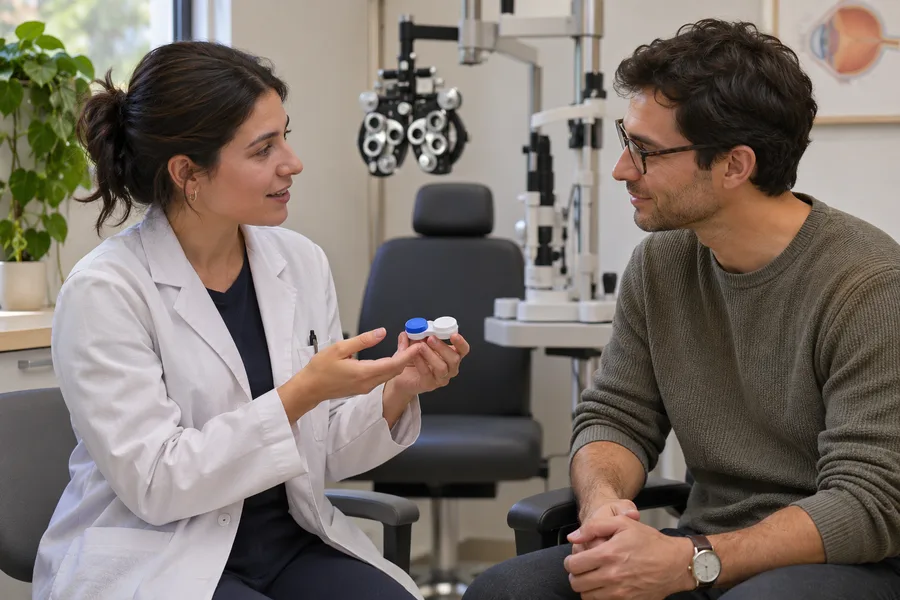
Adults with low to moderate nearsightedness can use ortho-k to go without glasses or contacts during the day. In the FDA study behind a current US approval, most participants were adults, about 95% of eyes saw 20/40 or better without correction after six months and 41.5% reached 20/20 or better. The lenses have to be worn overnight on a prescribed schedule for as long as you want the effect, and overnight wear carries an infection risk.
What results to expect
Detailed data for adults come from the US pivotal study of the Paragon Z CRT lens. The FDA used these data in 2026 to approve another lens made of the same material to the same design. The study enrolled 102 people and treated 98. Their mean age was about 35, with a range of 11 to 57, and they were followed for six months.
| Outcome at 6 months | Result |
|---|---|
| Unaided vision 20/20 or better | 41.5% of eyes |
| Unaided vision 20/40 or better | 94.8% of eyes |
| Within 0.50 D of the intended correction | 77.6% of eyes |
| Rated satisfaction with unaided vision very good or excellent | 59 of 72 people who completed, versus none before treatment |
| Stopped for clinical reasons | 19% of treated participants |
Results depended on the starting prescription. Full temporary correction was reached in some people with up to -5.50 diopters; above that, only partial correction could be expected. The higher the starting myopia, the smaller the share who reached 20/20 or full correction. The lens approved in 2026 on the basis of these data is labeled for myopia up to 6.00 diopters with up to 1.75 diopters of astigmatism.
Who else is a good fit, and which eye conditions rule ortho-k out, is covered in who can wear ortho-k lenses.
Comfort and vision quality
A randomized crossover trial compared the two ways of wearing lenses directly. People with mild myopia wore overnight corneal reshaping lenses for 8 weeks and daytime soft disposable lenses for 8 weeks, in random order. Of the 65 who finished both phases:
- soft lenses gave better visual acuity and less trouble with glare
- overnight lenses meant fewer limits on activities, fewer symptoms and less dependence on correction
- 67.7% chose the overnight lenses at the end, and 32.3% chose soft lenses
People who preferred ortho-k tended to have lower myopia, and their vision with ortho-k differed less from their vision with soft lenses.
A 2006 review in Clinical and Experimental Optometry noted that ortho-k induces higher-order aberrations, especially spherical aberration. These may affect vision in low contrast and when the pupil is dilated. The same review reported patient satisfaction similar to or better than with other popular types of contact lenses.
In the FDA study, discomfort was the most commonly reported symptom. Unacceptable vision was the most common clinical reason for stopping (13%), followed by lack of comfort (3%). Lens adherence, a lens sticking to the eye, was reported in nine participants.
Safety in adults
Infection of the cornea, or microbial keratitis, is the main serious risk of ortho-k. In a 2013 study of 1,317 ortho-k wearers, no cases were found in adults over 1,164 years of combined wear, compared with an estimated 13.9 per 10,000 years in children. The authors cautioned that the study was too small to detect differences of fewer than 50 cases per 10,000 years, and the upper limit of the 95% confidence interval for adults was 31.7 per 10,000 years.
The FDA summary for the 2026 lens notes that the risk of corneal ulcer is greater with overnight lenses than with daily wear lenses and that smoking increases the risk, especially with overnight wear. Strict lens care and the wearing schedule are the main protections, as described in ortho-k safety and eye infections.
Ortho-k or laser surgery?
The FDA summary lists the alternatives for correcting myopia: other rigid or soft contact lenses, glasses and refractive surgery such as LASIK. One key difference: the 2006 review concluded that ortho-k changes to the cornea are fully reversible, so the effect fades if you stop, as covered in what happens when you stop ortho-k.
According to the FDA, you are probably not a good candidate for LASIK if:
- you are under 18; no lasers are approved for LASIK in this age group
- your glasses or contact lens prescription changed in the past year
- you take part in contact sports such as boxing, wrestling or martial arts
The FDA also lists dry eye, which LASIK tends to aggravate, and corneas that are too thin among the conditions a doctor should screen for. Severe dry eye is also on the FDA list of conditions that rule out ortho-k lenses.
If you wear ortho-k and want to be evaluated for LASIK, the FDA advises stopping gas permeable lenses for at least 3 weeks, and hard lenses for at least 4 weeks, before the first evaluation. The FDA page does not mention ortho-k specifically, so ask the surgeon how long they want you out of the lenses, since they reshape the cornea on purpose.
Deciding
Ortho-k is an option for adults who want to be free of glasses during the day, have a prescription within the labeled range and can keep a nightly routine. A certified eye care professional can tell you whether your eyes are suitable and what results are realistic for your prescription. More on the method is in how orthokeratology works and the orthokeratology section.
Frequently asked questions
Is ortho-k a good alternative to LASIK?
It can be for some adults. Ortho-k is reversible and needs nightly lens wear and care; LASIK is surgery with its own eligibility rules. The FDA lists situations where LASIK is probably not a good choice, such as a prescription that changed in the past year or being under 18.
Will I see 20/20 with ortho-k?
Not always. In the FDA study behind a 2026 approval, 41.5% of eyes reached 20/20 or better without correction at 6 months and 94.8% reached 20/40 or better.
Do I need to stop ortho-k before a LASIK evaluation?
The FDA advises gas permeable lens wearers to stop for at least 3 weeks before the first evaluation. Ask the surgeon how this applies to ortho-k, which deliberately reshapes the cornea.
Sources
- Summary of Safety and Effectiveness Data (SSED): Optimum Infinite (tisilfocon A) Orthokeratology Lenses II, PMA P240045. U.S. Food and Drug Administration, 2026
- Overnight corneal reshaping versus soft disposable contact lenses: vision-related quality-of-life differences from a randomized clinical trial. Optometry and Vision Science, 2005
- The risk of microbial keratitis with overnight corneal reshaping lenses. Optometry and Vision Science, 2013
- Orthokeratology review and update. Clinical and Experimental Optometry, 2006
- When is LASIK not for me?. U.S. Food and Drug Administration, 2018
- What should I expect before, during, and after surgery?. U.S. Food and Drug Administration, 2018
← All Orthokeratology articles
- How Orthokeratology Works: Reshaping the Cornea Overnight
Ortho-k lenses thin the center of the cornea's surface layer during sleep, reducing myopia for the day. How fast it works, how long it lasts and its limits. - What Happens When You Stop Ortho-K?
After ortho-k stops, the cornea returns to its original shape within days to weeks. In children, eye growth may speed up again, so timing matters. - Who Can Wear Ortho-K Lenses? Prescription, Age and Eye Health
Two ortho-k lenses the FDA approved in 2026 are labeled for myopia up to 4.00 and 6.00 D with limited astigmatism. Eye health and a nightly routine matter too. - Axial Length and Myopia: Why the Length of the Eye Matters
Axial length is the front-to-back length of the eye. It is linked to long-term risk and is the main way to track myopia during ortho-k. What the numbers mean. - Does Ortho-K Slow Myopia in Children? What the Studies Show
In the 2025 Cochrane review, children's eyes grew 0.30 mm less over two years with ortho-k than with single-vision lenses (moderate certainty). The caveats. - How to Care for Ortho-K Lenses: A Daily Routine That Cuts Risk
Clean hands, the prescribed solution, no tap water, fresh solution each time and a new case at least every 3 months: CDC and FDA basics for overnight lenses.