Orthokeratology · Lenses
How Ortho-K Lenses Are Fitted
This article is for general information and does not replace advice from a doctor. Medical disclaimer
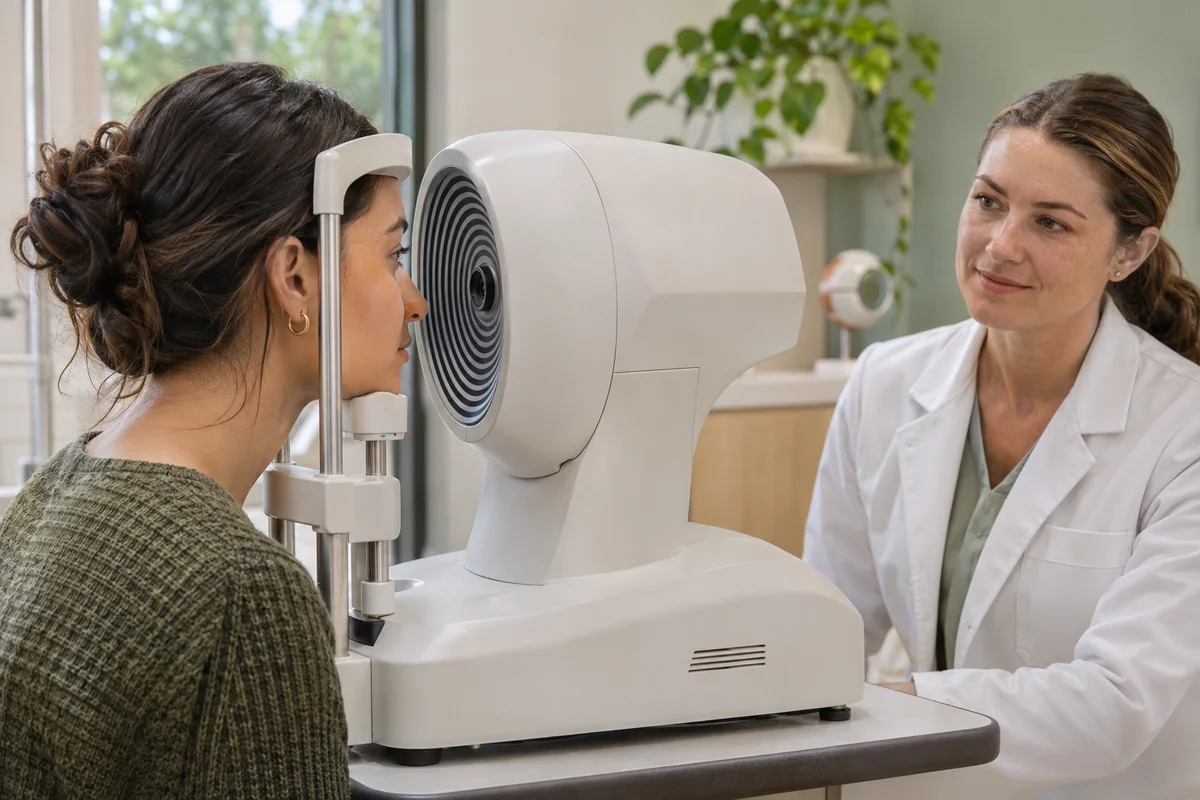
Fitting ortho-k lenses A rigid gas-permeable contact lens worn overnight that temporarily reshapes the cornea so you can see clearly during the day. starts with a vision check and a corneal exam. The eye care professional uses both the optical measurements and the shape of the eye’s surface to choose a lens. A follow-up exam compares daytime vision and the corneal map with the starting measurements.
What happens at the first appointment
An eye care professional who fits ortho-k checks visual acuity and refraction The bending of light as it passes through the eye. In an eye exam, refraction also refers to measuring the correction needed for clear focus. , examines the front of the eye, and asks about prior infections, surgery, or trouble wearing contacts. If the lenses are being considered for a child’s myopia Also called nearsightedness. Distant objects look blurry because light focuses in front of the retina. management, axial length The distance from the front of the cornea to the retina along the eye's axis. may also be measured as a baseline for follow-up.
Corneal topography Measurement and mapping of the shape of the corneal surface. maps the shape of the cornea. The map helps the practitioner select the lens design and compare the treatment zone after wear. Bring your glasses and any prescriptions or recent exam records. If you already wear contacts, ask the practice how far in advance to remove them before the measurements.
How astigmatism affects the fitting
An eyeglass prescription usually lists a cylinder and axis for astigmatism A refractive error in which the eye bends light by different amounts in different directions. . These describe optical correction. A corneal map also shows the contours of the surface the lens will sit on. If that surface curves differently in different directions, a toric lens design may help the lens sit more steadily.
The toric feature can apply to the part of the lens that controls how it fits. Daytime vision also depends on your starting prescription and how the cornea responds. Ask what residual astigmatism the clinician expects and how they will check it.
What happens after the trial fitting
The practitioner checks where the lens sits and shows you how to put it in, take it out, and care for it. At an early follow-up, they check vision without the lenses, the eye’s surface, and the position of the treatment zone. They may adjust the design or discuss another option. Ask when to return, whom to call for pain, redness, or worse vision, and which visits the fee covers. See ortho-k safety and eye infections.
Frequently asked questions
Can ortho-k lenses be fitted from my glasses prescription?
An eye care professional also examines the eye's surface and measures corneal shape. Bring your glasses prescription so it can be compared with the new measurements.
Can I get ortho-k lenses if I have astigmatism?
Sometimes. The clinician considers the astigmatism, the shape of the cornea, and the range of a particular lens design. A toric design may help achieve a stable fit.
Sources
- Types of Contact Lenses. U.S. Food and Drug Administration
- Orthokeratology in Moderate Myopia: A Study of Predictability and Safety. Journal of Ophthalmic & Vision Research, 2020
- To Achieve a Bullseye: Factors Related to Corneal Refractive Therapy Orthokeratology Lens Toricity. Journal of Clinical Medicine, 2022
- Corneal Elevation, Power, and Astigmatism to Assess Toric Orthokeratology Lenses in Moderate-to-High Astigmats. Eye & Contact Lens, 2021
← All Orthokeratology articles
- How Much Do Ortho-K Lenses Cost in the U.S.?
Compare published U.S. fees for ortho-k fitting, a pair of lenses, follow-up care, and replacements. - How Orthokeratology Works: Reshaping the Cornea Overnight
Ortho-k lenses thin the center of the cornea's surface layer during sleep, reducing myopia for the day. How fast it works, how long it lasts and its limits. - Ortho-K for Adults: Results, Comfort and Alternatives
In an FDA trial of mostly adults, about 95% of eyes saw 20/40 or better unaided after 6 months. What else to expect and how ortho-k compares with LASIK. - What Happens When You Stop Ortho-K?
After ortho-k stops, the cornea returns to its original shape within days to weeks. In children, eye growth may speed up again, so timing matters. - Who Can Wear Ortho-K Lenses? Prescription, Age and Eye Health
Two ortho-k lenses the FDA approved in 2026 are labeled for myopia up to 4.00 and 6.00 D with limited astigmatism. Eye health and a nightly routine matter too. - Axial Length and Myopia: Why the Length of the Eye Matters
Axial length is the front-to-back length of the eye. It is linked to long-term risk and is the main way to track myopia during ortho-k. What the numbers mean.