Orthokeratology · Lenses
Who Can Wear Ortho-K Lenses? Prescription, Age and Eye Health
This article is for general information and does not replace advice from a doctor. Medical disclaimer
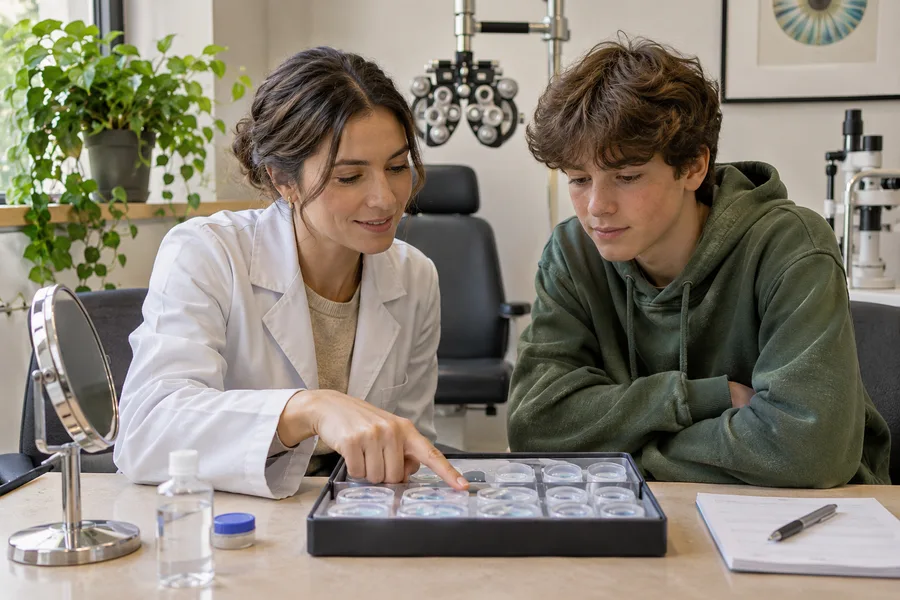
Ortho-k suits people with nearsightedness in a limited range, little astigmatism, healthy corneas and enough tears, who can follow a strict nightly routine. Each FDA-approved lens has its own labeled range; two lenses approved in 2026 cover myopia up to 4.00 and up to 6.00 diopters. A certified eye care professional makes the final call after an eye exam.
Prescription range
Each overnight ortho-k lens A rigid gas-permeable contact lens worn overnight that temporarily reshapes the cornea so you can see clearly during the day. approved by the FDA has its own labeled range. Two recent approvals show the spread:
| Lens (FDA approval) | Myopia | Astigmatism | Notes from the FDA summary |
|---|---|---|---|
| Optimum Infinite Orthokeratology Lenses II, PMA P240045 (2026) | Up to 6.00 D | Up to 1.75 D | Chemical disinfection only. In the clinical study behind it, full temporary correction was reached in some patients with up to -5.50 D; above that, partial |
| Dilight Overnight Orthokeratology Contact Lens, PMA P220015 (2026) | Up to 4.00 D | Up to 1.50 D | Chemical disinfection only. Pivotal trial enrolled people aged 8 to 40 |
Both summaries describe the use as temporary reduction of myopia in non-diseased eyes. Neither covers farsightedness. If a prescription falls outside the range, the eye care professional may suggest other options.
Eye health: conditions that rule it out
The two FDA summaries list the same contraindications. Ortho-k lenses should not be used when any of these are present:
- acute or subacute inflammation or infection in the front chamber of the eye
- any eye disease, injury or abnormality that affects the cornea, conjunctiva or eyelids
- severe dry eye
- reduced corneal sensitivity
- a systemic disease that may affect the eye or be made worse by contact lenses
- allergic reactions of the eye surface or surrounding tissue caused or worsened by lenses or lens solutions
- allergy to an ingredient in a lens care solution
- any active corneal infection, bacterial, fungal or viral
- red or irritated eyes
The Dilight trial shows what else researchers screened for. It enrolled only people with corneal curvature within a set range, stable refraction and best-corrected vision of 20/20 or better. It excluded people with pupils larger than 6.2 mm, previous corneal surgery or trauma, conditions such as blepharitis or conjunctivitis, pregnancy, and medicines that can cause dry eye. These were trial criteria, so a clinic may apply them differently, but they show the measurements an exam is likely to include.
Age
The indications in these FDA summaries do not set an age limit. The Dilight trial included three age groups, 8 to 12, 13 to 18 and over 18, and the average participant was 17.7 years old. The study behind the 2026 Optimum Infinite approval enrolled mostly adults, with a mean age of about 35; 10 of the 102 people enrolled were adolescents.
For children, the FDA’s consumer advice on contact lenses names no minimum age. It suggests that parents look at how well the child handles other responsibilities, especially personal hygiene. The FDA also notes that kids and contact lenses are not always the best fit.
Age also affects the second reason families consider ortho-k: slowing myopia. The 2019 American Academy of Ophthalmology review found a potentially greater effect when ortho-k started at ages 6 to 8, and possibly in children with larger than average pupils. That evidence is covered in does ortho-k slow myopia. Adults have different considerations, described in ortho-k for adults.
Routine and commitment
Ortho-k depends on regular use. The FDA says overnight lenses are commonly prescribed for at least eight hours of wear each night, and they must keep being worn every night or on another prescribed schedule to maintain the effect. The labeling notes for both lenses warn that missing the schedule can cause fluctuating vision and affect activities such as night driving.
Not everyone sticks with it. In the study behind the 2026 Optimum Infinite approval, 19% of treated participants stopped for clinical reasons, mostly unacceptable vision (13%) and discomfort (3%). In the Dilight trial, the stated reasons included difficulty handling and wearing the lenses, loss of interest, poor vision in dim light, discomfort and adverse events. The 2025 Cochrane review of myopia control in children noted that ortho-k lenses were often poorly tolerated and that in some studies more than half of the children did not complete treatment.
Lens care is the other half of the commitment. The cleaning steps are in how to care for ortho-k lenses.
The fitting
The FDA requires eye care professionals to be trained and certified before they use overnight ortho-k lenses, and it suggests asking which lenses a practitioner is certified to fit. Follow-up visits start right after the fitting. In the Dilight trial, checks were scheduled after 1 day, 1 week, 2 weeks, 30 days and then 3, 6, 9 and 12 months of wear.
Whether ortho-k is the right choice depends on the eye exam, the prescription and the person’s habits, and only an eye care professional can weigh those together. For background on the method, see how orthokeratology works or the orthokeratology section.
Frequently asked questions
Is there a minimum age for ortho-k?
The FDA indications for the two lenses reviewed here do not set an age range. One of the trials enrolled people aged 8 to 40. The FDA suggests judging a child's readiness by how well they handle hygiene and other responsibilities.
Can ortho-k correct astigmatism?
Not reliably. The two lenses reviewed here are labeled for reducing myopia in eyes with astigmatism up to 1.75 or 1.50 diopters, and in the study behind one of them ortho-k did not predictably change the amount of astigmatism.
Can any eye doctor fit ortho-k?
The FDA requires eye care professionals to be trained and certified before using overnight ortho-k lenses, so it is worth asking which lenses a practice is certified to fit.
Sources
- Summary of Safety and Effectiveness Data (SSED): Optimum Infinite (tisilfocon A) Orthokeratology Lenses II, PMA P240045. U.S. Food and Drug Administration, 2026
- Summary of Safety and Effectiveness Data (SSED): Dilight (roflufocon E) Overnight Orthokeratology Contact Lens, PMA P220015. U.S. Food and Drug Administration, 2026
- Types of Contact Lenses. U.S. Food and Drug Administration, 2018
- What To Know If Your Child Wants Contact Lenses. U.S. Food and Drug Administration, 2023
- Use of Orthokeratology for the Prevention of Myopic Progression in Children: A Report by the American Academy of Ophthalmology. Ophthalmology, 2019
- Interventions for myopia control in children: a living systematic review and network meta-analysis. Cochrane Database of Systematic Reviews, 2025
← All Orthokeratology articles
- How Orthokeratology Works: Reshaping the Cornea Overnight
Ortho-k lenses thin the center of the cornea's surface layer during sleep, reducing myopia for the day. How fast it works, how long it lasts and its limits. - Ortho-K for Adults: Results, Comfort and Alternatives
In an FDA trial of mostly adults, about 95% of eyes saw 20/40 or better unaided after 6 months. What else to expect and how ortho-k compares with LASIK. - What Happens When You Stop Ortho-K?
After ortho-k stops, the cornea returns to its original shape within days to weeks. In children, eye growth may speed up again, so timing matters. - Axial Length and Myopia: Why the Length of the Eye Matters
Axial length is the front-to-back length of the eye. It is linked to long-term risk and is the main way to track myopia during ortho-k. What the numbers mean. - Does Ortho-K Slow Myopia in Children? What the Studies Show
In the 2025 Cochrane review, children's eyes grew 0.30 mm less over two years with ortho-k than with single-vision lenses (moderate certainty). The caveats. - How to Care for Ortho-K Lenses: A Daily Routine That Cuts Risk
Clean hands, the prescribed solution, no tap water, fresh solution each time and a new case at least every 3 months: CDC and FDA basics for overnight lenses.