Orthopedics · Pillows and mattresses
Pillows for Neck Pain: What the Research Actually Shows
This article is for general information and does not replace advice from a doctor. Medical disclaimer
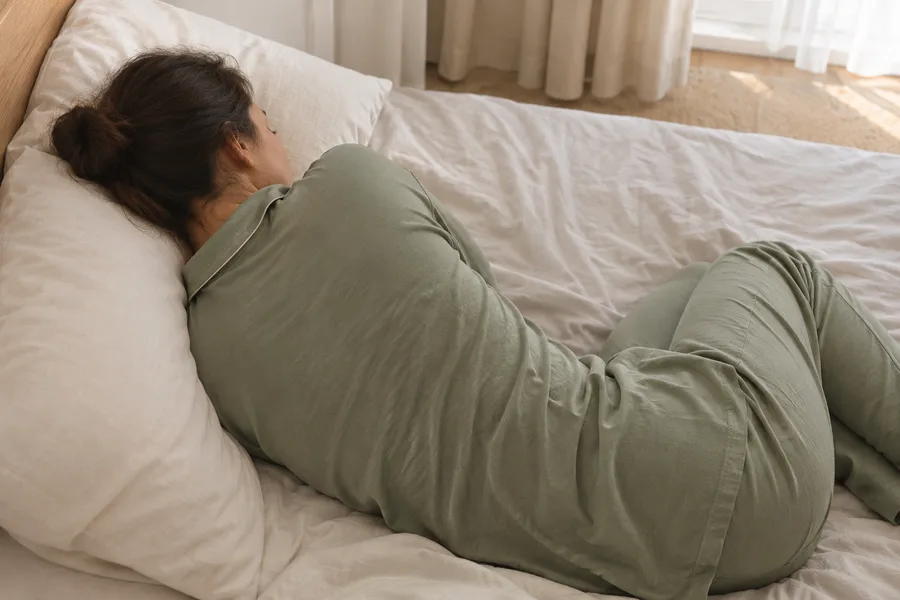
Research on pillows for neck pain is limited, and no pillow type has been shown to be clearly better than the rest. A 2021 meta-analysis found small benefits from rubber (latex) pillows in people with chronic neck pain, while a 2025 review of newer studies found no type clearly superior. Pillow height and shape may matter more for neck position than the filling, and a pillow is at most an addition to other care.
What the reviews found
A 2021 systematic review and meta-analysis in Clinical Biomechanics included 35 articles, nine of them high-quality studies with 555 participants. It found that:
- the pooled results favored rubber pillows for reducing neck pain, though the effect was small
- using the study pillows reduced waking pain and neck disability and increased satisfaction
- pillow design did not change sleep quality in people with chronic neck pain
- neck alignment when lying on the side may not differ between rubber and feather pillows, while pillow shape and height may change it significantly
A 2025 systematic review in Rehabilitación looked only at interventional studies published from 2015 to June 2024. It found five studies with 239 participants. Pain scores improved slightly but not significantly, disability results were inconsistent, and sleep quality did not change significantly. The authors concluded that there is limited evidence for specific pillows as an add-on treatment, and that no type, whether latex, foam or standard, was clearly superior.
Pillow materials in field trials
| Study | Who took part | What was compared | Result |
|---|---|---|---|
| Gordon and colleagues, 2009 | 106 side sleepers who used one pillow | A week each on their own pillow and on polyester, foam, feather, rubber and contour foam pillows | Rubber did best for waking neck pain, sleep quality and comfort; own pillow similar to foam and polyester; contour foam no better than regular foam; feather not recommended |
| Gordon and colleagues, 2019 | Side sleepers with neck symptoms on waking and spinal degeneration confirmed on imaging | Latex and polyester pillows for 28 days each, with the usual pillow in between | No pillow significantly changed any outcome; the latex pillow did not perform well |
| Clinical Biomechanics review, 2021 | 9 high-quality studies, 555 people | Different pillow designs | Small reduction in neck pain with rubber pillows; no effect on sleep quality |
| Rehabilitación review, 2025 | 5 studies, 239 people with chronic neck pain | Latex, foam and standard pillows | No type clearly better |
Earlier work had reported that latex or polyester pillows improved waking neck symptoms in the general population. The 2019 pilot did not replicate this in people with degenerative changes in the neck. The authors estimated that a properly powered trial would need more than 400 participants with symptoms.
Height and shape
The 2021 review concluded that the shape and height of a pillow may affect neck alignment more than what it is made of. The NHS advice for neck pain is to use a low, firm pillow and, when sleeping, keep your head at the same height as the rest of your body. In the 2009 field trial, the contour foam pillow had no advantage over a regular-shaped foam pillow.
What to keep in mind
- Your current pillow may be fine. In the 2009 trial, people’s own pillows performed about as well as foam and polyester ones.
- Feather pillows fared poorly. The authors of the 2009 trial concluded that they should not be recommended.
- If you have known degenerative changes in your neck, the 2019 pilot found no significant benefit from switching to latex or polyester.
- A pillow is an add-on, not a treatment. The 2025 review found only limited evidence for pillows even as an addition to other care.
- Keep moving. The NHS advises against wearing a neck collar for ordinary neck pain unless a doctor tells you to, and notes that most neck pain lasts only a few weeks.
The research on mattresses is summarized in mattress for back pain.
When neck pain needs prompt care
The American Academy of Orthopaedic Surgeons (AAOS) advises:
- seeking medical care immediately for severe neck pain after an injury such as a car crash, diving accident or fall, with a trained professional such as a paramedic keeping the neck still to avoid further injury
- seeking immediate care when an injury causes neck pain that spreads down the arms and legs
- getting checked if you have symptoms in your arms or legs, such as numbness, tingling or weakness, even without much neck pain
- getting checked for trouble with fine hand movements, such as changes in handwriting or difficulty with buttons
- seeing a doctor if neck pain is constant and persistent, severe, or comes with headaches, numbness, tingling or weakness
The NHS adds that you should see a doctor if neck pain or stiffness does not go away after a few weeks, if painkillers have not helped, or if you have pins and needles or a cold arm. For numbness and tingling mainly in the hand, see also the guide to wrist splints for carpal tunnel syndrome. For more guides on sleep and supports, see the orthopedics section.
Frequently asked questions
What kind of pillow is best for neck pain?
No type is clearly best. A 2021 meta-analysis found that rubber (latex) pillows reduced neck pain slightly, but a 2025 review found no pillow type clearly better than the others.
Are contour pillows better than regular pillows?
In a field trial of 106 side sleepers, a contour foam pillow had no advantage over a regular-shaped foam pillow.
Should I wear a neck collar at night?
The NHS advises against wearing a neck collar for ordinary neck pain unless a doctor tells you to, because it is better to keep the neck moving.
Sources
- The effects of pillow designs on neck pain, waking symptoms, neck disability, sleep quality and spinal alignment in adults: A systematic review and meta-analysis. Clinical Biomechanics, 2021
- Effect of pillow on pain, disability and sleep quality in patients with chronic neck pain: A systematic review. Rehabilitación, 2025
- Pillow use: the behaviour of cervical pain, sleep quality and pillow comfort in side sleepers. Manual Therapy, 2009
- Pillow preferences of people with neck pain and known spinal degeneration: a pilot randomized controlled trial. European Journal of Physical and Rehabilitation Medicine, 2019
- Neck pain. NHS
- Neck Pain. American Academy of Orthopaedic Surgeons (OrthoInfo)
- Mattress for Back Pain: What Trials Say About Firmness
In trials, medium-firm mattresses did better than very firm ones for chronic low back pain, but the differences were modest. What to weigh before buying. - Beginner yoga at home: choosing your first poses
Try mountain pose at home, choose between a chair and a mat, and learn what to look for in a beginner yoga class before you press play. - Chair yoga for beginners: three poses you can try seated
Set up a stable chair and explore seated mountain, a small seated cat movement and a side bend, with ways to adjust the range. - Downward-facing dog: how to try a supported chair variation
How downward dog works, how a higher hand support changes the pose, and what to consider if your wrists hurt or you have glaucoma. - Tree pose for beginners: finding balance beside a wall
Where to place your foot in tree pose, how to use a wall, and how to come out of the pose if you start to wobble. - Yoga breathing for beginners: a gentle introduction to pranayama
Try a quiet seated breath. Learn how alternate-nostril breathing, humming and breath retention differ, and when to pause a yoga breathing exercise.