Orthopedics · Orthoses
Wrist Splints for Carpal Tunnel Syndrome: What Studies Show
This article is for general information and does not replace advice from a doctor. Medical disclaimer
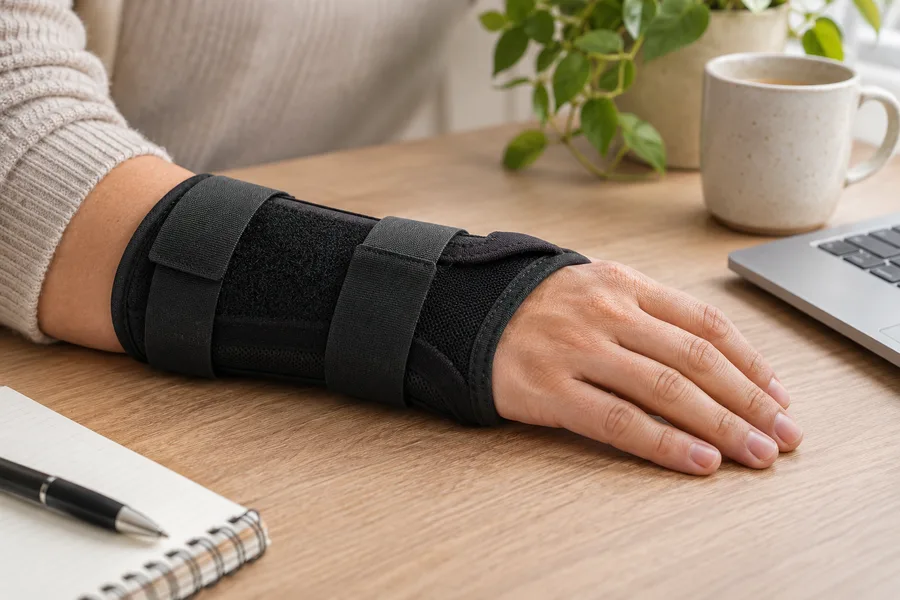
A wrist splint, usually worn at night, is often the first treatment offered for mild to moderate carpal tunnel syndrome. The 2023 Cochrane review of 29 trials with 1,937 adults concluded that there is not enough evidence to say whether splinting helps, although night splints may raise the chance of feeling better in the short term. Because splints are cheap and have no plausible long-term harms, the reviewers judged that even small benefits could justify trying one, particularly for people who want to avoid surgery or injections.
What carpal tunnel syndrome is
Carpal tunnel syndrome happens when the median nerve is squeezed where it passes through the wrist. The American Academy of Orthopaedic Surgeons (AAOS) lists the usual symptoms:
- numbness, tingling, burning and pain, mainly in the thumb and the index, middle and ring fingers
- symptoms that wake you from sleep
- weakness and clumsiness in the hand
The NHS notes that symptoms often start slowly, come and go, and are usually worse at night. In severe cases, AAOS says, the muscles at the base of the thumb may become visibly smaller.
How a splint is supposed to help
According to AAOS, a brace or splint worn at night keeps you from bending your wrist while you sleep, and holding the wrist straight reduces pressure on the nerve in the carpal tunnel. The NHS says a splint is worn at night and that it may take up to 6 weeks before symptoms start to improve.
What the trials show
The Cochrane review, updated in 2023, pooled the randomized trials. Its main findings for splinting compared with no active treatment are below. Symptom and function scores use a 1 to 5 scale, where a change of 1 point for symptoms and 0.7 points for function is the smallest change the reviewers counted as clinically important.
| Outcome | Result | Certainty of evidence |
|---|---|---|
| Symptoms, under 3 months | 0.37 points better with a splint: little or no benefit (6 studies, 306 people) | Low |
| Hand function, under 3 months | 0.24 points better: probably no meaningful improvement (6 studies, 306 people) | Moderate |
| Overall improvement with a night splint | More than three times as likely as with no treatment (1 study, 80 people) | Low |
| Referral for surgery | Unclear whether splinting reduces it (3 studies, 243 people) | Very low |
| Side effects | 7 of 40 people (18%) with a splint reported side effects, all temporary, versus none without | Low |
| Splint added to a steroid injection | May give no extra benefit | Moderate |
| Six months of splinting versus six weeks | Six months may be better for symptoms and function | Low |
The reviewers could not tell whether full-time or night-only wear is better. Low-certainty evidence suggested that benefits may show up over the longer term.
What US orthopedic guidelines say
The first edition of the AAOS guideline, from 2016, rated the evidence as strong that immobilization with a brace, splint or orthosis should improve patient-reported outcomes. It based this on two high-quality trials: one compared eight weeks of full-time splinting with no splint, and the other compared four weeks of night bracing with no treatment. AAOS saw no harm in using a brace or splint if the patient tolerates it.
That edition has been replaced. The 2024 AAOS guideline focused on long-term, disease-modifying effects, dropped the 2016 recommendations on short-term effects and does not include a separate recommendation on splints for nonsurgical care. It finds no significant difference in patient-reported outcomes between the various nonsurgical treatments, a limited-strength finding. It also concludes, with moderate evidence, that a sling or orthosis should not be used after carpal tunnel release surgery, and, with strong evidence, that steroid injections do not give long-term improvement.
Taken together, a splint remains a low-cost, low-risk option, but the newer evidence is more cautious than the 2016 rating.
When a splint is not enough
Splints are meant for milder cases. See a doctor promptly, rather than waiting for a splint to work, if you notice:
- numbness that is constant rather than coming and going
- the muscles at the base of the thumb looking smaller
- weakness, clumsiness or trouble gripping that is getting worse
AAOS says surgery may be recommended to prevent permanent damage in long-standing cases with constant numbness and wasting of the thumb muscles, and is considered when nonsurgical treatment does not relieve symptoms. The NHS advises seeing a doctor if symptoms are getting worse or not going away, or if treatment at home is not working. A doctor may suggest a steroid injection if a splint does not help, or refer you to discuss surgery, which the NHS says usually cures the condition. If the diagnosis is unclear, nerve conduction tests or imaging may be arranged.
If you also have neck pain with numbness or tingling in the arms, the guide to pillows for neck pain lists the warning signs that need prompt assessment. For other supports with mixed evidence, see back support belts or the orthopedics section.
Frequently asked questions
Should a carpal tunnel splint be worn at night or all day?
It is not clear. The 2023 Cochrane review found too little evidence to say whether full-time or night-only wear works better. AAOS and the NHS describe night use.
How long does a wrist splint take to work?
The NHS says you may need to wear a splint for up to 6 weeks before symptoms start to improve.
When is surgery considered for carpal tunnel syndrome?
According to AAOS, surgery is considered when nonsurgical treatment does not relieve symptoms, and it may be recommended to prevent permanent nerve damage in long-standing cases with constant numbness or thumb muscle wasting.
Sources
- Splinting for carpal tunnel syndrome. Cochrane Database of Systematic Reviews, 2023
- Management of Carpal Tunnel Syndrome Evidence-Based Clinical Practice Guideline. American Academy of Orthopaedic Surgeons, 2016
- Management of Carpal Tunnel Syndrome Evidence-Based Clinical Practice Guideline. American Academy of Orthopaedic Surgeons, 2024
- Carpal Tunnel Syndrome. American Academy of Orthopaedic Surgeons (OrthoInfo)
- Carpal tunnel syndrome. NHS
- Types of knee braces: support, fit and selection
Compare sleeves, hinged supports and unloading braces. Learn what to check when fitting a knee brace and what to ask about arthritis. - Bunion Splints and Toe Spacers: What They Can and Cannot Do
Splints, toe spacers and insoles may ease bunion pain, but none has been shown to permanently correct a bunion. What studies found and when surgery comes up. - Beginner yoga at home: choosing your first poses
Try mountain pose at home, choose between a chair and a mat, and learn what to look for in a beginner yoga class before you press play. - Chair yoga for beginners: three poses you can try seated
Set up a stable chair and explore seated mountain, a small seated cat movement and a side bend, with ways to adjust the range. - Downward-facing dog: how to try a supported chair variation
How downward dog works, how a higher hand support changes the pose, and what to consider if your wrists hurt or you have glaucoma. - Tree pose for beginners: finding balance beside a wall
Where to place your foot in tree pose, how to use a wall, and how to come out of the pose if you start to wobble.