Orthodontics · Care and risks
How to Clean Your Teeth With Braces: A Daily Routine
This article is for general information and does not replace advice from a doctor. Medical disclaimer
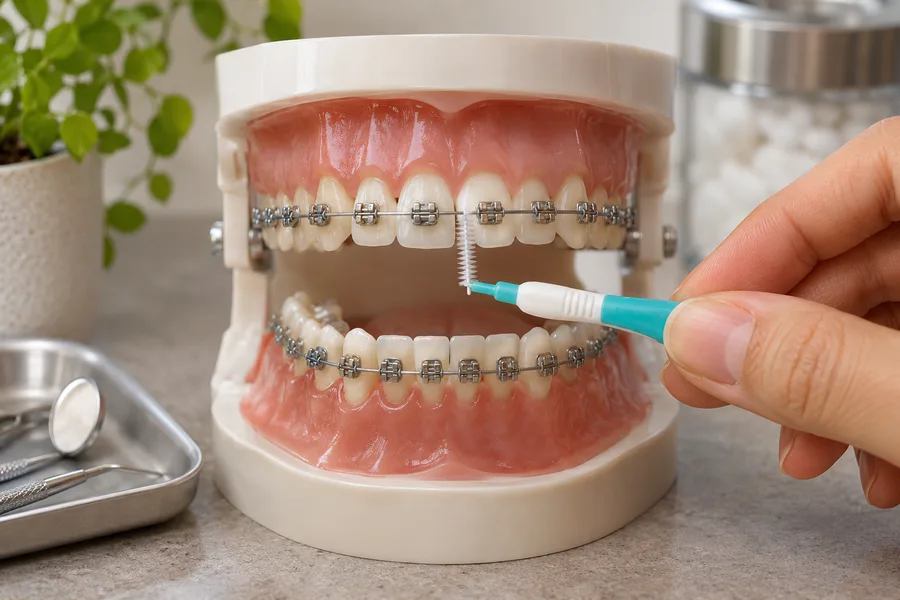
Brackets and wires trap food and plaque, which makes teeth harder to clean and raises the risk of early decay that shows up as white marks on the enamel. The American Association of Orthodontists (AAO) recommends brushing after every meal and before bed, cleaning between the teeth at least once a day, limiting sugary drinks and keeping up regular dental check-ups. Research on electric brushes and extra fluoride is limited and mostly low in certainty.
A daily routine with braces
Your orthodontist may give you specific instructions, and those come first. The AAO’s general routine looks like this:
- Brush for two minutes after every meal or snack and again before bed, using fluoride toothpaste.
- Floss at least once a day. The AAO calls flossing crucial to successful orthodontic treatment and to long-term oral health.
- Use an interproximal brush, a small brush that fits between the teeth, to dislodge plaque and food trapped between teeth and around brackets and wires. Your orthodontist may give you one.
- If you like, add a water irrigator, also called a water flosser. The AAO says these can flush out food particles.
- Ask whether a daily fluoride rinse suits you. The AAO says a fluoride rinse can strengthen enamel and help prevent white marks.
- When you cannot brush after eating, at least rinse your mouth with plain water.
- Carry a travel toothbrush and a small tube of toothpaste, and keep supplies such as orthodontic wax at home.
The AAO warns that plaque and food left around braces can lead to cavities, swollen gums, bad breath and permanent white marks on the teeth. If you notice white, chalky marks near the brackets or swollen gums, mention them to your orthodontist or dentist.
What to eat and drink
The AAO advises avoiding hard, sticky, crunchy and chewy foods for the whole of treatment, because they can damage brackets and wires. Its list of foods to avoid includes:
- hard candy and sticky candy such as taffy and caramel
- popcorn, nuts, chips and pretzels
- raw crunchy fruit and vegetables
- crusty pizza crust, bagels and hard rolls
- chewy cuts of meat, unless cut into bite-sized pieces
- ice
Softer choices such as oatmeal, scrambled eggs, soups, pasta, flaky fish, steamed vegetables, mashed potatoes, yogurt, bananas and berries are easier on braces. In the first days after braces go on, or after an adjustment, the mouth is often sore, and the AAO suggests softer foods and cutting food into small pieces.
For drinks, the AAO says tap water and milk are the best choices. It advises skipping or limiting sugary drinks such as soda and sports drinks, and rinsing well with water if you cannot brush after one.
Keep seeing your dentist
The AAO stresses that regular dental visits continue during orthodontic treatment, at least every six months or more often if your dentist recommends it.
If a bracket or wire breaks, contact your orthodontist promptly. The AAO notes that broken braces cannot apply the right forces to move teeth, which can make treatment take longer.
What research says about brushes and fluoride
| Question | What systematic reviews found | Certainty |
|---|---|---|
| Electric or manual toothbrush? | A 2020 review of 5 trials found no difference in plaque or gum scores at 4 and 8 weeks | Very low to moderate |
| Electric or manual toothbrush, updated | A 2026 review of 23 papers found electric brushes may moderately improve plaque and gum scores; counter-rotating designs showed the largest effect on plaque | Low to very low |
| Fluoride foam applied by a professional every two months | New white spot lesions in 12% of patients compared with 49% with placebo, in one trial | Low |
| High-fluoride toothpaste, 5,000 ppm, compared with regular 1,450 ppm toothpaste | New lesions in 18% compared with 27%, in one trial | Low |
| Fluoride varnish applied by a professional | Not enough evidence of a difference | Low |
The 2019 Cochrane review behind the fluoride findings included 10 studies with 1,798 participants. Adverse effects from fluoride products were rare. The reviewers noted that each promising result came from a single study, so more trials are needed. Whether high-fluoride toothpaste or a professional fluoride treatment is worth it in your case is a question for your dentist.
For toothbrushes, the two reviews point in slightly different directions, and both rate the evidence as weak. The AAO’s advice is to use the toothbrush that works best for you and to brush for two minutes each time.
How often white spots and other side effects occur is covered in orthodontic treatment risks. Bracket designs and their effect on plaque are compared in types of braces, and aligners, which come out for cleaning, in clear aligners vs braces. Cleaning matters after treatment too, when retainers take over. More guides are in the orthodontics section.
Frequently asked questions
Do I need an electric toothbrush with braces?
Not necessarily. One review of five trials found no difference in plaque or gum scores between electric and manual brushes. A 2026 review found a possible moderate benefit for electric brushes, but rated the evidence as low in quality.
What should I do if I cannot brush after lunch?
The AAO suggests at least rinsing with plain water. Keeping a travel toothbrush and small tube of toothpaste with you makes this easier.
Sources
- Living With Braces: The Brace-Faced Adventure. American Association of Orthodontists
- Oral Hygiene Tips During Orthodontic Treatment. American Association of Orthodontists
- What Can I Eat with Braces? A Comprehensive Guide. American Association of Orthodontists, 2025
- Fluorides for preventing early tooth decay (demineralised lesions) during fixed brace treatment. Cochrane Database of Systematic Reviews, 2019
- Powered vs manual tooth brushing in patients with fixed orthodontic appliances: A systematic review and meta-analysis. American Journal of Orthodontics and Dentofacial Orthopedics, 2020
- Powered vs. manual toothbrushes in fixed orthodontic patients: a systematic review and meta-analysis. European Journal of Orthodontics, 2026
- Risks of Orthodontic Treatment: Enamel, Roots, Gums and Pain
White spots on enamel, root shortening, small gum changes and soreness are the main side effects of braces. How common they are and what lowers the risk. - Clear Aligners vs Braces: What the Research Shows
Reviews find braces give a more precise bite on average, most clearly when teeth are extracted, with closer results otherwise. Why DIY aligners are risky. - Early Orthodontic Treatment for Children: When It Helps
What Cochrane reviews show about two-phase treatment for protruding teeth, underbites, crossbites and thumb sucking, and why it is not right for every child. - How Long Does Orthodontic Treatment Take? What Studies Show
Treatment with braces averaged about 20 months in clinical trials. What makes it longer, and whether vibration, lasers or minor surgery really speed it up. - Types of Malocclusion: Bite Problems and How Common They Are
Class I, II and III bites, crossbite, open bite, deep bite and crowding explained, with prevalence figures from a US survey and a review of 53 studies. - Orthodontics for Adults: Gum Health, Timing and Options
The AAO says one in three orthodontic patients is an adult. How adult treatment differs: gum health, treatment time, aligners versus braces and retainers.