Orthodontics · Braces
Types of Braces: Metal, Ceramic, Lingual and Self-Ligating
This article is for general information and does not replace advice from a doctor. Medical disclaimer
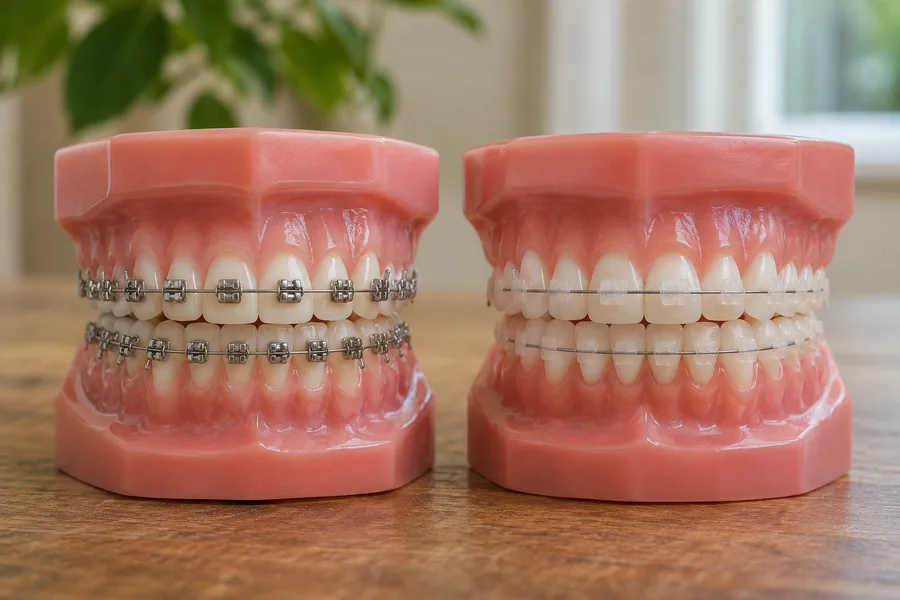
All fixed braces work the same way: brackets bonded to the teeth hold a wire, and the wire slowly moves the teeth. The types differ in what the brackets are made of, which side of the teeth they sit on and how the wire is held in place. Systematic reviews have found little evidence that one type gives better results than another, so the choice usually comes down to appearance, comfort, cost and what your orthodontist recommends for your bite.
How braces move teeth
The American Association of Orthodontists (AAO) describes braces as a combination of brackets and wires fixed to the teeth. Elastic bands can be added for extra force to move teeth and correct the bite. Depending on the stage of treatment, you visit the orthodontist every 4 to 12 weeks for adjustments.
According to the AAO, most people wear braces for 12 to 24 months. Small corrections can take a few months, and complex cases can take years. What affects the timeline is explained in how long orthodontic treatment takes.
The four main types
Metal braces
Traditional metal braces have metal brackets bonded to the front of the teeth. The AAO describes them as known for working well and being affordable. The reviews below compare other designs with conventional brackets like these.
Ceramic braces
Ceramic braces use tooth-colored or clear brackets, and sometimes tooth-colored wires, so they blend in with the teeth. The way they move teeth is the same as with metal brackets, and their advantage is appearance.
Lingual braces
Lingual braces are bonded to the back of the teeth, facing the tongue, so they are close to invisible from the front. A 2016 systematic review pooled 11 clinical trials with 407 patients. Compared with braces on the front of the teeth, lingual braces were linked with more overall discomfort in the mouth, more speech difficulty, both when measured and as judged by listeners, and more trouble eating. They also held the upper back teeth in place better while gaps were closed. The authors concluded that the quality of evidence was low and too limited for firm recommendations either way.
Self-ligating braces
Self-ligating brackets have a built-in clip or door that holds the wire. They are often promoted as having advantages over conventional brackets, but reviews of clinical trials have not supported most of those claims:
- A 2010 systematic review of 6 randomized and 11 controlled trials found no advantage for either bracket type in pain. The authors concluded there was not enough good evidence to favor self-ligating brackets over conventional ones, or the reverse.
- A 2017 review of 12 randomized trials with 575 people found no significant difference between passive self-ligating and conventional brackets in plaque control, and no difference between self-ligating and conventional brackets in discomfort at 4 hours, 24 hours, 3 days or 7 days.
- A 2021 network meta-analysis of 30 randomized and 9 split-mouth trials looked at outcomes including treatment time, number of visits, alignment speed and root shortening. Only 16 of 85 comparisons showed a significant difference. Wires were quicker to change in active self-ligating brackets, and gums bled less four to five weeks after bonding with passive self-ligating brackets. Placing or removing one type of stiff steel wire was more painful with passive self-ligating brackets. The authors wrote that most claims made by suppliers were not substantiated.
How the types compare
| Type | Where the brackets sit | Main appeal | What trials show |
|---|---|---|---|
| Metal | Front of the teeth | Effective and affordable, per the AAO | The comparison group in the reviews below |
| Ceramic | Front of the teeth | Tooth-colored or clear, less visible | Same brackets-and-wire mechanics as metal |
| Lingual | Back of the teeth | Hidden from view | More discomfort, speech and eating difficulty; low-quality evidence |
| Self-ligating | Front of the teeth | Clips hold the wire, wire changes are quicker | No meaningful difference from conventional brackets for most outcomes, including pain and plaque |
What about the wires?
The wire does the work of moving teeth, and several materials are used for the first stage of treatment. A 2024 Cochrane review of 29 randomized trials with 1,915 participants found insufficient evidence that any initial wire material or size is better than another for the speed of alignment, root shortening or pain. Two findings were rated moderate certainty: superelastic nickel-titanium wires probably cause slightly more pain after one day than heat-activated nickel-titanium wires, and single-strand superelastic wires probably align teeth slightly more slowly over four weeks than coaxial, multi-strand ones. Your orthodontist chooses the wire sequence for your case.
Questions to ask before you choose
- Which type of braces do you recommend for my bite, and why?
- Is there a price difference between the options you offer?
- How visible will the braces be, and will they affect my speech?
- How often will I need appointments, and roughly how long will treatment take?
- What should I do if a bracket comes loose?
Braces are not the only way to straighten teeth. How removable aligners compare is covered in clear aligners vs braces. Whatever type you choose, brackets make cleaning harder, so see cleaning your teeth with braces and the overview of orthodontic treatment risks. Other guides are in the orthodontics section.
Frequently asked questions
Are self-ligating braces faster?
Trials have not confirmed it. A 2021 network meta-analysis of 39 trials, which looked at outcomes including treatment time, found significant differences in only 16 of 85 comparisons and concluded that most claims made by suppliers were not substantiated.
Do lingual braces work as well as braces on the front of the teeth?
A 2016 review of 11 trials found too little good-quality evidence for firm conclusions. Lingual braces caused more discomfort, speech difficulty and eating difficulty in those trials.
Sources
- How Do Braces Work?. American Association of Orthodontists
- Self-ligating brackets in orthodontics. A systematic review. The Angle Orthodontist, 2010
- Is there any difference between conventional, passive and active self-ligating brackets? A systematic review and network meta-analysis. International Orthodontics, 2021
- Effects of self-ligating brackets on oral hygiene and discomfort: a systematic review and meta-analysis of randomized controlled clinical trials. International Journal of Dental Hygiene, 2017
- Lingual vs. labial fixed orthodontic appliances: systematic review and meta-analysis of treatment effects. European Journal of Oral Sciences, 2016
- Initial arch wires used in orthodontic treatment with fixed appliances. Cochrane Database of Systematic Reviews, 2024
- How Long Does Orthodontic Treatment Take? What Studies Show
Treatment with braces averaged about 20 months in clinical trials. What makes it longer, and whether vibration, lasers or minor surgery really speed it up. - How to Clean Your Teeth With Braces: A Daily Routine
A step-by-step cleaning routine for braces based on AAO guidance, what to eat and drink, and what trials show about electric brushes and fluoride. - Clear Aligners vs Braces: What the Research Shows
Reviews find braces give a more precise bite on average, most clearly when teeth are extracted, with closer results otherwise. Why DIY aligners are risky. - Early Orthodontic Treatment for Children: When It Helps
What Cochrane reviews show about two-phase treatment for protruding teeth, underbites, crossbites and thumb sucking, and why it is not right for every child. - Types of Malocclusion: Bite Problems and How Common They Are
Class I, II and III bites, crossbite, open bite, deep bite and crowding explained, with prevalence figures from a US survey and a review of 53 studies. - Risks of Orthodontic Treatment: Enamel, Roots, Gums and Pain
White spots on enamel, root shortening, small gum changes and soreness are the main side effects of braces. How common they are and what lowers the risk.