Orthodontics · Braces
How Long Does Orthodontic Treatment Take? What Studies Show
This article is for general information and does not replace advice from a doctor. Medical disclaimer
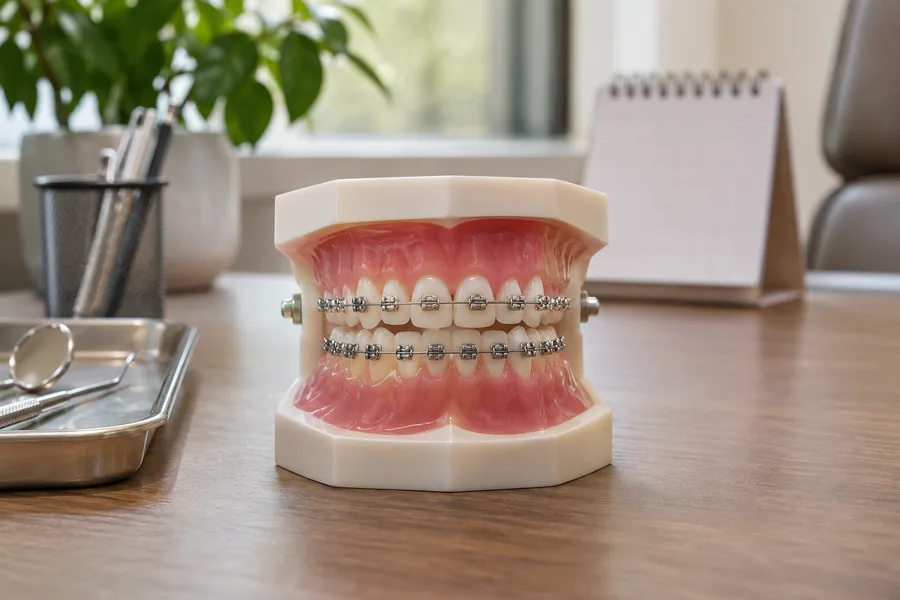
Comprehensive treatment with fixed braces takes a little under two years on average. A 2016 systematic review of clinical trials put the mean at 19.9 months. Your own timeline depends on the problem being treated, whether teeth need to be removed and several other factors, so only your orthodontist can estimate it after an exam.
The average course of treatment
The 2016 review, published in the American Journal of Orthodontics and Dentofacial Orthopedics, pooled 22 studies with 1,089 participants. The average treatment time was 19.9 months, and adding three more studies barely changed the figure, at 20.0 months. Five studies reported the number of visits, which averaged about 18. The authors noted that their data came from prospective studies run in university settings.
The first stage, lining up the teeth, has been measured separately. A 2022 meta-analysis included 35 trials. Pooling the trials that measured it, full alignment of the lower teeth took about 263 days on average (4 trials), and alignment of the lower front teeth about 101 days (9 trials). Individual patient data from two or three of the trials showed that aligning the whole lower arch took about 14 days longer for each additional year of age and about 18 days longer for each extra millimeter of irregularity.
What makes treatment longer
A 2008 systematic review in the European Journal of Orthodontics looked at 41 studies on treatment time. Its main conclusions:
| Factor | What the research found |
|---|---|
| Removing teeth to make space | Indications that treatment with extractions lasts longer than without |
| Age, once all permanent teeth are in | Does not seem to play a role |
| Starting early for protruding upper teeth | The earlier treatment begins, the longer the total time |
| Severity of the original problem | Plays a role, along with technique and the skill and number of clinicians involved |
| Patient cooperation | Plays a role |
| Impacted upper canines | Appear to prolong treatment |
| Combined orthodontics and jaw surgery | Duration varies and depends on the treating team |
A 2020 meta-analysis compared adults with adolescents. Across 7 studies, it found no significant difference in total treatment time with fixed braces. One study found that bringing a canine displaced toward the roof of the mouth into line took about 3.8 months longer in adults. The authors rated the evidence as low in quality.
How bracket designs, and aligners compared with braces, affect treatment time is covered in types of braces and clear aligners vs braces.
Can treatment be sped up?
Several add-on methods are offered to shorten treatment. Cochrane reviews have looked at both non-surgical and surgical options.
Vibration, lasers and light
A 2023 Cochrane review included 23 randomized trials with 1,027 children and adults, none rated at low risk of bias.
- Light vibration devices showed no evidence of a difference in overall treatment time or in the number of adjustment visits, in two studies with 77 participants in total. There was also no evidence of a difference in how fast teeth lined up or how fast gaps closed.
- Low-level laser therapy shortened the early alignment stage by about 50 days in two studies, and was linked with fewer appointments. Effects in later stages were small and judged not clinically significant.
- Light-emitting diode treatment shortened alignment of the lower teeth by about 25 days in one study.
The reviewers concluded that the evidence, of low to very low certainty, suggests no added benefit from vibration or light therapy for reducing the overall length of orthodontic treatment.
Minor surgery to the bone
Some clinicians offer procedures on the bone around the teeth, such as corticotomy, to speed up movement. A 2015 Cochrane review found four randomized trials with only 57 participants. Teeth moved slightly faster with surgery over one and three months, but no trial measured total treatment time, and none reported data on side effects. The 2022 alignment meta-analysis also found that surgically assisted treatment shortened alignment of the lower front teeth by about 44 days. Whether that translates into a shorter course overall has not been shown.
What you can influence
The 2008 review lists patient cooperation among the factors that affect treatment time. Things that are within your control include:
- keeping scheduled appointments
- wearing elastics, aligners or other appliances as instructed
- following your orthodontist’s advice on caring for your braces
- asking your orthodontist early if something feels wrong or comes loose
It also helps to ask at the start what your estimated treatment time is, what could extend it and how often you will be seen. Treatment time for adults is discussed further in orthodontics for adults.
Active treatment is only part of the commitment. Once braces or aligners come off, a retainer phase follows, as explained in retainers and relapse. Other guides are in the orthodontics section.
Frequently asked questions
Does treatment take longer for adults?
A 2020 meta-analysis found no significant difference in overall treatment time between adults and adolescents, although the evidence was low in quality. Bringing a displaced canine into place took longer in adults in one study.
Do vibration devices make braces faster?
A 2023 Cochrane review found no evidence that light vibration shortens overall treatment time or reduces the number of visits.
Sources
- How long does treatment with fixed orthodontic appliances last? A systematic review. American Journal of Orthodontics and Dentofacial Orthopedics, 2016
- Duration of tooth alignment with fixed appliances: A systematic review and meta-analysis. American Journal of Orthodontics and Dentofacial Orthopedics, 2022
- Factors affecting the duration of orthodontic treatment: a systematic review. European Journal of Orthodontics, 2008
- Duration of orthodontic treatment with fixed appliances in adolescents and adults: a systematic review with meta-analysis. Progress in Orthodontics, 2020
- Non-surgical adjunctive interventions for accelerating tooth movement in patients undergoing orthodontic treatment. Cochrane Database of Systematic Reviews, 2023
- Surgical adjunctive procedures for accelerating orthodontic treatment. Cochrane Database of Systematic Reviews, 2015
- Types of Braces: Metal, Ceramic, Lingual and Self-Ligating
How metal, ceramic, lingual and self-ligating braces differ, and what systematic reviews show about speed, comfort and hygiene: few differences hold up. - How to Clean Your Teeth With Braces: A Daily Routine
A step-by-step cleaning routine for braces based on AAO guidance, what to eat and drink, and what trials show about electric brushes and fluoride. - Clear Aligners vs Braces: What the Research Shows
Reviews find braces give a more precise bite on average, most clearly when teeth are extracted, with closer results otherwise. Why DIY aligners are risky. - Early Orthodontic Treatment for Children: When It Helps
What Cochrane reviews show about two-phase treatment for protruding teeth, underbites, crossbites and thumb sucking, and why it is not right for every child. - Types of Malocclusion: Bite Problems and How Common They Are
Class I, II and III bites, crossbite, open bite, deep bite and crowding explained, with prevalence figures from a US survey and a review of 53 studies. - Risks of Orthodontic Treatment: Enamel, Roots, Gums and Pain
White spots on enamel, root shortening, small gum changes and soreness are the main side effects of braces. How common they are and what lowers the risk.