Orthodontics · Clear aligners
Clear Aligners vs Braces: What the Research Shows
This article is for general information and does not replace advice from a doctor. Medical disclaimer
- Goal which tooth movements are needed
- Routine care, wear and follow-up visits
- Outcome how the bite will be checked after treatment
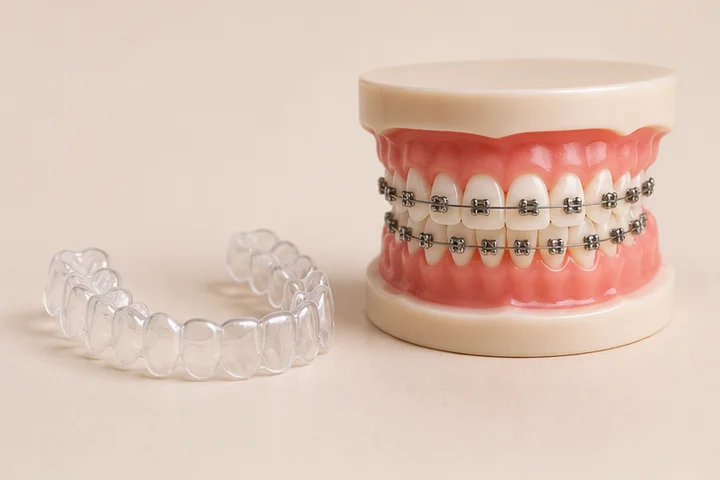
Clear aligners A thin, removable plastic tray worn over the teeth. A series of them moves the teeth in small, planned steps. and fixed braces can both straighten teeth. Systematic reviews suggest braces produce a more precise final bite on average, with the clearest gap in cases where teeth are removed to make space. In cases treated without extractions, a 2025 review found no significant difference in quality or treatment time. The evidence has limits: the 2020 review mostly involved adults, and the reviews point to risk of bias, mixed study designs and short follow-up.
How the two approaches differ
Aligners are a series of custom-made, removable plastic trays that move teeth step by step. The FDA classes them as prescription devices, safe to use only under the supervision of a licensed practitioner. Braces are brackets and wires fixed to the teeth for the whole course of treatment.
The American Association of Orthodontists (AAO) sets out the practical differences:
- Aligners typically need to be worn for at least 22 hours a day, in the correct sequence. They come out for eating, brushing and flossing.
- Soft drinks, flavored waters and sports drinks should not be drunk with aligners in.
- Tooth-colored attachments are often bonded to the teeth to help the trays guide them.
- Teeth are easier to clean with aligners, but they have to be spotless before the trays go back in. Braces need careful brushing and flossing around brackets and wires.
- Aligners can be lost or damaged because they are removable.
The AAO’s summary is that most orthodontic problems can be treated with braces, aligners work for many problems but suitability depends on the case, and one appliance is not inherently better than the other.
What systematic reviews found
Overall quality of the result
A 2020 review in the European Journal of Orthodontics included 11 studies with 887 patients, average age 28. Moderate-quality evidence showed a worse finished bite with aligners on the American Board of Orthodontics grading system, and more patients with results rated unacceptable. The authors concluded that current evidence does not show aligners to be as effective as braces in adults.
A 2025 review of 15 trials with 1,084 patients reached a more nuanced result. In non-extraction cases it found no significant difference in treatment quality. In extraction cases, braces gave better results, which the authors put down to better control of tooth movement. They concluded that both methods can achieve treatment goals and that case complexity and patient compliance should guide the choice.
Specific tooth movements
A 2019 review of 8 studies in BMC Oral Health found that both methods corrected malocclusion. Braces were better at producing good contacts between upper and lower teeth, at controlling the inward or outward tilt of the teeth, known as torque, and at widening the dental arch. The authors saw an advantage for aligners in moving teeth in small segments.
Treatment time
Findings vary. The 2020 review found no significant difference in treatment time. The 2019 review pooled three non-extraction studies and found aligner treatment was about six months shorter. The 2025 review found no significant difference in non-extraction cases, although some sensitivity analyses pointed to shorter treatment with aligners.
Stability after treatment
Evidence on how well results hold is thin. The 2025 review found limited evidence of similar stability. One study in the 2019 review found more relapse of alignment after aligner treatment.
| Outcome | What the reviews found | Strength of evidence |
|---|---|---|
| Final bite quality, all cases | Worse with aligners on a standard grading scale | Moderate (2020 review) |
| Non-extraction cases | No significant difference in quality or time | Risk of bias varied across studies (2025 review) |
| Extraction cases | Better results with braces | Limited by heterogeneity and short follow-up (2025 review) |
| Tooth tilt, bite contacts, arch widening | Better with braces | Based on a few small studies (2019 review) |
| Treatment time | No difference to about six months shorter with aligners | Inconsistent across reviews |
| Stability | Similar or slightly more relapse with aligners | Limited |
These reviews compared groups of patients. They cannot tell you which method suits your own bite; that takes an exam by an orthodontist.
Mail-order and do-it-yourself aligners
The FDA says it has not authorized clear aligners sold directly to consumers without a prescription, and that using them without proper professional supervision may increase the risk of complications. It has received reports of new or worsening tooth pain, jaw pain, bite problems, worsening misalignment and new gaps between teeth. It says in-person visits help lower the risk of an uneven bite, unintended tooth movement, pain and tooth loss, and among the general risks of aligners it notes that crowns, fillings and implants may loosen or come off.
The FDA advises getting an evaluation from a dentist or orthodontist, preferably in person, before starting, and reporting serious problems through its MedWatch program. The AAO points out that mail-order companies often provide no X-rays, thorough exam or in-person supervision, and it strongly discourages this route because of the risk of irreversible damage, including loss of teeth and gum tissue and a changed bite.
Questions to ask your orthodontist
- Is my case suitable for aligners, or would braces control the movements I need better?
- Will I need teeth removed, and how does that affect the choice?
- How many hours a day will I need to wear aligners, and what happens if I fall behind?
- How will progress be checked, and how often in person?
- What is the plan if my teeth do not move as expected?
Braces themselves come in several designs, compared in types of braces. Expected timelines are covered in how long orthodontic treatment takes. Holding the result afterward is explained in retainers and relapse. More guides are in the orthodontics section.
Frequently asked questions
Are aligners faster than braces?
Not reliably. A 2020 meta-analysis found no significant difference in treatment time. A 2025 review found none in non-extraction cases, although some of its sensitivity analyses suggested aligners were quicker.
Are mail-order aligners approved by the FDA?
The FDA says it has not authorized clear aligners sold directly to consumers without a prescription. Aligners are prescription devices meant to be used under the supervision of a licensed dentist or orthodontist.
Sources
- Treatment outcome with orthodontic aligners and fixed appliances: a systematic review with meta-analyses. European Journal of Orthodontics, 2020
- A comparison of treatment effectiveness between clear aligner and fixed appliance therapies. BMC Oral Health, 2019
- Quality and stability of orthodontic treatment outcomes with clear aligners versus fixed appliances: a systematic review and meta-analysis. European Journal of Orthodontics, 2025
- Aligners vs. Braces: A Comparison. American Association of Orthodontists
- Clear Dental Aligners. U.S. Food and Drug Administration, 2026
- At-Home Orthodontics: Cons and Considerations. American Association of Orthodontists
- How to Clean Your Teeth With Braces: A Daily Routine
A step-by-step cleaning routine for braces based on AAO guidance, what to eat and drink, and what trials show about electric brushes and fluoride. - Early Orthodontic Treatment for Children: When It Helps
What Cochrane reviews show about two-phase treatment for protruding teeth, underbites, crossbites and thumb sucking, and why it is not right for every child. - How Long Does Orthodontic Treatment Take? What Studies Show
Treatment with braces averaged about 20 months in clinical trials. What makes it longer, and whether vibration, lasers or minor surgery really speed it up. - Types of Malocclusion: Bite Problems and How Common They Are
Class I, II and III bites, crossbite, open bite, deep bite and crowding explained, with prevalence figures from a US survey and a review of 53 studies. - Risks of Orthodontic Treatment: Enamel, Roots, Gums and Pain
White spots on enamel, root shortening, small gum changes and soreness are the main side effects of braces. How common they are and what lowers the risk. - Orthodontics for Adults: Gum Health, Timing and Options
The AAO says one in three orthodontic patients is an adult. How adult treatment differs: gum health, treatment time, aligners versus braces and retainers.