Orthodontics · Basics
Palatal expanders for children: what to expect
This article is for general information and does not replace advice from a doctor. Medical disclaimer
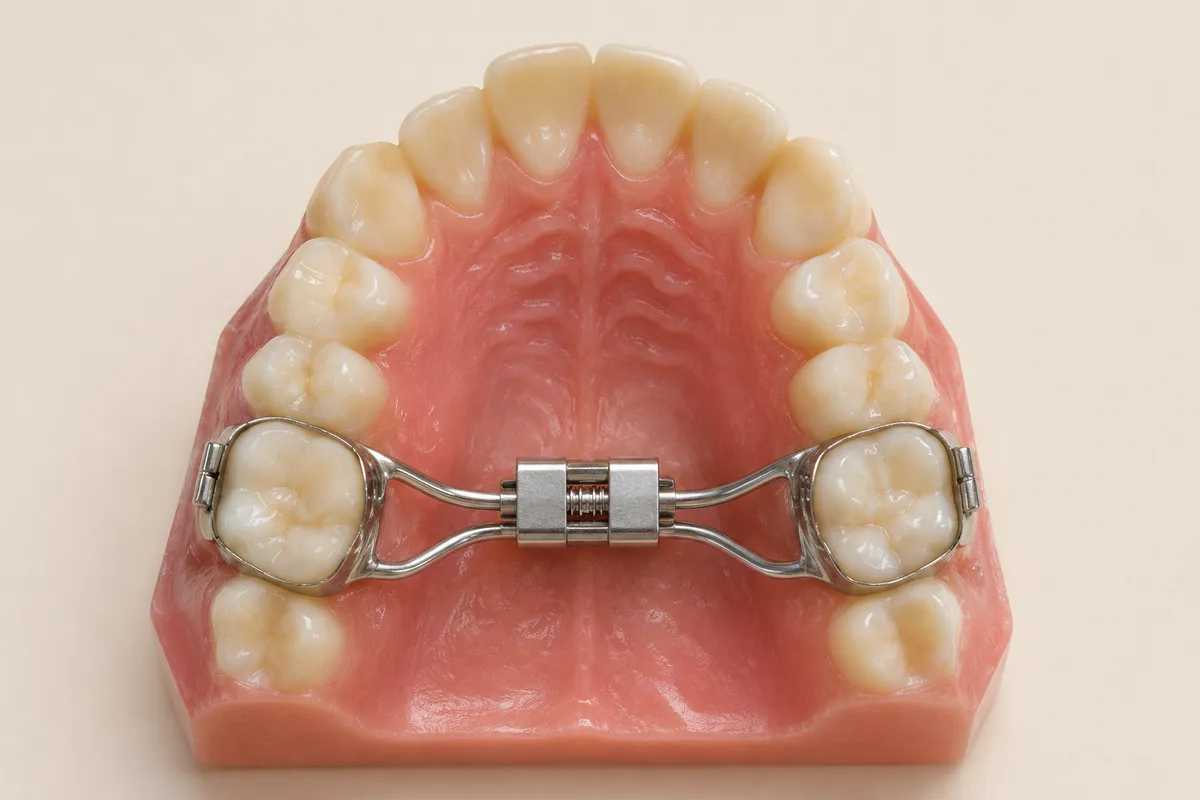
A palatal expander widens the upper arch when it is too narrow in relation to the lower arch. A posterior crossbite can be one sign. In this bite, some upper back teeth sit inside the lower teeth as the mouth closes. Crowding in a photo alone does not establish whether an expander would help.
What the orthodontist checks
The examination looks at how the teeth fit and whether the lower jaw shifts sideways as the child closes. The clinician considers whether a narrow upper jaw, the tilt of the teeth, or both explain the bite. Growth and development affect how a given appliance works. An expander used in a growing child differs from approaches an adult might be offered.
Early days with the appliance
A fixed appliance takes up space near the roof of the mouth. Speech or swallowing may feel different at first. With rapid expansion, a gap can appear between the upper front teeth. Before leaving the fitting appointment, find out what the office expects in your child’s case and who to call if the appliance loosens or hurts.
The stage after widening
The appliance may stay in place to hold the change after active expansion ends. Ask how the team will check width and stability and whether another stage is planned to align individual teeth. To understand where expansion fits in a child’s care, read about early orthodontic treatment.
Frequently asked questions
Does every child with crowded teeth need an expander?
No. The orthodontist has to check whether the upper jaw is narrow and what is causing the crowding.
Does an expander replace braces?
The appliances address different goals. Expansion changes width. A separate stage may be needed to position individual teeth.
Sources
- What Is a Palatal Expander?. American Association of Orthodontists
- Rapid Maxillary Expansion (RME). British Orthodontic Society
- Interproximal reduction: how orthodontists make space
What enamel reduction between teeth means, how it differs from separators, and what to ask before agreeing to it. - Tooth extractions for braces: how the decision is made
Why an orthodontist may suggest premolar extraction, and what to ask when comparing an extraction plan with other options. - Wisdom teeth before braces: when removal is considered
How third molars are assessed, what the evidence says about crowding, and what to ask about timing. - Early Orthodontic Treatment for Children: When It Helps
What Cochrane reviews show about two-phase treatment for protruding teeth, underbites, crossbites and thumb sucking, and why it is not right for every child. - Types of Malocclusion: Bite Problems and How Common They Are
Class I, II and III bites, crossbite, open bite, deep bite and crowding explained, with prevalence figures from a US survey and a review of 53 studies. - Orthodontics for Adults: Gum Health, Timing and Options
The AAO says one in three orthodontic patients is an adult. How adult treatment differs: gum health, treatment time, aligners versus braces and retainers.