Orthoptics · Eye checks
Vision Screening for Children: What US Guidelines Recommend
This article is for general information and does not replace advice from a doctor. Medical disclaimer
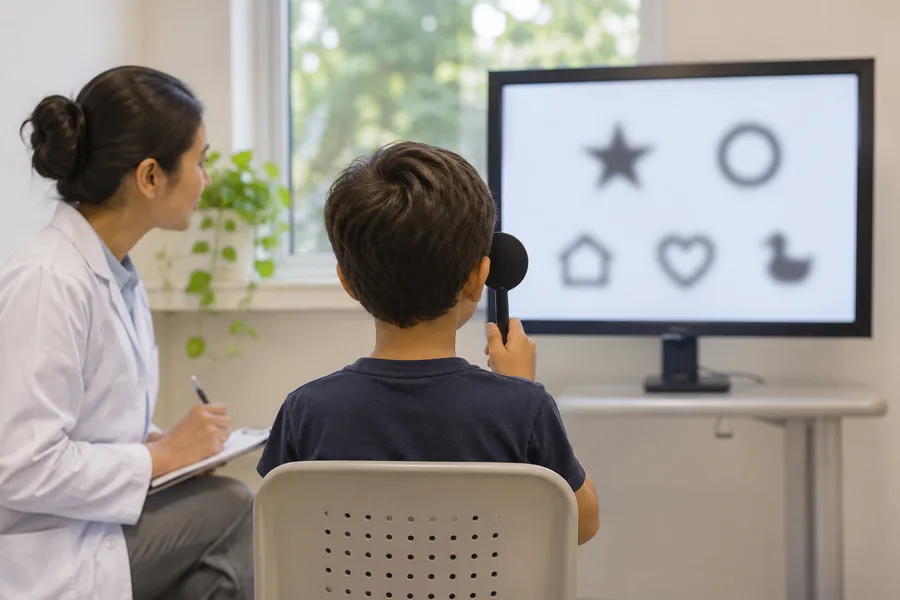
Vision screening is a quick check that picks out children who need a full eye exam. Its main target in young children is amblyopia Reduced vision in one eye that develops in childhood because the brain favors the other eye. Often called lazy eye. and the conditions that cause it, so they can be found and treated early. The U.S. Preventive Services Task Force (USPSTF) recommends screening at least once between ages 3 and 5, and pediatric and eye care groups advise checks from birth onward.
Why preschool children are screened
Amblyopia does not always cause signs that parents can see. The American Academy of Ophthalmology (AAO) guideline on pediatric eye evaluations notes that children with amblyopia may seem to see normally until they are formally tested, and that the earlier it is found and treated, the better the chance of recovering vision.
According to the USPSTF, the prevalence of amblyopia, strabismus (an eye turn) and anisometropia (a large difference in prescription between the eyes) ranges from 1% to 6% among US children younger than 6. The Task Force lists other factors linked to amblyopia, strabismus or focusing errors: a family history in a parent or sibling, premature birth, low birth weight, maternal substance use or smoking during pregnancy and low parental education.
What the guidelines say
| Organization | Ages covered | Recommendation |
|---|---|---|
| USPSTF (2017) | 3 to 5 years | Screen at least once (grade B) |
| USPSTF (2017) | Under 3 years | Evidence insufficient to assess the balance of benefits and harms (I statement) |
| AAP with AAO, AAPOS and AACO (2016) | Newborn to childhood | Inspection and red reflex test in newborns; instrument-based screening first attempted between 12 months and 3 years and then at yearly well-child visits until acuity can be tested; direct acuity testing can often begin by age 4 |
| AAO guideline (2023) | Newborn to adolescence | Age-matched tests at each stage, then screening every 1 to 2 years after age 5 |
| UK National Screening Committee (2019 review, UK only) | 4 to 5 years | In the UK, offer screening to all children, in a service organized and led by orthoptists |
The USPSTF is updating its 2017 recommendation. It posted a final research plan in July 2025, which sets out questions on whether screening improves vision, school performance and quality of life, how accurate the tests are and what harms screening and treatment cause.
What the tests involve
The AAO guideline lists different checks by age:
- red reflex test, looking for a reflex that is absent, white, dull or uneven between the eyes
- inspection of the eyes and lids, for example for a drooping eyelid
- pupil check
- whether a baby fixes on and follows a target, and the corneal light reflex, from about 3 months
- instrument-based screening with a photoscreener or autorefractor, from about 6 months
- the cover test, in which the examiner watches whether the uncovered eye moves to refixate
- a vision chart for each eye, using LEA Symbols or HOTV letters for young children and Sloan letters for older ones
Instrument-based devices detect risk factors for amblyopia, such as strabismus, high or unequal focusing errors and cataract. They do not measure how well a child sees, and their readings should not be converted into a visual acuity. The guideline says many 3-year-olds can take part in chart testing, accurate testing of each eye is more successful at 4, and after age 4 chart testing is the preferred method.
What a result means, and what it does not
A screening only sorts children into “probably fine” and “needs a full exam”. The AAO guideline advises referral for a comprehensive eye exam after the first failed acuity screening. Preschool children who cannot complete the test are at least twice as likely to have a vision disorder as testable children who pass, so they should be rescreened within 6 months or referred.
The guideline’s screening table gives two cut-offs for chart testing: vision worse than 20/50 in either eye, listed from age 3, and worse than 20/40 in either eye, listed from age 4. A difference of two lines between the eyes is also a reason to refer.
Screening has costs too. The USPSTF found that false-positive rates were usually above 75% in groups where fewer than 10% of children had a vision problem, and noted that false positives can lead to overdiagnosis or unneeded treatment.
Passing a screening does not end the need for checks. Problems can appear later, so screening should continue through childhood and adolescence. A full eye exam is advised even after a pass if a child has vision complaints, unusual visual behavior or a higher risk, for example with Down syndrome, prematurity, juvenile idiopathic arthritis or neurofibromatosis, or a family history of amblyopia, strabismus, retinoblastoma, congenital cataract or congenital glaucoma.
Why follow-up often falls through
According to the AAO guideline, almost 40% of children in the US have never had a vision screening. Among 15 US screening programs, more than 70% of referred children got a follow-up exam in four programs, but fewer than half did in the other 11. The AAP advises that a child who fails a vision assessment or has an eye abnormality be referred to a pediatric ophthalmologist or another eye care specialist trained to treat children. For who does what at that visit, see what an orthoptist does.
Signs worth an earlier check
The AAO guideline points to findings that deserve a doctor’s attention. If you notice one, contact your pediatrician promptly rather than waiting for the next scheduled screening:
- a red reflex that is absent, white, dull or uneven between the eyes, which its screening table lists as a reason for referral
- an uneven corneal light reflex, also a referral finding, or eyes that are not aligned by 6 months of age, when alignment should be normal
- poor eye contact with a caregiver after 8 weeks of age, which may warrant further assessment
You can read more about eye turns in types of strabismus. If amblyopia is found, treatment usually starts with glasses and may include patching. For nearsightedness in children, see the related article listed below, and for an overview of the field, the orthoptics section.
Frequently asked questions
At what age should a child have a vision screening?
The USPSTF recommends at least one screening between ages 3 and 5. The AAP and eye care groups also advise eye checks from the newborn period, instrument-based screening from about 12 months and regular screening through childhood.
Is a vision screening the same as an eye exam?
No. Screening is a short test to find children who need a comprehensive eye exam. A child who fails, cannot be tested, has symptoms or has risk factors should be referred for a full exam.
My child passed a screening. Can I skip later checks?
No. Eye problems can appear at different ages, so the AAO guideline advises periodic screening throughout childhood and adolescence.
Sources
- Vision in Children Ages 6 Months to 5 Years: Screening. U.S. Preventive Services Task Force, 2017
- Final Research Plan: Vision in Children Ages 6 Months to 5 Years: Screening. U.S. Preventive Services Task Force, 2025
- Visual System Assessment in Infants, Children, and Young Adults by Pediatricians. Pediatrics (American Academy of Pediatrics), 2016
- Pediatric Eye Evaluations Preferred Practice Pattern. Ophthalmology (American Academy of Ophthalmology), 2023
- Vision defects. UK National Screening Committee, 2019
Related topics
- Orthokeratology Myopia in Children: Causes, Risk Factors and Outlook
- What Does an Orthoptist Do? Training, Tests and Who They See
Orthoptists assess and treat eye alignment, eye movement and two-eye vision problems such as amblyopia, strabismus and double vision, working with eye doctors. - Accommodative Esotropia: Why Farsighted Children's Eyes Cross
Accommodative esotropia links eye crossing to farsightedness. Glasses are the main treatment; some children need bifocals, and a minority need surgery. - Atropine Eye Drops for Amblyopia: What the Research Shows
In PEDIG trials, atropine drops in the stronger eye improved amblyopia about as much as patching, including weekend use. Side effects and who it may suit. - Binocular and Digital Amblyopia Treatment: What the Trials Show
Dichoptic games and videos for lazy eye: an iPad game fell short of patching, while two FDA-authorized devices showed gains over 12 to 16 weeks. - Convergence Insufficiency: Symptoms and What the CITT Trials Found
Convergence insufficiency causes eye strain and double vision up close. In trials, office-based therapy beat home push-ups but not placebo for reading scores. - Patching for Amblyopia: What Trials Show About Glasses and Hours
Glasses come first. In PEDIG trials, 2 hours of daily patching matched 6 for moderate amblyopia, and 6 matched full-time patching for severe amblyopia.