Orthopedics · Braces and supports
Back Support Belts: Do They Prevent or Treat Low Back Pain?
This article is for general information and does not replace advice from a doctor. Medical disclaimer
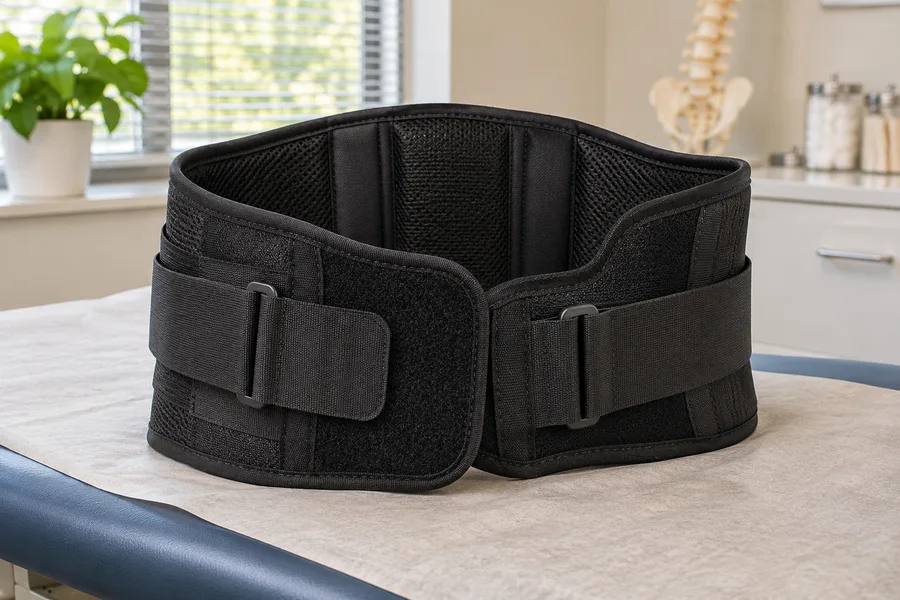
Back support belts became common in workplaces where people lift for a living, but the research does not show that they prevent back injuries. The National Institute for Occupational Safety and Health (NIOSH) does not recommend them for workers who have never been injured. A 2008 Cochrane review found moderate evidence that lumbar supports are no better than no intervention or training at preventing low back pain. For people who already have chronic low back pain, a 2026 Cochrane review found too little evidence to support their routine use.
What NIOSH concluded
NIOSH set up a working group to review the published research on back belts, mostly laboratory studies of lifting. Its 1994 report found:
- not enough data to show that typical industrial back belts significantly reduce the load on the trunk during manual lifting
- no study giving conclusive evidence that belts reduce trunk muscle forces or compression on the spine
- that long-term use might weaken abdominal muscle tone, which could raise the risk of injury once a worker stops wearing the belt
- that workers may lift heavier loads while wearing a belt
A later NIOSH leaflet added that a false sense of security may expose workers to greater risk. NIOSH’s position is that the most effective way to prevent back injury is to redesign the work environment and work tasks, alongside training workers to recognize lifting hazards and use safe techniques. NIOSH did not address back belts used as medical treatment during recovery from an injury.
The large studies
| Study | Who was studied | Finding |
|---|---|---|
| NIOSH cohort study, JAMA 2000 | 13,873 material-handling employees in 160 new retail stores in 30 US states; 89 stores required belts and 71 left them voluntary | Neither frequent belt use nor a store policy requiring belts was linked to fewer back injury claims or less self-reported back pain |
| Cochrane review, 2008 | 7 prevention studies with 14,437 people and 8 treatment studies with 1,361 people | Moderate evidence that lumbar supports are no more effective than no intervention or training for prevention; conflicting evidence on whether they add anything to other prevention measures; unclear whether they help treat back pain |
| Cochrane review, 2026 | 8 randomized trials with 501 adults who had chronic low back pain for at least a year | Supports alone may make little or no difference to pain or disability; added to anti-inflammatory drugs, they may slightly reduce pain over three to four weeks; certainty of evidence low or very low |
The JAMA study, run by NIOSH researchers, was described as the largest prospective cohort study of back belt use. Its median follow-up was six and a half months, and the analysis was adjusted for individual risk factors. The 2008 Cochrane reviewers rated the overall quality of the trials as rather low and said future trials need to make sure people actually wear the supports.
Belts for back pain you already have
Here the evidence is thin. The 2008 Cochrane review concluded that it remained unclear whether lumbar supports work better than no treatment or other treatments for low back pain.
A 2026 Cochrane review looked only at chronic low back pain and found eight trials, all of lumbar supports. In the one trial that compared a support with no intervention, it may have made little or no difference to pain or disability at three months. Added to anti-inflammatory painkillers, it may slightly reduce pain in the short term, but the effect on disability is very uncertain. None of the trials reported on side effects, so possible harms remain unknown. The reviewers concluded that there is not enough evidence to support routine use of lumbar supports for chronic low back pain. NIOSH did not address belts used as treatment.
That leaves the decision to you and your clinician. If a support makes a specific task more comfortable after an injury, it is worth asking a doctor or physical therapist whether it fits into your recovery plan and for how long.
What guidelines recommend instead
The American College of Physicians (ACP) 2017 guideline points out that most people with acute or subacute low back pain improve over time regardless of treatment. For that stage it recommends starting with non-drug options:
- superficial heat, supported by moderate-quality evidence
- massage, acupuncture or spinal manipulation, supported by low-quality evidence
For chronic low back pain, ACP recommends starting with non-drug treatments such as exercise, multidisciplinary rehabilitation, acupuncture, mindfulness-based stress reduction, tai chi, yoga, motor control exercise, progressive relaxation, cognitive behavioral therapy or spinal manipulation. Back belts are not among the recommended treatments.
The NHS adds practical advice: stay active, try to continue your daily activities and do not stay in bed for long periods. Walking, swimming, yoga and pilates may also help. A bed that suits your back is a separate question, covered in choosing a mattress for back pain.
When back pain needs urgent care
The NHS lists symptoms that need emergency care. In the US, that means calling 911 or going to an emergency room if you have back pain with:
- pain, tingling, weakness or numbness in both legs
- loss of feeling around the genitals or anus
- changes in bladder or bowel control, such as difficulty peeing or not being able to control it
- changes in sensation or function during sex
- chest pain
- pain that started after a serious accident, such as a car crash
Get urgent medical advice if you feel hot, cold, shivery or generally unwell, or if severe pain starts suddenly or gets worse quickly. See a doctor if the pain does not improve after a few weeks, stops your daily activities, is worse at night, comes with unexplained weight loss, or if there is a lump or change in the shape of your back.
The same pattern of mixed or weak evidence comes up with other supports; compare knee braces for osteoarthritis, or browse the orthopedics section.
Frequently asked questions
Does wearing a back belt at work prevent injury?
There is no good evidence that it does. NIOSH does not recommend back belts to prevent injuries in workers who have never been injured, and a study of 13,873 retail workers found no drop in back injury claims or back pain with belt use.
Can a lumbar support help if my back already hurts?
The evidence is weak. A 2026 Cochrane review of eight trials in chronic low back pain found that supports used on their own may make little or no difference to pain or disability, and concluded that there is not enough evidence to support their routine use.
What does help acute low back pain?
The American College of Physicians notes that most acute back pain improves over time regardless of treatment, and recommends options such as superficial heat, massage, acupuncture or spinal manipulation. The NHS advises staying active.
Sources
- Workplace Use of Back Belts: Review and Recommendations. National Institute for Occupational Safety and Health (NIOSH), 1994
- Back Belts: Do They Prevent Injury?. National Institute for Occupational Safety and Health (NIOSH), 1996
- A prospective study of back belts for prevention of back pain and injury. JAMA, 2000
- Lumbar supports for prevention and treatment of low back pain. Cochrane Database of Systematic Reviews, 2008
- Assistive technologies (lumbar supports and other devices) for treating chronic low back pain. Cochrane Database of Systematic Reviews, 2026
- Noninvasive Treatments for Acute, Subacute, and Chronic Low Back Pain: A Clinical Practice Guideline From the American College of Physicians. Annals of Internal Medicine, 2017
- Back pain. NHS
- Abdominal binders after surgery: fit and questions to ask
Learn what evidence says about postoperative binders, how to compare width and closure, and what to ask your surgical team about fit. - Compression stockings: types, sizing and fit
Compare knee-high, thigh-high and waist-high compression garments. Check pressure labelling, measurements and fitting questions. - Ankle Braces After a Sprain: Recovery and Preventing Repeats
For most ankle sprains, guidelines favor early movement, exercise and a brace or tape, and bracing has strong evidence for preventing repeat sprains. - Knee Braces for Osteoarthritis: What Guidelines Recommend
US guidelines support knee braces for some people with knee osteoarthritis, but trial results are mixed. Which brace suits which problem and what comes first. - Beginner yoga at home: choosing your first poses
Try mountain pose at home, choose between a chair and a mat, and learn what to look for in a beginner yoga class before you press play. - Chair yoga for beginners: three poses you can try seated
Set up a stable chair and explore seated mountain, a small seated cat movement and a side bend, with ways to adjust the range.