Orthopedics · Braces and supports
Ankle Braces After a Sprain: Recovery and Preventing Repeats
This article is for general information and does not replace advice from a doctor. Medical disclaimer
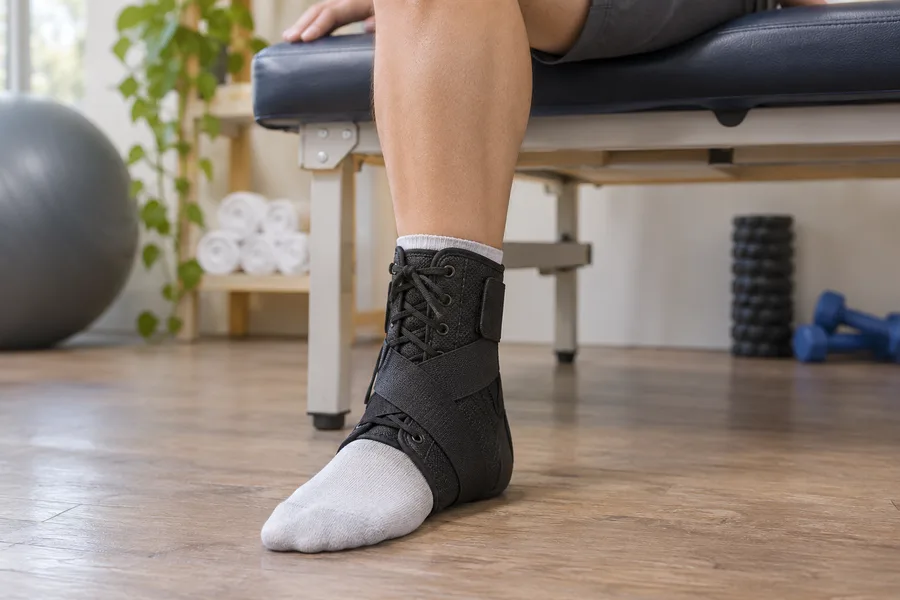
For most ankle sprains, the evidence favors early movement, an exercise program and support from tape or a brace. A 2018 clinical guideline in the British Journal of Sports Medicine found that a short period of immobilization may ease pain and swelling, but people with a torn ankle ligament benefit most from tape or a brace combined with exercise. Braces also reduce the chance of spraining the ankle again.
First, find out how bad the sprain is
Ankle sprains range from a mild stretch to a complete ligament tear. The American Academy of Orthopaedic Surgeons (AAOS) describes three grades:
| Grade | What happens to the ligament | Typical signs | Early support AAOS describes |
|---|---|---|---|
| 1 | Slight stretching and microscopic tearing | Mild tenderness and swelling, usually no pain bearing weight | No specific brace named; general home care with rest, ice, compression and elevation |
| 2 | Partial tear | Moderate swelling, mild pain bearing weight, slight looseness | A removable plastic support such as a walking boot or brace |
| 3 | Complete tear | Significant swelling, severe pain bearing weight, clear instability | Possibly a short leg cast or cast-brace for 10 to 14 days |
The 2018 guideline notes that the severity of ligament damage is judged most reliably by a physical exam 4 to 5 days after the injury. AAOS warns that the symptoms of a severe sprain are similar to those of a broken bone and need prompt medical evaluation.
What trials found about braces, tape and casts
An overview of 46 systematic reviews, published in 2017, found strong evidence for early mobilization after an acute sprain and moderate evidence for exercise and manual therapy, for pain, swelling and function.
For severe sprains, a UK trial published in The Lancet in 2009 compared four types of support in 584 people treated in emergency departments: a 10-day below-knee cast, a brace, a protective boot and a double-layer tubular compression bandage. At 3 months, ankle function was 9% better with the cast and 8% better with the brace than with the bandage. The boot gave no benefit over the bandage, which was the least effective option. By 9 months, there were no significant differences between the bandage and the other treatments. The authors concluded that a short period in a below-knee cast or a brace leads to faster recovery than a compression bandage alone.
The 2018 guideline sums up the picture: supervised exercise-based programs are preferred over passive treatments because they help the ankle regain stable function, and surgery is kept for cases that do not respond to thorough exercise-based treatment.
Getting back to activity
AAOS describes recovery in three phases. The first is a short period of immobilization, rest and ice, usually with early weight-bearing as tolerated. The second starts early and adds range-of-motion, strengthening and balance exercises. The third adds more advanced exercises and a gradual return to activity, starting with movements that do not twist the ankle and moving on later to sports with sharp turns. AAOS notes that taping or bracing may be needed for an early return to sport or work. Points from the sources:
- AAOS says it is important to end immobilization during the second phase to avoid stiffness.
- Recovery can take about 2 weeks for a minor sprain and 6 to 12 weeks for a more severe injury, according to AAOS.
- The NHS says most sprains feel better after 2 weeks, while severe ones can take months.
- AAOS names incomplete rehabilitation as the most common cause of chronic ankle instability after a sprain.
- Pain that continues for more than 4 to 6 weeks may mean a chronic sprain, and AAOS advises evaluation if swelling or pain lasts for several weeks.
Bracing to prevent another sprain
This is where braces have the clearest evidence. The 2017 overview found strong evidence for bracing and moderate evidence for neuromuscular training in preventing a repeat sprain. The 2018 guideline recommends considering ankle braces as an effective option to prevent recurrent sprains.
A randomized trial assigned 1,460 high school basketball players from 46 schools to wear lace-up ankle braces or not during a season. Acute ankle injuries occurred at a rate of 0.47 per 1,000 exposures in the braced group and 1.41 in the control group. The braces worked for players with and without a previous ankle injury. They did not make injuries less severe: the median time lost was 6 days with a brace and 7 without.
That trial studied teenage basketball players, so the numbers may not carry over to every sport or age group. A clinician or athletic trainer can help decide whether a brace makes sense for your activity and for how long.
When to get checked
The NHS lists signs that a bone may be broken and that need emergency care. In the US, that means calling 911 or going to an emergency room if:
- you heard a crack when the injury happened
- the foot or ankle has changed shape or is pointing at an odd angle
- the foot or ankle is numb, tingling or has pins and needles
- the skin around the injury has turned blue or grey or is cold to the touch
The NHS advises getting urgent advice if:
- the pain is severe or getting worse
- there is a lot of swelling or bruising, or it is getting worse
- you cannot put any weight on the foot or walk more than a few steps
- the ankle feels very stiff or is hard to move
- you also have a very high temperature or feel hot, cold or shivery, which could be a sign of infection
See a doctor if the sprain is getting worse or not feeling better after treating it yourself.
For a child or teenager, the guide to flat feet in children covers foot problems that need a doctor’s check. For bracing of other joints, see knee braces for osteoarthritis or the orthopedics section.
Frequently asked questions
Should I wear a brace or keep my sprained ankle still?
For most sprains, a short period of protection followed by a brace or tape and an exercise program is the approach the 2018 clinical guideline supports. Severe sprains may need a cast or more rigid support for a short time, which a clinician decides after an exam.
Does wearing an ankle brace prevent another sprain?
The evidence says yes. A 2017 overview of systematic reviews rated the evidence for bracing to prevent repeat sprains as strong, and in a trial of 1,460 high school basketball players, lace-up braces cut the rate of acute ankle injuries by about two thirds.
How long does a sprained ankle take to heal?
According to AAOS, recovery can take about 2 weeks for a minor sprain and 6 to 12 weeks for a more severe one.
Sources
- Diagnosis, treatment and prevention of ankle sprains: update of an evidence-based clinical guideline. British Journal of Sports Medicine, 2018
- Treatment and prevention of acute and recurrent ankle sprain: an overview of systematic reviews with meta-analysis. British Journal of Sports Medicine, 2017
- Mechanical supports for acute, severe ankle sprain: a pragmatic, multicentre, randomised controlled trial. The Lancet, 2009
- The effect of lace-up ankle braces on injury rates in high school basketball players. The American Journal of Sports Medicine, 2011
- Sprained Ankle. American Academy of Orthopaedic Surgeons (OrthoInfo)
- Sprains and strains. NHS
- Abdominal binders after surgery: fit and questions to ask
Learn what evidence says about postoperative binders, how to compare width and closure, and what to ask your surgical team about fit. - Compression stockings: types, sizing and fit
Compare knee-high, thigh-high and waist-high compression garments. Check pressure labelling, measurements and fitting questions. - Back Support Belts: Do They Prevent or Treat Low Back Pain?
Back belts have not been shown to prevent back injuries at work, and their value for treating back pain is unclear. What studies found and what helps instead. - Knee Braces for Osteoarthritis: What Guidelines Recommend
US guidelines support knee braces for some people with knee osteoarthritis, but trial results are mixed. Which brace suits which problem and what comes first. - Beginner yoga at home: choosing your first poses
Try mountain pose at home, choose between a chair and a mat, and learn what to look for in a beginner yoga class before you press play. - Chair yoga for beginners: three poses you can try seated
Set up a stable chair and explore seated mountain, a small seated cat movement and a side bend, with ways to adjust the range.