Orthopedics · Braces and supports
Knee Braces for Osteoarthritis: What Guidelines Recommend
This article is for general information and does not replace advice from a doctor. Medical disclaimer
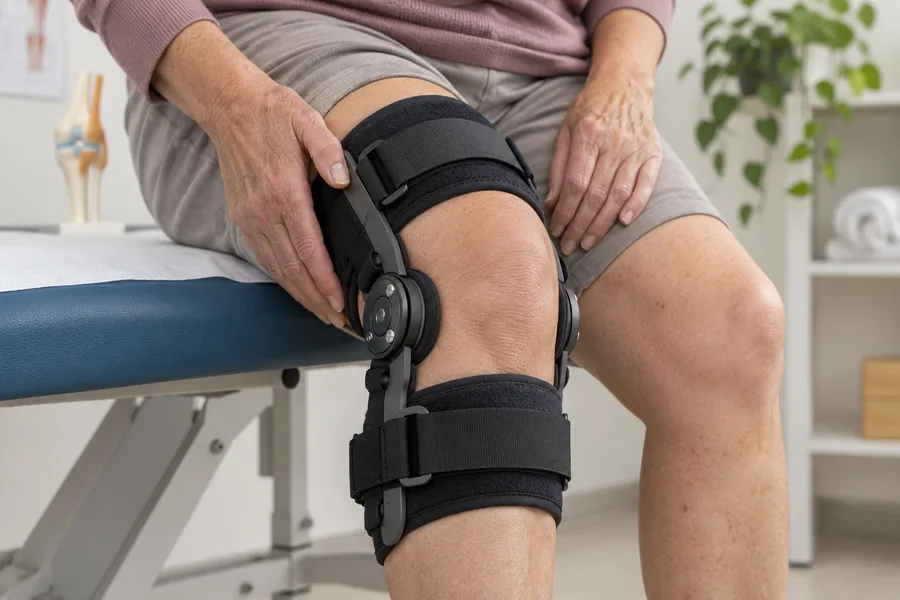
A knee brace can help some people with knee osteoarthritis walk with less pain, and both major US guidelines include bracing among their options. The evidence is less tidy than the recommendations suggest: trials vary, in one trial 40% of people given a brace stopped using it because it was not helping, and a Cochrane review called the overall evidence inconclusive. Guidelines treat exercise and, for people who are overweight, weight loss as core care, and the type of brace depends on which part of the knee is affected.
Which part of the knee is affected
Osteoarthritis can affect different compartments of the knee, and guidelines treat them separately:
- tibiofemoral osteoarthritis affects the joint between the thigh bone and the shin bone
- patellofemoral osteoarthritis affects the joint behind the kneecap
The American Academy of Orthopaedic Surgeons (AAOS) explains that an “unloader” brace shifts weight away from the affected portion of the knee, while a “support” brace helps support the whole knee. AAOS adds that a brace may be especially helpful when arthritis is centered on one side of the knee.
What US guidelines say
| Guideline | Treatment | Recommendation |
|---|---|---|
| ACR and Arthritis Foundation, 2019 | Tibiofemoral knee brace | Strongly recommended for people who can tolerate the inconvenience and burden of bracing |
| ACR and Arthritis Foundation, 2019 | Patellofemoral knee brace | Conditionally recommended, because trial results vary and some people find these braces hard to tolerate |
| ACR and Arthritis Foundation, 2019 | Lateral or medial wedged insoles | Conditionally recommended against |
| ACR and Arthritis Foundation, 2019 | Cane | Strongly recommended |
| AAOS, 2021 | Braces | Could be used to improve function, pain and quality of life. Moderate strength, downgraded because the studies differed |
| AAOS, 2021 | Lateral wedge insoles | Not recommended. Strong strength |
In the ACR guideline, a strong recommendation means the panel was confident the benefits outweigh the downsides for almost all patients. A conditional recommendation means most informed patients would choose the option but some would not, so the choice should be made together with a clinician. Both brace recommendations apply to people whose arthritis affects walking, joint stability or pain enough to need an assistive device.
The ACR guideline also notes that getting the most from a brace is likely to require clinicians who know the different brace types and have expertise in fitting them. Patients on the guideline panel stressed coordination between primary care, specialists and the people who supply braces.
What the trials show
The AAOS guideline reviewed ten studies. Three randomized trials comparing a brace with a control group reported clinically meaningful improvement in symptoms, although in one of them, of a valgus brace, pain and function scores did not differ significantly and the gain was in walking distance. In that trial the benefit was larger in people with bowed legs and more severe symptoms. Another trial compared a valgus brace with the same brace with its corrective straps removed and found meaningful improvements with the real one. AAOS says there are almost no harms in trying a brace besides some skin irritation or discomfort.
The Cochrane review from 2015 was more cautious. It included 13 studies with 1,356 people. Four studies compared a brace with no treatment, but only one, with 117 participants, gave usable data at 12 months, and it found no evidence of an effect on pain, function or quality of life. Many people in that study stopped their treatment because it was not helping: 24 of 60 in the brace group and 14 of 57 with no treatment. Other studies reported some improvement. The reviewers concluded that the evidence on bracing for medial knee osteoarthritis was inconclusive.
Braces come after the basics
The Osteoarthritis Research Society International (OARSI) 2019 guidelines name arthritis education and structured land-based exercise, with or without dietary weight management, as core treatments for knee osteoarthritis. The ACR guideline gives strong recommendations to exercise, weight loss for people who are overweight or obese, self-management programs, tai chi and cane use, alongside tibiofemoral bracing.
Before you get a brace
- Ask which compartment is affected. The guidelines treat tibiofemoral and patellofemoral bracing differently.
- Have the brace fitted by someone trained to do it, as the ACR guideline suggests.
- Expect some inconvenience. The ACR guideline mentions the burden of wearing a brace, AAOS mentions discomfort and skin irritation, and in the Cochrane review many people gave up.
- Wedged shoe inserts fare poorly. AAOS says placing wedges in shoes is not recommended for knee discomfort, and both US guidelines advise against lateral wedge insoles.
- Exercise stays central. The ACR guideline strongly recommends exercise for knee osteoarthritis, and OARSI lists it as a core treatment.
If you are also choosing a support for another joint, the guides to ankle braces after a sprain and back support belts show how the evidence differs from one brace to another.
When knee pain needs prompt care
The NHS advises getting urgent advice if:
- the knee is very painful
- you cannot move the knee or put weight on it
- the knee is badly swollen or has changed shape
- the knee locks, gives way or clicks painfully
- you have a very high temperature or feel hot, cold or shivery, with redness or heat around the knee, which can be a sign of infection
See a doctor if knee pain does not improve within a few weeks. A clinician can confirm whether the pain comes from osteoarthritis and which part of the knee is involved before you choose a brace. More guides on supports are in the orthopedics section.
Frequently asked questions
Do knee braces work for arthritis?
Some people get relief. The ACR/Arthritis Foundation guideline strongly recommends a brace for tibiofemoral knee osteoarthritis that affects walking, stability or pain enough to need an assistive device, in people who can tolerate wearing one. A Cochrane review found the trial evidence inconclusive.
What is an unloader brace?
According to AAOS, an unloader brace shifts weight away from the damaged part of the knee. It may be most useful when arthritis mainly affects one side of the joint.
Should I use wedged insoles instead of a brace?
US guidelines advise against them. AAOS gives a strong recommendation against lateral wedge insoles for knee osteoarthritis, and the ACR/Arthritis Foundation guideline conditionally recommends against wedged insoles.
Sources
- 2019 American College of Rheumatology/Arthritis Foundation Guideline for the Management of Osteoarthritis of the Hand, Hip, and Knee. Arthritis & Rheumatology, 2020
- Management of Osteoarthritis of the Knee (Non-Arthroplasty) Evidence-Based Clinical Practice Guideline. American Academy of Orthopaedic Surgeons, 2021
- Braces and orthoses for treating osteoarthritis of the knee. Cochrane Database of Systematic Reviews, 2015
- OARSI guidelines for the non-surgical management of knee, hip, and polyarticular osteoarthritis. Osteoarthritis and Cartilage, 2019
- Arthritis of the Knee. American Academy of Orthopaedic Surgeons (OrthoInfo)
- Knee pain. NHS
- Abdominal binders after surgery: fit and questions to ask
Learn what evidence says about postoperative binders, how to compare width and closure, and what to ask your surgical team about fit. - Compression stockings: types, sizing and fit
Compare knee-high, thigh-high and waist-high compression garments. Check pressure labelling, measurements and fitting questions. - Ankle Braces After a Sprain: Recovery and Preventing Repeats
For most ankle sprains, guidelines favor early movement, exercise and a brace or tape, and bracing has strong evidence for preventing repeat sprains. - Back Support Belts: Do They Prevent or Treat Low Back Pain?
Back belts have not been shown to prevent back injuries at work, and their value for treating back pain is unclear. What studies found and what helps instead. - Beginner yoga at home: choosing your first poses
Try mountain pose at home, choose between a chair and a mat, and learn what to look for in a beginner yoga class before you press play. - Chair yoga for beginners: three poses you can try seated
Set up a stable chair and explore seated mountain, a small seated cat movement and a side bend, with ways to adjust the range.