Orthopedics · Footwear
Flat Feet in Children: When Arch Supports Help and When to Wait
This article is for general information and does not replace advice from a doctor. Medical disclaimer
- Comfort can your child walk and play as usual?
- Pain where and when does it occur?
- Changes do the feet look and move similarly on both sides?
Most young children have flat feet, and the NHS says they do not usually cause problems. The American Academy of Orthopaedic Surgeons (AAOS) states plainly that if flexible flatfoot does not cause pain or discomfort, no treatment is needed. Arch supports are an option for a child whose feet ache, and a stiff, painful or one-sided flat foot is a reason to see a doctor.
Flexible and rigid flat feet
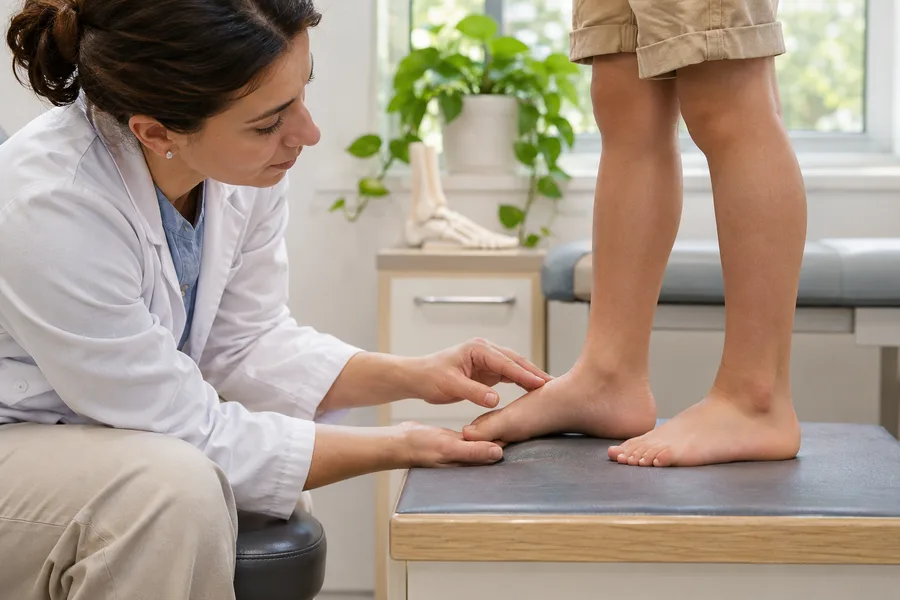
In flexible flatfoot, the arch disappears when the child stands and comes back when the child sits or rises onto tiptoes. AAOS describes it as common in children and notes that it always affects both feet. Arches take time to form. The NHS says children usually develop them between 3 and 10 years of age, and AAOS notes that many children with flexible flatfoot do not start to develop arches until age 5 or later, while some never do.
A rigid flat foot is stiff rather than flexible, and AAOS says it may be a more serious condition. One cause is tarsal coalition, an abnormal connection between two or more bones in the foot. According to AAOS, it usually does not cause symptoms until early adolescence, and it can lead to:
- stiff, painful feet, usually below the ankle around the middle or back of the foot
- a rigid flat foot that makes walking on uneven ground difficult
- repeated ankle sprains
AAOS estimates that about one in every 100 people may have a tarsal coalition, though many never notice it.
How common flat feet are
Estimates vary widely because studies use different measurements. A 2011 review by Evans and Rome found published prevalence figures ranging from 0.6% to 77.9%. It estimated that about 45% of preschool children and 15% of older children, around age 10 on average, have flat feet. The authors found that flat feet normally become less common with age and that few flexible flat feet cause symptoms. Joint hypermobility and higher body weight may make flat feet more likely regardless of age.
What studies show about arch supports
Research on insoles for children is thin. The key studies are summarized below.
| Review | What it included | Main findings |
|---|---|---|
| Cochrane review, 2022 | 16 trials, 1,058 children aged 11 months to 19 years with flexible flat feet | In healthy children without symptoms, custom or prefabricated orthoses made little or no difference to the share of children without pain at one year compared with shoes. In children with juvenile idiopathic arthritis, orthoses may improve pain and function compared with shoes, with little difference between custom and prefabricated devices. Certainty of evidence was low to very low. The authors found no supporting evidence for costly custom orthoses in healthy children whose flat feet do not hurt. |
| Evans and Rome, 2011 | Review of the evidence on flexible flat feet | Flexible flat feet are often treated unnecessarily. When orthoses are indicated, inexpensive generic ones usually suffice. Custom orthoses are best kept for children with foot pain and arthritis, unusual foot shape, or no response to simpler measures. |
| Molina-García and colleagues, 2023 | 7 controlled trials, 679 children aged 3 to 14 | All studies reported benefits, but with risk of bias. No treatment algorithm, no agreed definition of flexible flatfoot and no single best type of orthosis. |
The overall picture is that arch supports may ease symptoms in children who have them. There is no good evidence that they are needed for a child with painless flexible flat feet.
What doctors usually suggest
AAOS recommends treatment only if the child has discomfort. When it is needed, a doctor may suggest:
- stretching exercises for the heel cords
- shoe inserts, if discomfort continues. AAOS says arch supports may relieve foot pain and tiredness, and that over-the-counter supports can be just as effective as custom-molded ones, which offer little benefit in most cases
- physical therapy or casting, for a child whose flexible flatfoot comes with tight heel cords
AAOS adds that arch supports can make shoes last longer when a child wears them unevenly, and that off-the-shelf supports are much cheaper to replace as a child grows. A child’s first orthotic insole A shoe insert shaped to support the arch and heel and change how load is spread across the foot when you stand and walk. rarely needs to be made to measure.
The NHS adds that insoles, stretches and exercises will not change the shape of the feet, though they can help with pain or stiffness. Surgery is rare. AAOS says children almost never need surgery for flexible flatfoot. It may be considered for a teenager with persistent pain or a foot that has become rigid over time.
Signs that need a doctor
Based on NHS and AAOS guidance, book an appointment if your child:
- has feet that are painful, stiff, weak or numb
- often gets foot or ankle injuries
- has problems with walking or balance
- has flat feet that are new, or that affect only one foot
- has foot pain that persists
- has an arch that does not fully come back when the child stands on tiptoes, or a foot that seems to have become rigid
A doctor will examine the feet to rule out other types of flat feet that need treatment. If a teenager has repeated ankle sprains, the guide to ankle braces after a sprain explains how sprains are managed, but a stiff foot behind those sprains still needs its own assessment.
Adults with heel pain face a different set of questions, covered in insoles for plantar fasciitis. For other guides on feet and footwear, see the orthopedics section.
Frequently asked questions
At what age do children develop arches?
The NHS says children usually develop arches between 3 and 10 years of age. AAOS notes that many children with flexible flatfoot do not begin to develop arches until age 5 or later, and some never do.
Does my child need custom orthotics for flat feet?
Usually not. AAOS says custom-molded arch supports offer little benefit in most cases, and over-the-counter supports can be just as effective for a child whose feet ache.
Will arch supports change the shape of my child's feet?
No. The NHS says insoles, stretches and exercises will not change the shape of the feet, though they can help with pain or stiffness.
Sources
- Flexible Flatfoot in Children. American Academy of Orthopaedic Surgeons (OrthoInfo)
- Tarsal Coalition. American Academy of Orthopaedic Surgeons (OrthoInfo)
- Flat feet. NHS
- Foot orthoses for treating paediatric flat feet. Cochrane Database of Systematic Reviews, 2022
- A Cochrane review of the evidence for non-surgical interventions for flexible pediatric flat feet. European Journal of Physical and Rehabilitation Medicine, 2011
- Efficacy of Plantar Orthoses in Paediatric Flexible Flatfoot: A Five-Year Systematic Review. Children (Basel), 2023
- Footwear for Diabetes: Shoes, Insoles and Daily Foot Checks
IWGDF and ADA guidance on shoes for people with diabetes: who needs therapeutic footwear, how fit is checked and which foot changes need urgent care. - Beginner yoga at home: choosing your first poses
Try mountain pose at home, choose between a chair and a mat, and learn what to look for in a beginner yoga class before you press play. - Chair yoga for beginners: three poses you can try seated
Set up a stable chair and explore seated mountain, a small seated cat movement and a side bend, with ways to adjust the range. - Downward-facing dog: how to try a supported chair variation
How downward dog works, how a higher hand support changes the pose, and what to consider if your wrists hurt or you have glaucoma. - Tree pose for beginners: finding balance beside a wall
Where to place your foot in tree pose, how to use a wall, and how to come out of the pose if you start to wobble. - Yoga breathing for beginners: a gentle introduction to pranayama
Try a quiet seated breath. Learn how alternate-nostril breathing, humming and breath retention differ, and when to pause a yoga breathing exercise.