Orthopedics · Footwear
Footwear for Diabetes: Shoes, Insoles and Daily Foot Checks
This article is for general information and does not replace advice from a doctor. Medical disclaimer
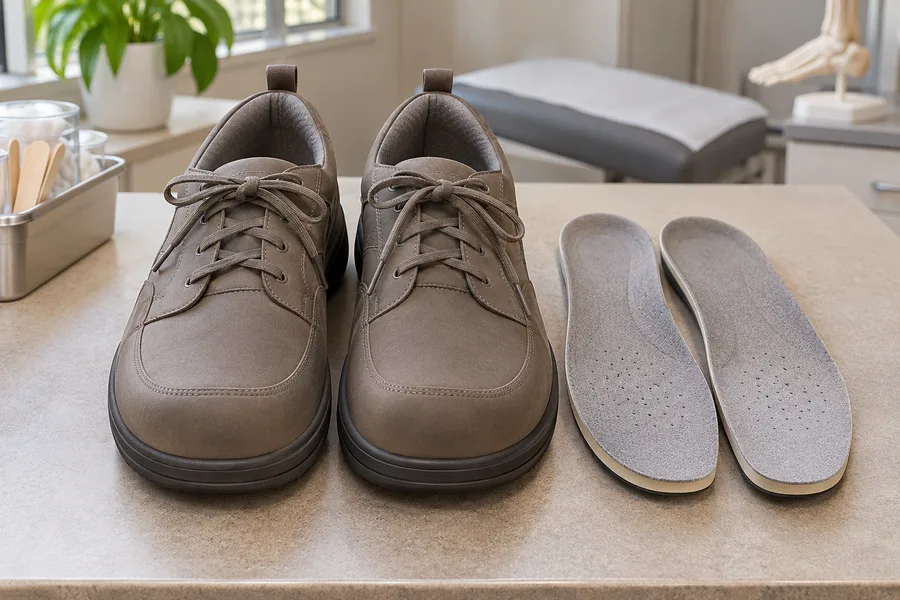
Not everyone with diabetes needs special shoes, but everyone with diabetes should have their feet checked for risk. The International Working Group on the Diabetic Foot (IWGDF) ties footwear advice to that risk. People at risk should not walk barefoot and should wear shoes that fit and accommodate the shape of their feet. Those who have had a foot ulcer on the sole should have therapeutic footwear shown to relieve pressure during walking. Any open wound, or unexplained swelling, redness or warmth of the foot, needs an urgent referral to a foot care specialist.
Why feet are at risk
The IWGDF 2023 guideline reports that 19% to 34% of people with diabetes develop a foot ulcer in their lifetime, about 2% each year. After an ulcer heals, it comes back in 40% of people within a year and in 65% within three years. The main risk factors are loss of protective sensation, peripheral artery disease and foot deformity. People with diabetes who have none of these do not appear to be at higher risk than people without diabetes.
IWGDF risk categories
| Category | Risk | Features | Suggested foot screening |
|---|---|---|---|
| 0 | Very low | No loss of sensation and no peripheral artery disease | Once a year |
| 1 | Low | Loss of sensation or peripheral artery disease | Every 6 to 12 months |
| 2 | Moderate | Loss of sensation plus artery disease, or either one plus foot deformity | Every 3 to 6 months |
| 3 | High | Loss of sensation or artery disease plus a past foot ulcer, a lower-limb amputation or end-stage kidney disease | Every 1 to 3 months |
The IWGDF notes that these intervals are based on expert opinion, because there is no evidence to support specific intervals.
What the guidelines say about shoes
For people in risk categories 1 to 3, the IWGDF recommends:
- not walking barefoot, in socks without shoes, or in thin-soled slippers, indoors or outdoors
- with little or no deformity, footwear that accommodates the shape of the feet and fits properly
- with a deformity that raises pressure or a pre-ulcerative lesion such as a blister, crack in the skin or bleeding under the skin, considering extra-depth shoes, custom-made footwear, custom-made insoles or toe orthoses
- after a healed ulcer on the sole, therapeutic footwear with a demonstrated pressure-relieving effect during walking, worn consistently both indoors and outdoors
Fit should be checked by a trained professional, because people who have lost sensation cannot judge it reliably themselves. The IWGDF advises checking fit while standing, preferably at the end of the day, with enough length, width and depth. It also suggests seamless socks of natural materials, preferably light-colored so that stains from a wound show up.
The evidence behind therapeutic footwear is promising but not conclusive. In a meta-analysis of 3 randomized trials and 3 cohort studies that the IWGDF relied on, therapeutic footwear, insoles or orthoses may have reduced the risk of a first or repeat ulcer compared with people’s own footwear in those at moderate to high risk, with a relative risk of 0.53, but the confidence interval also included no effect. The IWGDF still makes a strong recommendation for properly fitting footwear, citing protection against heat and mechanical injury along with the evidence on ulcer risk.
The American Diabetes Association (ADA) Standards of Care 2026 recommend specialized therapeutic footwear for people at high risk of ulcers, including those with loss of sensation, foot deformities, ulcers, callus formation, poor circulation or a history of amputation. The ADA notes that bunions or hammertoes may require extra-depth shoes, and that well-fitted athletic or walking shoes with customized pressure-relieving inserts suit people with high pressure under the foot, such as those with calluses. For people who have healed from an ulcer on the sole, the IWGDF says therapeutic footwear, which may include a custom orthotic insole A shoe insert shaped to support the arch and heel and change how load is spread across the foot when you stand and walk. , needs to reduce pressure at high-risk spots, including the site of the previous ulcer.
Foot checks and daily care
The ADA recommends a comprehensive foot evaluation at least once a year. It should include a skin inspection, a check for deformities, a nerve test such as a 10-gram monofilament, and a check of the pulses in the legs and feet. People with loss of sensation or a past ulcer or amputation should have their feet inspected at every visit.
The CDC and IWGDF advise people at risk to:
- check their feet every day for cuts, redness, swelling, sores, blisters, corns and calluses
- wash their feet daily and dry them carefully, especially between the toes
- moisturize dry skin, but not between the toes
- cut toenails straight across
- check that there are no pebbles or other objects inside their shoes
- wear shoes and socks, or slippers that are not thin-soled, even indoors
The CDC also recommends a complete exam by a foot doctor every year, more often if you have nerve damage.
Medicare coverage
Medicare Part B covers therapeutic shoes and inserts for people with diabetes and severe diabetes-related foot disease. Each calendar year it covers either one pair of custom-molded shoes with inserts, for people who cannot wear depth-inlay shoes because of a deformity, plus two more pairs of inserts, or one pair of extra-depth shoes plus three pairs of inserts. The doctor who treats your diabetes must certify the need, a podiatrist or other qualified doctor must order the items, and they must come from a podiatrist, orthotist, prosthetist, pedorthist or another qualified individual. Medicare pays only if your doctors and suppliers are enrolled in Medicare. In certain cases Medicare may cover separate inserts or shoe modifications instead of inserts. You pay 20% of the Medicare-approved amount after the Part B deductible if the supplier accepts assignment.
Foot changes that need urgent care
The ADA says anyone with an open ulcer, or with unexplained swelling, redness or increased warmth of the foot, should be referred urgently to a foot care specialist. The CDC lists tingling, burning or pain in the feet, a sore or ulcer, a blister or infected corn, and changes in the shape, color or temperature of the foot as reasons not to wait for your next appointment. An open wound on the foot should not wait for a routine visit.
If you also have heel pain or a bunion, read insoles for plantar fasciitis or bunion splints and toe spacers, and check with your diabetes care team before buying inserts or splints. More guides are in the orthopedics section.
Frequently asked questions
Does everyone with diabetes need special shoes?
No. The IWGDF guideline links footwear advice to risk. People without loss of protective sensation or peripheral artery disease are at very low risk. Those at higher risk should wear properly fitting shoes, and people with a healed plantar ulcer should have therapeutic footwear that relieves pressure.
Does Medicare pay for diabetic shoes?
Medicare Part B covers therapeutic shoes and inserts for people with diabetes and severe diabetes-related foot disease, when the doctor treating the diabetes certifies the need. After the Part B deductible, you pay 20% of the Medicare-approved amount if the supplier accepts assignment.
How often should my feet be checked?
The ADA recommends a comprehensive foot evaluation at least once a year, and a foot inspection at every visit for people with loss of sensation or a past ulcer or amputation.
Sources
- Guidelines on the prevention of foot ulcers in persons with diabetes (IWGDF 2023 update). International Working Group on the Diabetic Foot (Diabetes/Metabolism Research and Reviews), 2023
- 12. Retinopathy, Neuropathy, and Foot Care: Standards of Care in Diabetes-2026. American Diabetes Association (Diabetes Care), 2026
- Your Feet and Diabetes. Centers for Disease Control and Prevention
- Therapeutic shoes & inserts. Medicare.gov
- Flat Feet in Children: When Arch Supports Help and When to Wait
Most children with flexible flat feet have no pain and need no treatment. What studies show about arch supports and which signs mean a doctor should look. - Beginner yoga at home: choosing your first poses
Try mountain pose at home, choose between a chair and a mat, and learn what to look for in a beginner yoga class before you press play. - Chair yoga for beginners: three poses you can try seated
Set up a stable chair and explore seated mountain, a small seated cat movement and a side bend, with ways to adjust the range. - Downward-facing dog: how to try a supported chair variation
How downward dog works, how a higher hand support changes the pose, and what to consider if your wrists hurt or you have glaucoma. - Tree pose for beginners: finding balance beside a wall
Where to place your foot in tree pose, how to use a wall, and how to come out of the pose if you start to wobble. - Yoga breathing for beginners: a gentle introduction to pranayama
Try a quiet seated breath. Learn how alternate-nostril breathing, humming and breath retention differ, and when to pause a yoga breathing exercise.