Orthopedics · Insoles
Insoles for Plantar Fasciitis: What the Evidence Shows
This article is for general information and does not replace advice from a doctor. Medical disclaimer
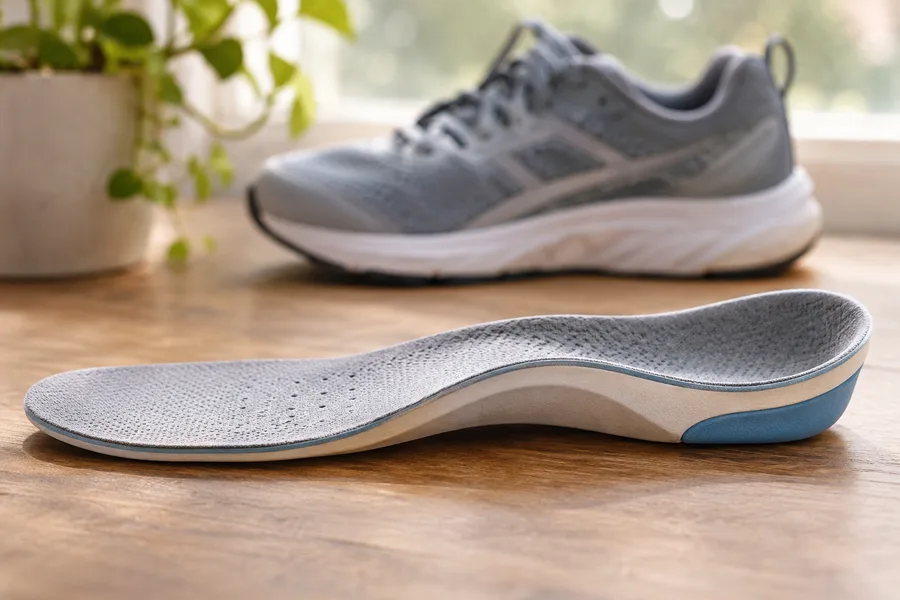
In clinical trials, insoles on their own make little difference to plantar fasciitis pain. The 2023 physical therapy guideline for plantar fasciitis advises against using foot orthoses as a stand-alone treatment for short-term pain and allows them in combination with other treatments. Stretching, taping and night splints have stronger support, and custom devices have not beaten off-the-shelf ones.
What plantar fasciitis feels like
The plantar fascia is a long, thin ligament under the skin of the sole that connects the heel to the front of the foot and supports the arch. The American Academy of Orthopaedic Surgeons (AAOS) lists the typical symptoms:
- pain on the bottom of the foot near the heel
- pain with the first few steps after getting out of bed, or after a long rest
- pain that is worse after exercise rather than during it
The outlook is good. According to AAOS, more than 90% of people with plantar fasciitis improve within 10 months of starting simple treatment.
What trials found about insoles
Two systematic reviews published in the British Journal of Sports Medicine in 2018 pooled the randomized trials. Several of these trials compared foot orthoses with sham devices.
The review by Rasenberg and colleagues included 20 trials of eight types of foot orthoses. For short-term pain it found no difference between prefabricated orthoses and sham inserts, none between custom orthoses and sham inserts, and none between custom and prefabricated devices. The authors concluded that foot orthoses are not superior to sham devices or other conservative treatments for pain and function.
The review by Whittaker and colleagues included 19 trials with 1,660 participants. It found moderate-quality evidence that orthoses reduced pain more than sham inserts at 7 to 12 weeks, but the authors were unsure whether the change was large enough to matter clinically. Evidence for the short term and the longer term was of very low quality and showed no benefit. Custom and prefabricated orthoses performed the same at every time point.
What the 2023 guideline recommends
The guideline from the Academy of Orthopaedic Physical Therapy, published in the Journal of Orthopaedic & Sports Physical Therapy, grades each recommendation by the strength of evidence behind it: A is strong, B moderate, C weak.
| Treatment | 2023 recommendation | Grade |
|---|---|---|
| Foot orthoses on their own | Should not be used as an isolated treatment for short-term pain relief | B |
| Foot orthoses with other treatments | May be used to reduce pain and improve function | C |
| Night splints | A 1- to 3-month program for people who consistently have pain with the first step in the morning | A |
| Taping, rigid or elastic | Used with other physical therapy for short-term pain and function | A |
| Plantar fascia and calf stretching | For short- and long-term pain and function | A |
| Manual therapy | For joint and soft tissue restrictions, pain and function | A |
| Resistance exercise for foot and ankle muscles | Part of therapeutic exercise | B |
This is a step down for insoles. The 2014 edition of the same guideline gave orthoses an A grade. The 2023 authors cite four meta-analyses showing a small to no effect of custom or prefabricated orthoses used alone in the first three months. They also note that evidence on the type, materials and design of orthoses is limited, while outcomes with custom and prefabricated devices are similar.
Night splints
A night splint is a prefabricated plastic orthosis that stops the ankle from pointing downward while you sleep. AAOS describes it as stretching the plantar fascia overnight. The 2023 update found no new studies of night splints and kept the A grade from 2014, so the recommendation still rests on the older evidence.
If you decide to try insoles
The 2023 guideline defines foot orthoses as supports meant to hold up the inner arch and take load off the plantar fascia. That covers a shop-bought orthotic insole A shoe insert shaped to support the arch and heel and change how load is spread across the foot when you stand and walk. as well as a custom device, and in the trials above the measurable benefit of either was small. A few points follow from the evidence:
- Price is a poor guide. Custom devices did not relieve pain better than prefabricated ones in either 2018 review.
- Insoles belong in a wider plan. The guideline advises against them as a stand-alone treatment for short-term pain and allows them when combined with other treatments.
- Shoes matter too. The NHS suggests shoes with cushioned heels and good arch support, insoles or heel pads, and avoiding high heels and tight pointed shoes.
If you have diabetes, read about footwear for diabetes before buying any insole. If the pain sits at the big toe joint rather than the heel, the guide to bunion splints and toe spacers is a better fit.
When to see a clinician
The NHS advises seeing a doctor if:
- the pain is severe or stops you doing normal activities
- it has not improved after two weeks of treating it yourself
- you have tingling or loss of feeling in the foot
- you have diabetes and foot pain, because foot problems can be more serious with diabetes
A podiatrist or physical therapist can check whether the pain really comes from the plantar fascia and put together a plan. According to the NHS, if insoles, shoes, night splints and exercises do not help, you may be offered steroid injections or shockwave therapy, and less commonly a referral to discuss surgery. AAOS says surgery is generally kept for people who have not improved after 12 months of thorough nonsurgical treatment.
For other foot and joint supports, see the orthopedics section.
Frequently asked questions
Are custom orthotics better than store-bought insoles for plantar fasciitis?
Not in the trials so far. Two 2018 meta-analyses found no difference in pain between custom-made and prefabricated foot orthoses.
Do night splints help plantar fasciitis?
The 2023 physical therapy guideline gives its strongest grade to a 1- to 3-month program of night splints for people who consistently have pain with the first steps in the morning.
How long does plantar fasciitis take to get better?
According to the American Academy of Orthopaedic Surgeons, more than 90% of people improve within 10 months of starting simple treatments such as stretching.
Sources
- Heel Pain - Plantar Fasciitis: Revision 2023. Journal of Orthopaedic & Sports Physical Therapy (APTA Academy of Orthopaedic Physical Therapy), 2023
- Efficacy of foot orthoses for the treatment of plantar heel pain: a systematic review and meta-analysis. British Journal of Sports Medicine, 2018
- Foot orthoses for plantar heel pain: a systematic review and meta-analysis. British Journal of Sports Medicine, 2018
- Plantar Fasciitis and Bone Spurs. American Academy of Orthopaedic Surgeons (OrthoInfo)
- Plantar fasciitis. NHS
- Custom vs prefabricated insoles: how to compare
Compare fitting, adjustments and total cost. See what research found when custom and prefabricated foot orthoses were compared for heel pain. - How to choose orthotic insoles: fit and types
Compare cushioning inserts, prefabricated orthoses and custom devices. Learn what to check inside your shoes and what to ask at a fitting. - Orthotic insoles and shoes: how to check the fit
Check heel depth, toe space and insole movement before altering an orthosis. Learn what to bring to a fitting or follow-up. - Beginner yoga at home: choosing your first poses
Try mountain pose at home, choose between a chair and a mat, and learn what to look for in a beginner yoga class before you press play. - Chair yoga for beginners: three poses you can try seated
Set up a stable chair and explore seated mountain, a small seated cat movement and a side bend, with ways to adjust the range. - Downward-facing dog: how to try a supported chair variation
How downward dog works, how a higher hand support changes the pose, and what to consider if your wrists hurt or you have glaucoma.