Orthopedics · Orthoses
Bunion Splints and Toe Spacers: What They Can and Cannot Do
This article is for general information and does not replace advice from a doctor. Medical disclaimer
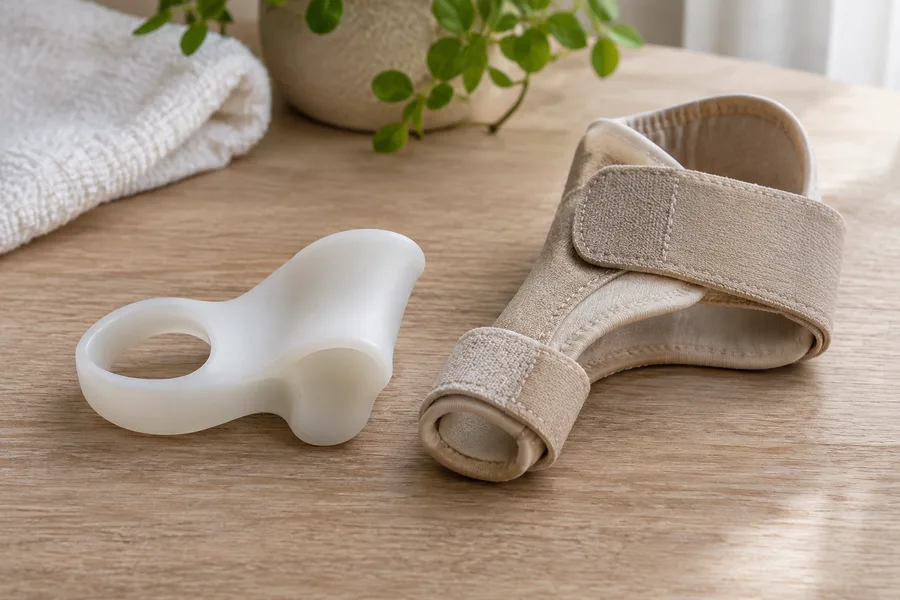
Bunion splints, toe spacers and shoe inserts can ease pain for some people, but none has been shown to permanently straighten a bunion. The American Academy of Orthopaedic Surgeons (AAOS) states that braces and splints have not been shown to permanently fix bunions and that nonsurgical treatment cannot reverse one. What these devices can do is reduce pressure and discomfort, and in the main randomized trial that relief was short-term.
What a bunion is
AAOS describes a bunion as a painful bony bump on the inside of the foot at the big toe joint, with the big toe gradually drifting toward the smaller toes. The medical name is hallux valgus. A 2024 Cochrane review puts its prevalence at 23% to 35% of the population and notes that it can cause poor balance, a higher risk of falls, trouble finding shoes that fit, and pain.
Genes play a large part: according to AAOS, up to 70% of people who develop bunions have a family history. Shoes with a narrow, pointed toe box that forces the toes into an unnatural position also contribute. Besides the bump, symptoms can include pain and tenderness, redness, calluses or corns over the bump, and stiffness in the big toe that can make walking harder.
What the research shows
| Study | Design | Main finding |
|---|---|---|
| Torkki and colleagues, JAMA 2001 | Randomized trial of 209 adults with a painful bunion and a toe angle of 35 degrees or less: surgery, orthoses or a one-year waiting list | At 6 months, pain fell more with orthoses than on the waiting list. At 1 year, 83% in the surgery group, 46% in the orthosis group and 24% on the waiting list felt improved. The authors concluded that orthoses give short-term relief |
| Kwan and colleagues, BMJ Open 2021 | Systematic review and meta-analysis of 9 studies of bunion orthoses | Orthoses with a toe separator had the largest effect on the toe angle |
| Zhu and colleagues, 2025 | Network meta-analysis of 11 randomized trials, 401 people with bunions | Exercise alone reduced the toe angle compared with placebo; exercise combined with taping or with orthoses ranked best for angle and pain. The authors drew their conclusions for mild to moderate bunions |
| Cochrane review of surgery, 2024 | 25 trials, 1,597 people | Surgery may reduce pain by a clinically important amount compared with no treatment or with non-surgical treatment, based on one trial of 140 people; low-certainty evidence |
These results need careful reading. The reviews measured changes in the toe angle, but AAOS states that braces and splints have not been shown to permanently fix bunions. The 2021 review named missing outcome data and measurement error as the main sources of possible bias, and the 2025 authors called for larger, high-quality trials that also look at possible side effects. The Cochrane review describes non-surgical treatments as usually the first step, aimed at treating pain rather than curing the deformity.
Footwear, pads and inserts
Both AAOS and the NHS start with shoes and simple padding. Their suggestions include:
- wide shoes with enough room for the toes, a low heel and a soft sole
- avoiding high heels and tight, pointed shoes
- bunion pads, such as silicone pads, to cushion the bump. AAOS advises trying them for a short time first, because a pad of the wrong size can add pressure
- custom or over-the-counter shoe inserts to take pressure off the bunion
- a night splint to help position the big toe, or a toe spacer worn between the toes
- losing weight if you are overweight, which the NHS lists as a way to ease pain
The NHS says a GP or podiatrist can advise on insoles, toe spacers and toe supports to reduce bunion pain. An orthotic insole A shoe insert shaped to support the arch and heel and change how load is spread across the foot when you stand and walk. or splint is a way to manage symptoms, and the NHS states plainly that you cannot get rid of a bunion or stop it getting worse yourself.
When surgery comes into the discussion
AAOS advises considering surgery only for a bunion that is painful and makes walking difficult after shoe changes and other nonsurgical treatments have been tried. The NHS says a doctor may refer you if bunions are very painful or are having a big effect on your life, that surgery is not done just to improve how the feet look, and that bunions sometimes come back after surgery.
In the 2001 JAMA trial, the surgery group also had the fewest painful days and footwear problems and the best function and satisfaction with treatment. In the Cochrane review, average pain at 12 months was 21 points on a 100-point scale after surgery and 39 points without treatment. The evidence was rated low-certainty because the trial was not blinded and its results were imprecise. Whether surgery is worth it depends on your pain, your daily limits and your health, which is a decision to make with a foot and ankle specialist.
When to see a clinician
The NHS advises seeing a doctor if:
- bunion pain has not improved after a few weeks of home treatment
- the pain stops you doing your normal activities
- your bunions are getting worse
- you have bunions and diabetes, because foot problems can be more serious with diabetes
If you have diabetes, read footwear for diabetes before choosing shoes or inserts. Heel pain is a different problem with its own evidence, covered in insoles for plantar fasciitis. More foot guides are in the orthopedics section.
Frequently asked questions
Can a toe spacer or bunion splint straighten my toe?
Not permanently, as far as the evidence shows. AAOS says braces and splints have not been shown to permanently fix bunions and that nonsurgical treatment cannot reverse a bunion. Some studies report changes in the toe angle while devices are used.
Do bunion orthoses help with pain?
They can, for a while. In a 2001 randomized trial, people given orthoses had less pain at 6 months than people on a waiting list, and the authors concluded that orthoses give short-term relief.
Is bunion surgery done for cosmetic reasons?
No. The NHS says surgery is not done just to improve how feet look, and AAOS advises considering surgery only for a painful bunion.
Sources
- Bunions. American Academy of Orthopaedic Surgeons (OrthoInfo)
- Bunions. NHS
- Surgery vs orthosis vs watchful waiting for hallux valgus: a randomized controlled trial. JAMA, 2001
- Hallux valgus orthosis characteristics and effectiveness: a systematic review with meta-analysis. BMJ Open, 2021
- Effects of exercise combined with external support on hallux valgus angle and pain: A systematic review and network meta-analysis. Foot and Ankle Surgery, 2025
- Surgical interventions for treating hallux valgus and bunions. Cochrane Database of Systematic Reviews, 2024
- Types of knee braces: support, fit and selection
Compare sleeves, hinged supports and unloading braces. Learn what to check when fitting a knee brace and what to ask about arthritis. - Wrist Splints for Carpal Tunnel Syndrome: What Studies Show
A night wrist splint is a common first step for carpal tunnel syndrome. The latest Cochrane review finds uncertain benefits and only temporary side effects. - Beginner yoga at home: choosing your first poses
Try mountain pose at home, choose between a chair and a mat, and learn what to look for in a beginner yoga class before you press play. - Chair yoga for beginners: three poses you can try seated
Set up a stable chair and explore seated mountain, a small seated cat movement and a side bend, with ways to adjust the range. - Downward-facing dog: how to try a supported chair variation
How downward dog works, how a higher hand support changes the pose, and what to consider if your wrists hurt or you have glaucoma. - Tree pose for beginners: finding balance beside a wall
Where to place your foot in tree pose, how to use a wall, and how to come out of the pose if you start to wobble.