Orthoptics · Strabismus
Accommodative Esotropia: Why Farsighted Children's Eyes Cross
This article is for general information and does not replace advice from a doctor. Medical disclaimer
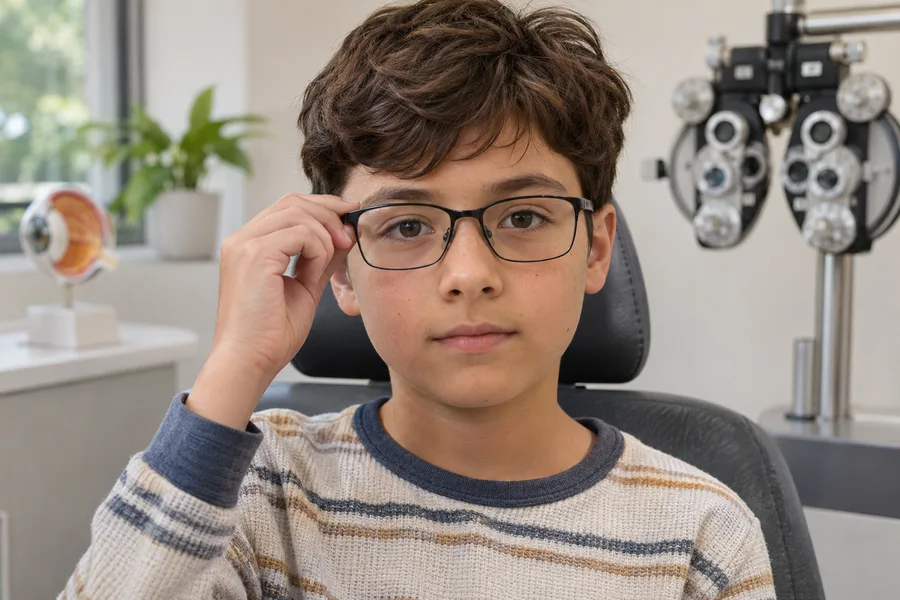
Accommodative esotropia is an inward eye turn caused by the extra focusing effort of a farsighted child. When the eyes focus (accommodate), they also turn inward, and a child who has to focus hard to see clearly can overshoot into crossing. Glasses that correct the farsightedness straighten the eyes in most cases. Some children also need bifocals, and a minority need surgery.
Why focusing makes the eyes cross
The American Academy of Ophthalmology (AAO) guideline on esotropia and exotropia describes the cause as excessive convergence in a child who usually has farsightedness in both eyes. Correcting the farsightedness removes the trigger. The American Association for Pediatric Ophthalmology and Strabismus (AAPOS) adds that the more farsighted a child is, the more likely the eyes are to cross, but many farsighted children never develop it. It can run in families.
Who gets it and when
Accommodative esotropia is common. In a population study in Olmsted County, Minnesota, fully accommodative esotropia made up 36.4% of 385 cases of childhood esotropia, and partially accommodative esotropia another 10.1%.
According to the AAO guideline, it typically starts between ages 1 and 4, at about 2 years on average, though it can appear in infancy or later in childhood. It may begin as an intermittent turn that shows up with tiredness, illness or close work, and it can be set off by an illness, fever or minor injury. A child’s two-eye vision may be normal before the turn starts, and because young children lose binocular vision quickly, the guideline advises correcting the farsightedness as soon as possible.
Types of accommodative esotropia
| Type | What happens | Usual approach in the AAO guideline |
|---|---|---|
| Fully accommodative, normal AC/A ratio | Glasses for the farsightedness straighten the eyes at distance and near | Glasses or contact lenses |
| Accommodative with a high AC/A ratio | Eyes straight at distance in glasses, but crossing at near; defined as a near turn at least 10 prism diopters larger than at distance | Glasses; bifocals may be considered; surgery in some older children |
| Partially accommodative | Glasses reduce the turn but do not remove it | Glasses, then surgery for the remaining turn if needed |
| Nonaccommodative (for comparison) | Glasses make no difference to the turn | Treated as a different condition; prompt assessment if it starts suddenly with other neurological signs |
The AC/A ratio describes how much the eyes turn in for each unit of focusing effort.
Glasses: the main treatment
Glasses are prescribed after a cycloplegic refraction, where drops relax focusing so the full farsightedness can be measured. In most cases the prescription corrects the full amount found. AAPOS advises that children with accommodative esotropia wear their glasses all the time. Even after a child starts wearing glasses, the eyes may still cross when the glasses come off, and AAPOS notes the crossing may seem worse at first.
Other points from the AAO guideline:
- improved alignment can take several weeks after the glasses arrive
- if the turn persists, the refraction should be repeated before surgery is considered, because more farsightedness may show up
- a repeat refraction is also needed if a child who was straight in glasses starts crossing again
- poor glasses wear makes poor alignment and poor two-eye vision likely
- impact-resistant lenses are preferred for children
Follow-up visits also check for amblyopia Reduced vision in one eye that develops in childhood because the brain favors the other eye. Often called lazy eye. , which AAPOS says is common with this condition. If it is present, treatment such as patching may be added.
Bifocals for crossing at near
Some children are straight at distance in their glasses but still cross when reading or looking at something close. For them, the AAO guideline says bifocals can be considered if the child has the potential for two-eye vision. If bifocals work, they may be needed long term.
The guideline also lists downsides: some children dislike how bifocals look and reject the glasses, and some clinicians skip bifocals because they think straight eyes at distance are enough to protect binocular vision. In some older children, surgery is used to reduce reliance on bifocals or to allow a switch to contact lenses.
Will my child outgrow it?
Sometimes, but slowly. AAPOS says some children outgrow it as their farsightedness decreases, usually through grade school and the teenage years, and that it is hard to predict for a given child.
The Olmsted County long-term study followed 306 children with accommodative esotropia:
- 80% had the fully accommodative form and 20% the partially accommodative form
- the share who no longer needed glasses for the eye turn was 8% at 5 years after diagnosis, 20% at 10 years and 37% at 20 years
- children born prematurely or with higher farsightedness were less likely to become glasses-free
- 13.5% of children with the fully accommodative form eventually had surgery, more often boys and children whose crossing started or was diagnosed earlier
In older children whose eyes stay straight, the AAO guideline describes trying a gradual reduction of the prescription.
When surgery comes in
AAPOS says surgery is needed only if glasses do not fully straighten the eyes, and it usually does not remove the need for glasses. The AAO guideline adds that surgery is rarely justified when the main goal is to get rid of glasses. Children whose accommodative esotropia starts very early are more likely to develop a partially accommodative turn that needs surgery. See strabismus surgery for what the operation involves.
When to call the eye doctor
AAPOS says eye crossing is never normal except in the first few months of life. Book an exam if you notice crossing in a child older than about 4 months, if crossing returns while the child is wearing glasses, or if the child complains of double vision. An inward turn that starts suddenly, especially with other neurological signs, needs prompt assessment. For the other forms of eye turn, see types of strabismus, or go back to the orthoptics section.
Frequently asked questions
Why do my child's eyes still cross when the glasses come off?
The glasses reduce the focusing effort that triggers the crossing. AAPOS notes that the eyes may still cross with the glasses off, and at first the crossing may even seem worse, and it advises wearing the glasses all the time.
Will my child need glasses forever?
Not always. In a Minnesota cohort, 8% of children had stopped needing glasses for the eye turn 5 years after diagnosis, 20% after 10 years and 37% after 20 years.
Can surgery replace the glasses?
Usually not. Surgery is considered when glasses do not fully straighten the eyes, and it typically does not remove the need for glasses.
Sources
- Accommodative Esotropia. American Association for Pediatric Ophthalmology and Strabismus, 2025
- Esotropia. American Association for Pediatric Ophthalmology and Strabismus, 2023
- Esotropia and Exotropia Preferred Practice Pattern®. Ophthalmology (American Academy of Ophthalmology), 2023
- Incidence and types of childhood esotropia: a population-based study. Ophthalmology, 2007
- The long-term follow-up of accommodative esotropia in a population-based cohort of children. Ophthalmology, 2011
- Strabismus Surgery: What Happens, Risks and Repeat Operations
Eye muscle surgery loosens or tightens muscles, usually as a day procedure. In a US registry, about 1 in 15 patients had a second operation within a year. - Types of Strabismus: Eyes That Turn In, Out, Up or Down
Esotropia, exotropia and vertical eye turns, constant or intermittent: how the main types differ, what pseudostrabismus is and which signs need prompt care. - Atropine Eye Drops for Amblyopia: What the Research Shows
In PEDIG trials, atropine drops in the stronger eye improved amblyopia about as much as patching, including weekend use. Side effects and who it may suit. - Binocular and Digital Amblyopia Treatment: What the Trials Show
Dichoptic games and videos for lazy eye: an iPad game fell short of patching, while two FDA-authorized devices showed gains over 12 to 16 weeks. - Convergence Insufficiency: Symptoms and What the CITT Trials Found
Convergence insufficiency causes eye strain and double vision up close. In trials, office-based therapy beat home push-ups but not placebo for reading scores. - Patching for Amblyopia: What Trials Show About Glasses and Hours
Glasses come first. In PEDIG trials, 2 hours of daily patching matched 6 for moderate amblyopia, and 6 matched full-time patching for severe amblyopia.