Orthoptics · Strabismus
Types of Strabismus: Eyes That Turn In, Out, Up or Down
This article is for general information and does not replace advice from a doctor. Medical disclaimer
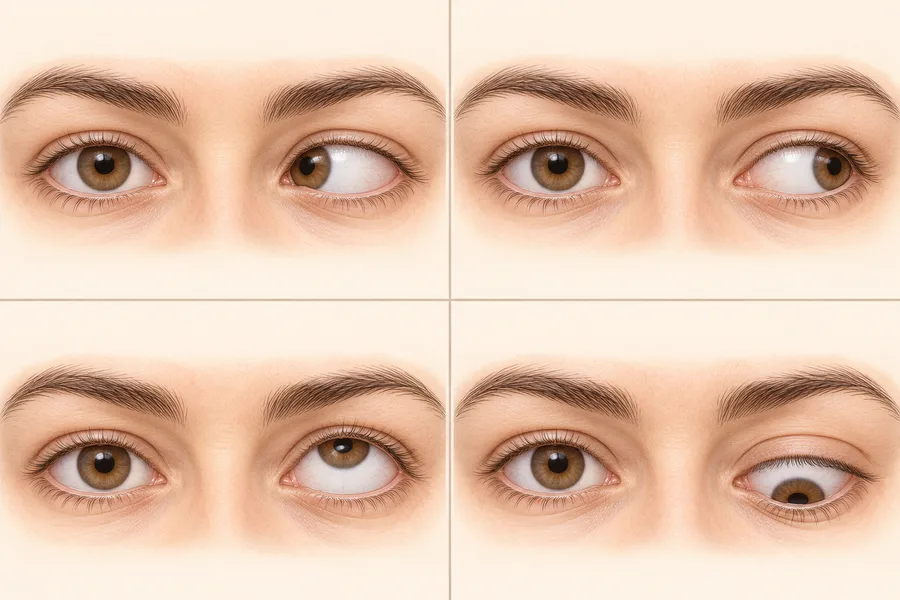
Strabismus means the eyes are not aligned: one eye looks at a target while the other turns in, out, up or down. The American Association for Pediatric Ophthalmology and Strabismus (AAPOS) estimates that about 4% of the US population has it. Doctors name each type by direction, by whether it is constant or comes and goes, and by cause. All types need an eye exam, because strabismus in a child can lead to amblyopia Reduced vision in one eye that develops in childhood because the brain favors the other eye. Often called lazy eye. and loss of depth perception.
Named by direction
AAPOS uses these terms:
- esotropia: one or both eyes turn inward, often called crossed eyes
- exotropia: one or both eyes turn outward
- hypertropia and hypotropia: one eye sits higher or lower than the other
The American Academy of Ophthalmology (AAO) guideline notes that prevalence estimates for strabismus range from 0.8% to 6.8% across populations. In the US, esotropia and exotropia are about equally common, while exotropia is more frequent in Hong Kong, Singapore, Japan and China.
A population study in Olmsted County, Minnesota, reviewed the records of all residents younger than 19 diagnosed with strabismus from 1985 to 1994:
| Type | Share of 627 new cases |
|---|---|
| Esotropia (all forms) | 60.1% |
| Exotropia (all forms) | 32.7% |
| Hypertropia | 6.7% |
| Accommodative esotropia | 27.9% |
| Intermittent exotropia | 16.9% |
| Acquired nonaccommodative esotropia | 10.2% |
| Esotropia with a central nervous system disorder | 7.0% |
| Convergence insufficiency | 6.4% |
The first three rows are the direction groups; the rest are the five most common specific forms.
Constant or intermittent
An eye turn can be present all the time or only some of the time. AAPOS notes that esotropia may come and go or be constant.
Intermittent exotropia is an outward drift that comes and goes. The AAO guideline says it usually appears before age 3, shows up when the child is tired, ill or not paying attention, and can make a child close or cover one eye in bright light. Children usually do not see double, because the brain ignores the image from the drifting eye, and severe amblyopia is uncommon. Young children with intermittent exotropia and good control can be followed without surgery, because worsening to a constant turn or loss of depth perception is uncommon.
Babies are a special case. The guideline says strabismus before 4 months of age sometimes resolves on its own, especially if it is intermittent, variable or smaller than 40 prism diopters. AAPOS advises that any eye crossing beyond 4 months of age should be checked, and that constant crossing at any age is worrisome.
Named by cause
- Accommodative esotropia: crossing linked to farsightedness and focusing effort, usually starting between ages 1 and 4. See accommodative esotropia.
- Infantile esotropia: a constant inward turn that starts before 6 months and is unlikely to resolve.
- Sensory strabismus: an eye with poor vision drifts out of line.
- Consecutive exotropia: an outward turn after surgery for esotropia.
- Nerve and muscle causes: AAPOS lists third and fourth nerve palsies and named patterns such as Brown syndrome and Duane syndrome.
- Convergence insufficiency: the eyes drift outward at near. See convergence insufficiency.
AAPOS says most strabismus comes from a problem in the neuromuscular control of eye movement, including the brain, and less often from the eye muscles themselves. It is more likely in children with cerebral palsy, Down syndrome, hydrocephalus or brain tumors. The AAO guideline adds farsightedness, unequal prescriptions, premature birth, low birth weight and a family history of strabismus as risk factors. In adults, AAPOS lists stroke and other blood vessel problems, injury, thyroid eye disease, cranial nerve palsies and previous eye surgery among the causes.
Pseudostrabismus: eyes that only look crossed
AAPOS describes pseudostrabismus as eyes that look misaligned but are actually straight. In babies it is usually caused by a flat nasal bridge and small folds of skin near the inner corners of the eyes, and it is most noticeable in photos when the child looks to the side. It generally needs no treatment and often improves as the face grows.
An eye doctor tells the two apart with the light reflex test, checking whether a light reflects from the same spot on each pupil, and the cover test. AAPOS notes that telling them apart can be difficult and that a baby with pseudostrabismus can still develop true strabismus later, so regular check-ups matter.
Treatment in brief
Treatment aims to straighten the eyes, help them work together and treat any amblyopia. For esotropia, AAPOS lists glasses, sometimes with prisms or bifocals, patching, eye muscle surgery and, less often, botulinum toxin injections. The choice depends on the type. For example, glasses alone straighten most accommodative esotropia, while an eye turn that glasses and amblyopia treatment do not correct may need strabismus surgery.
Signs that need prompt care
- An eye turn that starts suddenly. AAPOS says a misalignment that starts suddenly in an adult almost always causes double vision and is a warning sign that a doctor should check, sometimes with blood tests or an MRI scan.
- New double vision. AAPOS notes that older children and adults with a new inward turn often see double.
- An inward turn that starts suddenly with other neurological signs. The AAO guideline says these patients should be evaluated and treated promptly, and brain imaging should be considered. It also says neurological causes, especially head injury, should be considered and addressed promptly.
- Constant crossing at any age, or any crossing after 4 months.
For an overview of eye alignment and two-eye vision problems, see the orthoptics section.
Frequently asked questions
Is it normal for a newborn's eyes to cross?
Brief or variable crossing in the first few months can be normal and sometimes resolves. AAPOS advises that any eye crossing after about 4 months of age, and constant crossing at any age, should be checked.
Can a child outgrow strabismus?
Some eye turns in the first months of life resolve, and in young children with well-controlled intermittent exotropia, worsening is uncommon. Most other types need monitoring or treatment, so a pediatric ophthalmologist should assess any eye turn.
My baby looks cross-eyed in photos. Is that strabismus?
It may be pseudostrabismus, where a flat nasal bridge and small skin folds near the inner corners of the eyes make straight eyes look crossed. An eye exam is needed to tell the difference.
Sources
- Strabismus. American Association for Pediatric Ophthalmology and Strabismus, 2020
- Esotropia. American Association for Pediatric Ophthalmology and Strabismus, 2023
- Pseudostrabismus. American Association for Pediatric Ophthalmology and Strabismus, 2023
- Adult Strabismus (Adult Eye Misalignment). American Association for Pediatric Ophthalmology and Strabismus
- Esotropia and Exotropia Preferred Practice Pattern®. Ophthalmology (American Academy of Ophthalmology), 2023
- Common forms of childhood strabismus in an incidence cohort. American Journal of Ophthalmology, 2007
- Accommodative Esotropia: Why Farsighted Children's Eyes Cross
Accommodative esotropia links eye crossing to farsightedness. Glasses are the main treatment; some children need bifocals, and a minority need surgery. - Strabismus Surgery: What Happens, Risks and Repeat Operations
Eye muscle surgery loosens or tightens muscles, usually as a day procedure. In a US registry, about 1 in 15 patients had a second operation within a year. - Atropine Eye Drops for Amblyopia: What the Research Shows
In PEDIG trials, atropine drops in the stronger eye improved amblyopia about as much as patching, including weekend use. Side effects and who it may suit. - Binocular and Digital Amblyopia Treatment: What the Trials Show
Dichoptic games and videos for lazy eye: an iPad game fell short of patching, while two FDA-authorized devices showed gains over 12 to 16 weeks. - Convergence Insufficiency: Symptoms and What the CITT Trials Found
Convergence insufficiency causes eye strain and double vision up close. In trials, office-based therapy beat home push-ups but not placebo for reading scores. - Patching for Amblyopia: What Trials Show About Glasses and Hours
Glasses come first. In PEDIG trials, 2 hours of daily patching matched 6 for moderate amblyopia, and 6 matched full-time patching for severe amblyopia.