Orthoptics · Strabismus
Strabismus Surgery: What Happens, Risks and Repeat Operations
This article is for general information and does not replace advice from a doctor. Medical disclaimer
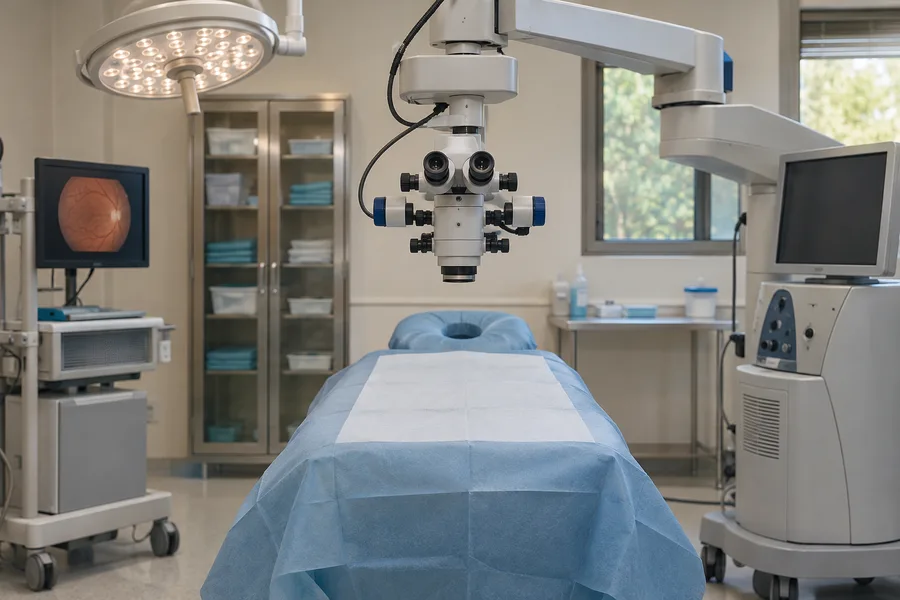
Strabismus surgery changes the pull of one or more eye muscles so the eyes line up better. It is usually a day procedure, done under general anesthesia in children. AAPOS says most adults see a big improvement in alignment after one operation, but some need another, and in US data the chance of a repeat operation rises with age.
When surgery is considered
The American Academy of Ophthalmology (AAO) guideline on esotropia and exotropia says children with an inward turn should have surgery if glasses and amblyopia treatment are not enough to align the eyes, and only when simpler methods have failed or are unlikely to help. Amblyopia Reduced vision in one eye that develops in childhood because the brain favors the other eye. Often called lazy eye. is usually treated first, because treating it can change the size of the turn and because surgery is less successful when moderate or severe amblyopia remains. Small turns under 12 prism diopters are not usually operated on unless they cause symptoms.
For intermittent exotropia, an outward drift that comes and goes, the guideline lists these reasons to operate: the drift becomes constant or nearly constant, depth perception declines, or it affects the child socially. Young children with good control can be watched without surgery. You can compare the different kinds of eye turn in types of strabismus.
What the surgeon does
The American Association for Pediatric Ophthalmology and Strabismus (AAPOS) describes the main techniques:
- recession: the muscle is detached and reattached farther back on the eye, which weakens its pull
- resection or plication: the muscle is shortened by removing or folding a segment, which strengthens its pull
- adjustable sutures: a temporary knot lets the surgeon fine-tune the position after the operation, usually with the patient awake and the eye numbed; this is limited to people who can cooperate, so mainly older children and adults
The eyeball is not removed from the socket, and there are no skin incisions. According to the AAO guideline, operating on two muscles is most common, while large turns may need three or four.
Anesthesia and recovery
Children usually have general anesthesia. Adults may have general anesthesia or sedation with local numbing. Most operations are outpatient, so the patient goes home the same day.
AAPOS describes the usual recovery. The white of the eye is red, sometimes for weeks or occasionally months. The eyes feel scratchy and sore when they move, which usually eases within a few days. Antibiotic or antibiotic-steroid drops or ointment are applied at the end of surgery, and some surgeons prescribe drops for a few days afterward. The AAO guideline says parents should be told about the risks and warning signs of complications after surgery, especially infection around the eye and a slipped or lost muscle.
Results and repeat operations
| Data | Finding |
|---|---|
| IRIS Registry, US practices, surgery in 2013 to 2015 | 6.72% had another strabismus operation within 1 year: 3.95% at ages 6 to 9, rising to 11.5% at 65 and older |
| Randomized trial of intermittent exotropia in the AAO guideline, 197 children aged 3 to 10 | Repeat surgery within 3 years in 10% after operating on both outer muscles and 5% after operating on two muscles of one eye; no significant difference in the share with a suboptimal outcome |
| AAO guideline, intermittent exotropia | About 80% have good alignment 6 months after surgery on both outer muscles, but recurrence over time is common |
| AAO guideline, infantile esotropia | Recurrence of crossing is most likely in the first year; the risk of drifting outward keeps rising for at least 10 years |
The IRIS Registry pools electronic health records from US ophthalmology practices; its figure works out to about 1 in 15 patients having a second operation within a year. Amblyopia and nystagmus are linked to a higher reoperation rate in infantile esotropia. After surgery for an outward turn, an inward overcorrection right after the operation often causes double vision. Some studies found it is usually temporary, while another found the outcome unpredictable. If it lasts several weeks, temporary prisms can help, and further surgery is often needed if they do not.
Botulinum toxin injections into an eye muscle are an alternative in some cases. In a randomized study of 30 adults, injections succeeded less often than adjustable-suture surgery (29% vs 77%), and the guideline notes that repeat injections are frequently needed.
Risks
A national UK surveillance study collected severe complications over two years, from 2008 to 2010, against about 24,000 operations:
- 60 severe events in total, about 1 in 400 operations
- perforation of the wall of the eyeball, 0.08%
- suspected slipped muscle, 0.067%
- severe infection, 0.06%
- scleritis, 0.02%, more common in adults
- lost muscle, 0.02%
A poor or very poor final outcome, meaning loss of corrected vision or double vision when looking straight ahead, occurred in about 1 per 2,400 operations. AAPOS adds that the common risks are incomplete alignment and persistent double vision, and that anesthesia reactions, infection, scarring, a droopy eyelid, bleeding and vision loss are rare.
Surgery in adults
Adults can be treated at any age; AAPOS notes that patients in their 90s have benefited. It classes eye muscle surgery as reconstructive and says it can reduce double vision, improve depth perception and sometimes side vision, and reduce the need for prism glasses. Insurance usually covers it, though coverage should be checked.
For adults whose eyes stay aligned, gains in quality of life appear to last. In a study of 73 adults, those still well aligned at 1 year had further gains between 6 weeks and 1 year on a questionnaire, with median psychosocial scores rising from 83.8 to 93.8 and function scores from 72.5 to 77.5. The AAO guideline also notes that treatment can improve both function and psychosocial outcomes into adulthood.
Questions to ask before surgery
- What is the goal: better two-eye vision, less double vision, appearance, or a combination?
- Which muscles will be operated on, and will adjustable sutures be used?
- What is the chance that a second operation will be needed in my child’s or my situation?
- Will glasses, patching or prisms still be needed afterward?
The AAO guideline stresses that the family and surgeon should agree on the goals beforehand. If the turn is linked to farsightedness, see accommodative esotropia; for an overview, the orthoptics section.
Frequently asked questions
Is the eye removed during strabismus surgery?
No. AAPOS stresses that the eyeball is not taken out of the socket. The surgeon reaches the muscles through the thin clear membrane over the white of the eye, without skin incisions.
How likely is a second operation?
In US registry data covering 2013 to 2015, 6.7% of patients had another strabismus operation within a year. The rate was lowest at ages 6 to 9 and highest in people 65 and older.
Is surgery for adults only cosmetic?
No. AAPOS says surgery can reduce double vision, improve depth perception and sometimes side vision, and it classes eye muscle surgery as reconstructive.
Sources
- Strabismus Surgery. American Association for Pediatric Ophthalmology and Strabismus, 2022
- Adult Strabismus (Adult Eye Misalignment). American Association for Pediatric Ophthalmology and Strabismus
- Esotropia and Exotropia Preferred Practice Pattern®. Ophthalmology (American Academy of Ophthalmology), 2023
- Strabismus, Strabismus Surgery, and Reoperation Rate in the United States: Analysis from the IRIS Registry. Ophthalmology, 2018
- Severe complications of strabismus surgery. Journal of AAPOS, 2013
- Changes in health-related quality of life 1 year following strabismus surgery. American Journal of Ophthalmology, 2012
- Accommodative Esotropia: Why Farsighted Children's Eyes Cross
Accommodative esotropia links eye crossing to farsightedness. Glasses are the main treatment; some children need bifocals, and a minority need surgery. - Types of Strabismus: Eyes That Turn In, Out, Up or Down
Esotropia, exotropia and vertical eye turns, constant or intermittent: how the main types differ, what pseudostrabismus is and which signs need prompt care. - Atropine Eye Drops for Amblyopia: What the Research Shows
In PEDIG trials, atropine drops in the stronger eye improved amblyopia about as much as patching, including weekend use. Side effects and who it may suit. - Binocular and Digital Amblyopia Treatment: What the Trials Show
Dichoptic games and videos for lazy eye: an iPad game fell short of patching, while two FDA-authorized devices showed gains over 12 to 16 weeks. - Convergence Insufficiency: Symptoms and What the CITT Trials Found
Convergence insufficiency causes eye strain and double vision up close. In trials, office-based therapy beat home push-ups but not placebo for reading scores. - Patching for Amblyopia: What Trials Show About Glasses and Hours
Glasses come first. In PEDIG trials, 2 hours of daily patching matched 6 for moderate amblyopia, and 6 matched full-time patching for severe amblyopia.