Orthoptics · Amblyopia
Patching for Amblyopia: What Trials Show About Glasses and Hours
This article is for general information and does not replace advice from a doctor. Medical disclaimer
- Goal which aspect of vision is being monitored
- Follow-up how the team will measure change
- Daily life discuss difficulties with wearing a patch
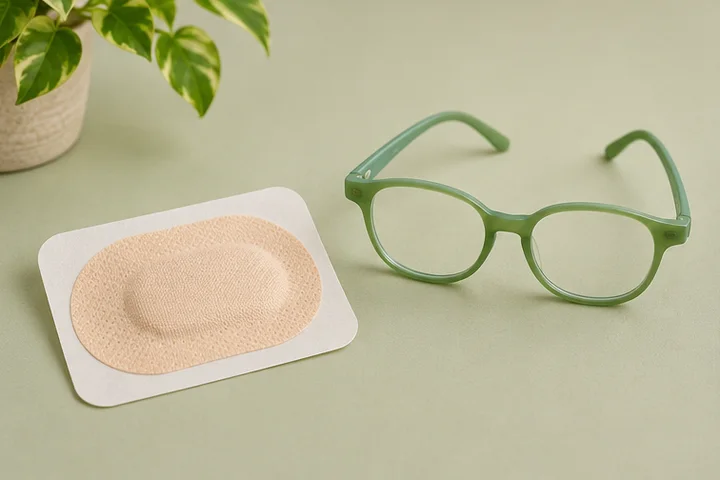
Patching covers the stronger eye so the brain has to use the weaker one. Treatment of amblyopia Reduced vision in one eye that develops in childhood because the brain favors the other eye. Often called lazy eye. usually starts with glasses alone, and patching is added if vision does not fully recover. Trials by the Pediatric Eye Disease Investigator Group (PEDIG) showed that shorter daily patching often works as well as longer patching.
Glasses usually come first
The American Academy of Ophthalmology (AAO) guideline on amblyopia calls correction of the focusing error the first step of treatment for children up to 17. Glasses alone can do a lot.
In a PEDIG study of 84 children aged 3 to 6 with untreated anisometropic amblyopia, where one eye has a much stronger prescription than the other, glasses alone improved vision by two or more lines in 77% and cleared the amblyopia in 27%. Improvement took up to 30 weeks to level off. The AAO guideline adds that children with amblyopia in both eyes from high prescriptions can also improve substantially with glasses alone.
How many hours: what the trials found
PEDIG compared patching schedules in children younger than 7. Visual acuity was measured in lines on an eye chart.
| Trial | Children | Compared | Result |
|---|---|---|---|
| Moderate amblyopia, 2003 | 189 children, vision 20/40 to 20/80 | 2 vs 6 hours a day | Both groups improved by an average of 2.4 lines at 4 months; 62% in each group reached 20/32 or gained 3 lines |
| Severe amblyopia, 2003 | 175 children, vision 20/100 to 20/400 | 6 hours a day vs full-time | 4.8 vs 4.7 lines of improvement at 4 months |
| Activities during patching, 2008 | 425 children, vision 20/40 to 20/400 | 2 hours with near vs distance activities | 2.5 vs 2.6 lines at 8 weeks; no added benefit from near work |
In the 2008 trial, children with severe amblyopia improved by an average of 3.6 lines by 17 weeks on 2 hours a day. The AAO guideline reflects these results. It suggests considering 2 hours a day as the first patching schedule for moderate amblyopia and notes that 6 or more hours is often prescribed when vision is worse than 20/80, though 2 hours has worked for some of these children.
When vision stops improving on 2 hours, the guideline describes two options: increasing to 6 hours, which in one trial gave 0.6 lines more improvement after 10 weeks than staying on 2 hours, or switching to atropine eye drops. The guideline bases the choice on the child’s age, vision, adherence and response so far, and their physical, social and psychological situation, so the schedule is set and adjusted by the pediatric ophthalmologist or orthoptist.
Wearing the patch: adherence is the hard part
Prescribed hours and worn hours are often different. In the UK MOTAS and ROTAS studies, where children were prescribed 6 or 12 hours a day, an electronic occlusion dose monitor recorded actual wear in 152 children with an average age of 68 months, just under 6 years. Mean adherence was 44% of the prescribed dose, and on 42% of days no patch was worn at all. Wear was lower at weekends than on weekdays (39% vs 46%), lower when clinic visits were less frequent and lower the longer treatment went on.
The AAO guideline says that explaining the reason for treatment to parents and children improves adherence. In one study, a cartoon story for 4-year-olds starting patching helped. The guideline prefers an opaque adhesive patch on the skin, with glasses worn over it. A cloth patch on the glasses frame can work, but children can look around it.
Side effects
The AAO guideline lists the problems seen with patching:
- mild skin irritation from the adhesive, reported in 41% of children in one trial, with moderate or severe irritation in another 6%
- distress for the child and parents, even in committed families
- accidents while one eye is covered, so children need careful supervision
- occasionally, reduced vision in the patched eye (reverse amblyopia)
- an eye turn that appears or gets worse, although a similar share of children see an existing eye turn improve
Switching to a different patch or using skin lotion when the patch is off can reduce irritation. Reduced vision in the stronger eye is one reason the clinician checks both eyes at every visit.
Older children and teenagers
Success rates fall with age, but the AAO guideline says treatment can be offered to older children and teenagers, especially if they have never been treated. Patching should be considered in that group too.
Follow-up and stopping
At each visit the clinician checks:
- vision in the amblyopic eye
- vision in the stronger eye
- how much patching was actually done
- any side effects of treatment
Once vision has reached its best level, treatment is usually reduced step by step. About one in four successfully treated children has a recurrence within the first year off treatment. For children under 8 on 6 or more hours a day, the guideline reports that recurrence is more likely when patching stops abruptly than when it is first reduced to 2 hours. Glasses usually continue until the visual system matures, typically by the early teens. If amblyopia returns, renewed treatment usually brings vision back to its previous best.
Results tend to last. The guideline reports that patching gains appear stable through at least age 15, and in one trial with long-term follow-up, 78% of children with anisometropic or strabismic amblyopia reached 20/32 or better.
Some children do not tolerate patching. Alternatives include atropine drops and newer binocular and digital treatments. For how amblyopia is first detected, see vision screening for children, or go back to the orthoptics section.
Frequently asked questions
How many hours a day does a child need to wear a patch?
It depends on the child, and the eye doctor sets the schedule. In PEDIG trials, 2 hours a day worked as well as 6 for moderate amblyopia, and 6 hours worked as well as full-time patching for severe amblyopia.
Does my child have to do close-up activities while patched?
A PEDIG trial of 425 children found no extra benefit from near activities compared with distance activities during 2 hours of daily patching.
Can amblyopia come back after patching stops?
Yes. The AAO guideline says about one in four successfully treated children has a recurrence within the first year off treatment, so follow-up visits continue after patching ends.
Sources
- Amblyopia Preferred Practice Pattern. Ophthalmology (American Academy of Ophthalmology), 2023
- A randomized trial of patching regimens for treatment of moderate amblyopia in children. Archives of Ophthalmology, 2003
- A randomized trial of prescribed patching regimens for treatment of severe amblyopia in children. Ophthalmology, 2003
- Treatment of anisometropic amblyopia in children with refractive correction. Ophthalmology, 2006
- A randomized trial of near versus distance activities while patching for amblyopia in children aged 3 to less than 7 years. Ophthalmology, 2008
- Compliance with occlusion therapy for childhood amblyopia. Investigative Ophthalmology & Visual Science, 2013
- Atropine Eye Drops for Amblyopia: What the Research Shows
In PEDIG trials, atropine drops in the stronger eye improved amblyopia about as much as patching, including weekend use. Side effects and who it may suit. - Binocular and Digital Amblyopia Treatment: What the Trials Show
Dichoptic games and videos for lazy eye: an iPad game fell short of patching, while two FDA-authorized devices showed gains over 12 to 16 weeks. - Accommodative Esotropia: Why Farsighted Children's Eyes Cross
Accommodative esotropia links eye crossing to farsightedness. Glasses are the main treatment; some children need bifocals, and a minority need surgery. - Convergence Insufficiency: Symptoms and What the CITT Trials Found
Convergence insufficiency causes eye strain and double vision up close. In trials, office-based therapy beat home push-ups but not placebo for reading scores. - Strabismus Surgery: What Happens, Risks and Repeat Operations
Eye muscle surgery loosens or tightens muscles, usually as a day procedure. In a US registry, about 1 in 15 patients had a second operation within a year. - Types of Strabismus: Eyes That Turn In, Out, Up or Down
Esotropia, exotropia and vertical eye turns, constant or intermittent: how the main types differ, what pseudostrabismus is and which signs need prompt care.