Orthoptics · Amblyopia
Atropine Eye Drops for Amblyopia: What the Research Shows
This article is for general information and does not replace advice from a doctor. Medical disclaimer
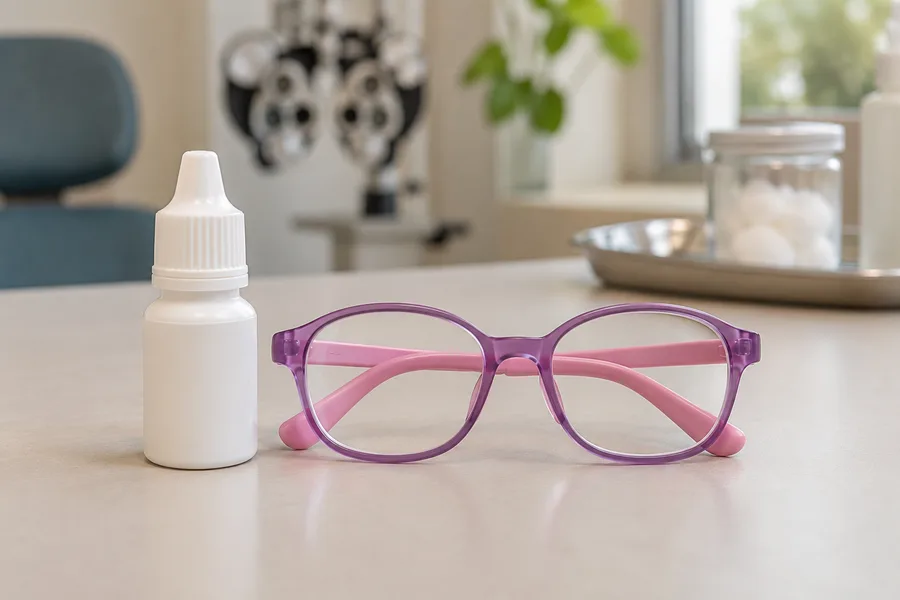
Atropine drops are an alternative to patching for amblyopia Reduced vision in one eye that develops in childhood because the brain favors the other eye. Often called lazy eye. . A drop in the stronger eye blurs its vision, mainly up close, so the brain relies more on the weaker eye. In large trials run by the Pediatric Eye Disease Investigator Group (PEDIG), atropine improved moderate amblyopia about as much as patching, and drops used only on weekends worked as well as daily drops.
How atropine works
Atropine relaxes the focusing muscle of the eye (cycloplegia). The American Academy of Ophthalmology (AAO) amblyopia guideline explains that this defocuses the stronger eye at near in a child wearing full glasses, and at both near and distance if the child’s farsightedness is not corrected. The guideline adds that the drops work best when the stronger eye is farsighted.
Like patching, atropine is usually considered after glasses alone have not cleared the amblyopia. The guideline also mentions it when a child has latent nystagmus, when patching has failed, or as maintenance treatment.
Atropine compared with patching
The table summarizes the main PEDIG trials. Vision is measured in lines on an eye chart.
| Trial | Children | Compared | Main result |
|---|---|---|---|
| Moderate amblyopia, 2002 | 419 children younger than 7, vision 20/40 to 20/100 | Daily atropine vs patching at least 6 hours a day, for 6 months | 2.84 vs 3.16 lines; 74% vs 79% reached 20/30 or gained 3 lines |
| Same children, age 15, 2014 | 147 measured at 15 | Original atropine vs patching group | Mean vision about 20/25; no difference between original treatments |
| Weekend use, 2004 | 168 children younger than 7, vision 20/40 to 20/80 | Daily vs weekend atropine for 4 months | 2.3 lines in each group at 4 months; 47% vs 53% reached 20/25 or matched the stronger eye by study end |
| Older children, 2008 | 193 children aged 7 to 12, vision 20/40 to 20/100 | Weekend atropine vs 2 hours of daily patching | 7.6 vs 8.6 letters at 17 weeks; 17% vs 24% reached 20/25 or better |
In the 2002 trial, vision improved faster with patching at first, but by 6 months the difference was small. The authors called it clinically inconsequential and concluded that both are appropriate first treatments for moderate amblyopia in children aged 3 to 6.
In the follow-up at age 15, 59.9% of the amblyopic eyes saw 20/25 or better, though mild residual amblyopia was common. Children who started treatment before age 5 had better vision at 15 than those who started at 5 or 6.
For severe amblyopia, the AAO guideline notes some success with atropine when vision is worse than 20/80 and reports an average gain of 4.5 lines with twice-weekly atropine in children aged 3 to 12 with severe amblyopia.
What the Cochrane review found
A 2019 Cochrane review included seven trials from six countries, covering 1,177 amblyopic eyes. The trials were too different to combine statistically, but six of them, including two at low risk of bias, suggested atropine is as effective as patching. Improvement was similar at every time point, from 5 weeks up to 10 years.
The review found:
- no difference in eye alignment, depth perception or vision in the stronger eye between the two treatments
- better adherence and quality of life with atropine
- more light sensitivity with atropine, and more mild loss of vision in the stronger eye that did not need treatment
- more skin, eyelid or eye-surface irritation with patching
- lower cost for atropine
Side effects
The AAO guideline reports side effects from the trials:
- light sensitivity in 18% of children and irritation of the eye surface (conjunctiva) in 4%, in the first PEDIG trial
- temporary reduced vision in the stronger eye, seen more often than with patching; in the 2002 trial it did not persist with further follow-up
- less commonly, reverse amblyopia in the stronger eye, which is why both eyes are checked at follow-up
- occasionally a new inward eye turn, although a similar share of children see an existing eye turn improve
- body-wide effects: dry mouth and skin, fever, delirium and a fast heart rate
The guideline notes that atropine for amblyopia has not been studied in trials in children younger than 3, who may be more prone to body-wide side effects. Ask the prescribing doctor in advance what to do if any body-wide symptoms appear.
Who atropine may suit
There is no single right answer, and the choice is made with the pediatric ophthalmologist or orthoptist. Points from the evidence:
- it works best when the stronger eye is farsighted
- parents in the 2002 trial rated atropine slightly more acceptable than patching for 6 or more hours a day
- the Cochrane review found better adherence with atropine than with patching
- light sensitivity may make it harder to use where sun exposure is high
The doctor also decides the dosing schedule, how long to continue and when to switch or combine treatments. Patching for amblyopia covers the alternative in detail, and binocular and digital treatment describes newer options. For the wider field, see the orthoptics section.
Frequently asked questions
Is atropine as effective as patching?
In PEDIG trials of moderate amblyopia, atropine and patching produced improvement of similar size, and a 2019 Cochrane review of seven trials reached the same conclusion.
Do the drops have to be used every day?
The schedule is set by the eye doctor. In a PEDIG trial of 168 children, drops used only on weekends improved vision as much as daily drops.
What side effects were reported?
Trials reported light sensitivity, eye irritation and reduced vision in the stronger eye. The AAO guideline also lists body-wide effects: dry mouth and skin, fever, confusion (delirium) and a fast heart rate.
Sources
- Amblyopia Preferred Practice Pattern. Ophthalmology (American Academy of Ophthalmology), 2023
- A randomized trial of atropine vs. patching for treatment of moderate amblyopia in children. Archives of Ophthalmology, 2002
- A randomized trial of atropine regimens for treatment of moderate amblyopia in children. Ophthalmology, 2004
- Patching vs atropine to treat amblyopia in children aged 7 to 12 years: a randomized trial. Archives of Ophthalmology, 2008
- Atropine vs patching for treatment of moderate amblyopia: follow-up at 15 years of age of a randomized clinical trial. JAMA Ophthalmology, 2014
- Conventional occlusion versus pharmacologic penalization for amblyopia. Cochrane Database of Systematic Reviews, 2019
- Binocular and Digital Amblyopia Treatment: What the Trials Show
Dichoptic games and videos for lazy eye: an iPad game fell short of patching, while two FDA-authorized devices showed gains over 12 to 16 weeks. - Patching for Amblyopia: What Trials Show About Glasses and Hours
Glasses come first. In PEDIG trials, 2 hours of daily patching matched 6 for moderate amblyopia, and 6 matched full-time patching for severe amblyopia. - Accommodative Esotropia: Why Farsighted Children's Eyes Cross
Accommodative esotropia links eye crossing to farsightedness. Glasses are the main treatment; some children need bifocals, and a minority need surgery. - Convergence Insufficiency: Symptoms and What the CITT Trials Found
Convergence insufficiency causes eye strain and double vision up close. In trials, office-based therapy beat home push-ups but not placebo for reading scores. - Strabismus Surgery: What Happens, Risks and Repeat Operations
Eye muscle surgery loosens or tightens muscles, usually as a day procedure. In a US registry, about 1 in 15 patients had a second operation within a year. - Types of Strabismus: Eyes That Turn In, Out, Up or Down
Esotropia, exotropia and vertical eye turns, constant or intermittent: how the main types differ, what pseudostrabismus is and which signs need prompt care.