Orthoptics · Amblyopia
Binocular and Digital Amblyopia Treatment: What the Trials Show
This article is for general information and does not replace advice from a doctor. Medical disclaimer
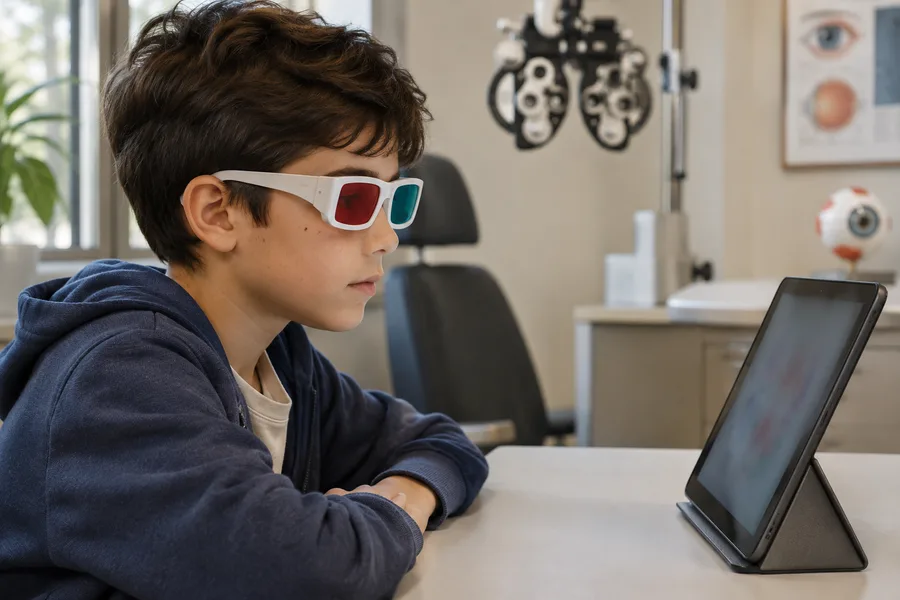
Binocular, or dichoptic, treatments show each eye a slightly different picture so that both eyes have to work together. They aim to treat amblyopia Reduced vision in one eye that develops in childhood because the brain favors the other eye. Often called lazy eye. without covering the stronger eye. The evidence is mixed: early game-based trials were disappointing, while two devices authorized by the US Food and Drug Administration (FDA) showed benefits over 12 to 16 weeks. How long the gains last is still unknown.
How dichoptic treatment works
The American Academy of Ophthalmology (AAO) amblyopia guideline describes the approach. The weaker eye sees a high-contrast image and the stronger eye a low-contrast one, or parts of the picture are hidden from one eye and shown to the other. Early versions used a falling-blocks game on a tablet with red-green glasses. Newer systems play films or TV shows through a headset or on a screen viewed with special glasses.
The guideline notes that binocular treatment has been used in children with no eye turn or only a small one who still have some two-eye vision, so the trials do not cover every type of amblyopia.
The iPad game trial
The Pediatric Eye Disease Investigator Group (PEDIG) tested a binocular iPad game against patching in 385 children aged 5 to 12. One group was prescribed the game for 1 hour a day, the other a patch for 2 hours a day, for 16 weeks.
- Vision in the weaker eye improved by 1.05 lines with the game and 1.35 lines with patching.
- The trial could not confirm the game was as good as patching, and a further analysis suggested it was not.
- Only 22% of children with game data played more than 75% of the prescribed time; the median was 46%.
- Children aged 5 to 6 with no previous treatment gained more: 2.5 lines with the game and 2.8 with patching.
The AAO guideline adds that three randomized trials failed to show that an hour a day of game play was as good as 2 hours of patching or better than a placebo game. A later trial with a more engaging game found no benefit over glasses alone in children aged 7 to 12. In children aged 4 to 6, the benefit seen at 4 weeks had faded by 8 weeks.
Two FDA-authorized devices
| Device | FDA status | Trial | Result |
|---|---|---|---|
| Luminopia One (headset showing modified TV and films) | De Novo request granted October 2021, for ages 4 to 7 with amblyopia from unequal prescriptions and/or mild strabismus | Randomized trial of 117 children: 1 hour a day, 6 days a week for 12 weeks, plus glasses, vs glasses alone | Weaker-eye vision improved 1.8 vs 0.85 lines; 62% vs 33% gained 2 or more lines |
| CureSight (eye tracker with red-blue glasses and streamed video) | 510(k) clearance September 2022, for ages 4 to under 9 with amblyopia from unequal prescriptions and/or mild strabismus | Randomized trial of 103 children aged 4 to 8: 90 minutes a day, 5 days a week for 16 weeks, vs 2 hours of daily patching | 0.28 vs 0.23 logMAR improvement, which met the trial’s test of being no worse than patching; adherence 91% vs 83% |
The FDA summary for Luminopia One reports headaches in 14.3% of children using the device and 1.7% of controls, all mild and all resolved, and eye strain in 3.6% of device users and none of the controls. The CureSight trial reported no serious adverse events. Two of its five authors were affiliated with NovaSight, the company that makes the device.
What is still unknown
The FDA lists the limits of the Luminopia One evidence. Because the trial ended at 12 weeks:
- safety and effectiveness beyond 12 weeks were not evaluated
- it is unknown whether the gains last after treatment stops
- the long-term effects of headset use in children aged 4 to 7 are unknown
The FDA also notes that in the 12-week study, depth perception did not improve in a clinically meaningful way.
A meta-analysis in Acta Ophthalmologica pooled 12 randomized trials with 1,034 children and found no significant difference between dichoptic treatment and patching in vision, depth perception, adherence or side effects. Results varied widely between trials, and the authors warned that the findings may not apply to amblyopia caused by strabismus, where two-eye vision is often absent.
The AAO guideline, which predates this meta-analysis, lists binocular digital therapy among amblyopia treatments but says the evidence is still too limited to recommend it.
Practical points for families
- Prescription only. Both devices are labeled for prescription use, and the FDA restricts Luminopia One to sale by or on the order of an ophthalmologist or optometrist.
- Glasses stay. Both devices are labeled as add-ons to full-time glasses.
- Fit matters. The FDA summary says children with an eye-to-eye pupil distance below 52 mm should not use Luminopia One, as it was not studied in them.
- Adherence varies. In the iPad trial, only 22% of children played more than three-quarters of the prescribed time.
Whether a child is a candidate depends on the cause and severity of the amblyopia, any eye turn, past treatment and age, so the decision belongs with a pediatric ophthalmologist or orthoptist. The standard treatments are covered in patching for amblyopia and atropine eye drops for amblyopia. For the wider field, see the orthoptics section.
Frequently asked questions
Can a video game replace an eye patch?
Not as a general rule. In a PEDIG trial of 385 children, a binocular iPad game did not prove as good as 2 hours of daily patching. In their trials, Luminopia One did better than glasses alone and CureSight was no worse than patching, but the results only cover 12 and 16 weeks.
Does my child still need glasses with a digital treatment?
Yes. FDA documents describe both Luminopia One and CureSight as add-ons to full-time glasses, which are worn under the headset or the device's colored glasses.
Are these treatments available without a prescription?
No. FDA documents label both Luminopia One and CureSight for prescription use only, with treatment instructions set by a trained eye care professional.
Sources
- Amblyopia Preferred Practice Pattern. Ophthalmology (American Academy of Ophthalmology), 2023
- Effect of a Binocular iPad Game vs Part-time Patching in Children Aged 5 to 12 Years With Amblyopia: A Randomized Clinical Trial. JAMA Ophthalmology, 2016
- De Novo Classification Request for Luminopia One. U.S. Food and Drug Administration, 2021
- An Eye-Tracking-Based Dichoptic Home Treatment for Amblyopia: A Multicenter Randomized Clinical Trial. Ophthalmology, 2023
- 510(k) Summary of Safety and Effectiveness: K221375 (CureSight-CS100). U.S. Food and Drug Administration, 2022
- The efficacy and safety of dichoptic therapy in comparison to patching in children with amblyopia: A systematic review and meta-analysis. Acta Ophthalmologica, 2026
- Atropine Eye Drops for Amblyopia: What the Research Shows
In PEDIG trials, atropine drops in the stronger eye improved amblyopia about as much as patching, including weekend use. Side effects and who it may suit. - Patching for Amblyopia: What Trials Show About Glasses and Hours
Glasses come first. In PEDIG trials, 2 hours of daily patching matched 6 for moderate amblyopia, and 6 matched full-time patching for severe amblyopia. - Accommodative Esotropia: Why Farsighted Children's Eyes Cross
Accommodative esotropia links eye crossing to farsightedness. Glasses are the main treatment; some children need bifocals, and a minority need surgery. - Convergence Insufficiency: Symptoms and What the CITT Trials Found
Convergence insufficiency causes eye strain and double vision up close. In trials, office-based therapy beat home push-ups but not placebo for reading scores. - Strabismus Surgery: What Happens, Risks and Repeat Operations
Eye muscle surgery loosens or tightens muscles, usually as a day procedure. In a US registry, about 1 in 15 patients had a second operation within a year. - Types of Strabismus: Eyes That Turn In, Out, Up or Down
Esotropia, exotropia and vertical eye turns, constant or intermittent: how the main types differ, what pseudostrabismus is and which signs need prompt care.