Orthodontics · Care and risks
Risks of Orthodontic Treatment: Enamel, Roots, Gums and Pain
This article is for general information and does not replace advice from a doctor. Medical disclaimer
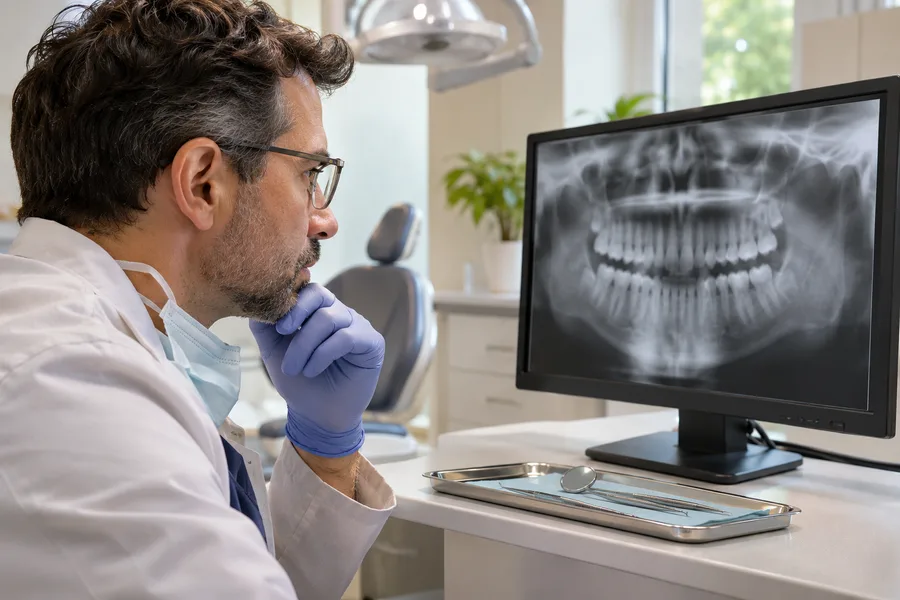
Moving teeth has side effects. The main ones are early enamel damage, soreness and shortening of tooth roots. Studies also report small changes to the gums and bone. Some of these risks may be lowered, for example with certain fluoride products or light forces, although the evidence is limited.
White spots on the enamel
White spot lesions are areas where the enamel has started to lose minerals. A Cochrane review describes them as early tooth decay that can appear on the teeth during treatment with fixed braces.
They are common. A 2015 meta-analysis of 14 studies found that 45.8% of patients developed new lesions during treatment with fixed braces, and that 68.4% of patients had lesions while in treatment.
Fluoride reduces decay in people who are prone to it, including orthodontic patients, according to the 2019 Cochrane review on fluoride during brace treatment. The review found low-certainty evidence for a few specific products and not enough evidence for others. Those results, along with a daily cleaning routine, are covered in cleaning your teeth with braces. Which fluoride products are right for you is a question for your dentist or orthodontist.
Root shortening
Orthodontic tooth movement can cause root resorption, a loss of root material that makes the roots shorter. A 2010 systematic review of 13 randomized trials in the American Journal of Orthodontics and Dentofacial Orthopedics found that:
- comprehensive orthodontic treatment increases how often root resorption happens and how severe it is
- heavy forces might be particularly harmful
- the order of wires, the bracket prescription and self-ligating brackets do not seem to affect it
- previous injury to a tooth and the shape of the tooth are unlikely causes
- there is some evidence that a pause of two to three months in treatment reduces the total amount
The authors found the evidence inconclusive for managing root resorption in practice, but supportive of light forces, especially when front teeth are being moved deeper into the bone, a movement called intrusion.
Gums and bone
Straight teeth are often said to be easier to keep healthy, but research has not shown a clear benefit for the gums. A 2008 systematic review in the Journal of the American Dental Association, based on one randomized and 11 non-randomized studies, compared people who had orthodontic treatment with people who had not. Treatment was associated with:
- 0.03 mm more gum recession
- 0.13 mm more loss of supporting bone
- 0.23 mm deeper gum pockets
Effects on gum inflammation and attachment loss were inconsistent. The authors concluded that there was no reliable evidence of benefit to gum health and that treatment appears to cause small harmful effects. The evidence was weak.
Pain and soreness
Pain is a common side effect, according to a 2017 Cochrane review. It increases with the amount of force applied, and the type of appliance can affect how strong it is. Pain is the most common reason people want to stop treatment and has been ranked as its worst aspect.
The review included 32 randomized trials with 3,110 participants aged 9 to 34. Moderate-quality evidence showed that pain relievers reduced pain at 2, 6 and 24 hours after treatment compared with a placebo or no treatment. Low-quality evidence found no difference between anti-inflammatory drugs such as ibuprofen and acetaminophen (paracetamol). Adverse effects were reported in only one study, where one participant developed a rash. Ask your orthodontist or pharmacist which pain reliever, if any, is suitable for you or your child.
Side effects at a glance
| Side effect | What studies found | What lowers the risk |
|---|---|---|
| White spot lesions | New lesions in 45.8% of patients with fixed braces | Some fluoride products helped in single trials |
| Root shortening | More frequent and more severe with comprehensive treatment | Light forces; a pause in treatment may help in some cases |
| Gum and bone changes | Fractions of a millimeter on average | No specific measure was tested in the review |
| Pain | Common, the leading reason people want to stop | Pain relievers worked better than placebo in trials |
When to contact your dentist or orthodontist
MedlinePlus, the National Library of Medicine’s consumer site, advises contacting your dentist if a toothache, mouth pain or other new symptoms develop during orthodontic treatment. It also notes that plaque left on braces can permanently mark the teeth or cause decay, so white, chalky marks appearing around the brackets are worth raising early.
The main bracket designs are compared in types of braces, and aligners in clear aligners vs braces. What affects the length of treatment is explained in how long orthodontic treatment takes. More guides are in the orthodontics section.
Frequently asked questions
How common are white spots after braces?
A 2015 meta-analysis of 14 studies found that 45.8% of patients developed new white spot lesions during treatment with fixed braces, and 68.4% had lesions during treatment.
Do braces shorten tooth roots?
Orthodontic tooth movement can shorten tooth roots. A systematic review found that comprehensive treatment increases how often and how much it happens, and that heavy forces may be particularly harmful.
Sources
- Critical evaluation of incidence and prevalence of white spot lesions during fixed orthodontic appliance treatment: A meta-analysis. Journal of International Society of Preventive and Community Dentistry, 2015
- Fluorides for preventing early tooth decay (demineralised lesions) during fixed brace treatment. Cochrane Database of Systematic Reviews, 2019
- Root resorption associated with orthodontic tooth movement: a systematic review. American Journal of Orthodontics and Dentofacial Orthopedics, 2010
- The effects of orthodontic therapy on periodontal health: a systematic review of controlled evidence. Journal of the American Dental Association, 2008
- Pharmacological interventions for pain relief during orthodontic treatment. Cochrane Database of Systematic Reviews, 2017
- Malocclusion of teeth. MedlinePlus, U.S. National Library of Medicine, 2026
- How to Clean Your Teeth With Braces: A Daily Routine
A step-by-step cleaning routine for braces based on AAO guidance, what to eat and drink, and what trials show about electric brushes and fluoride. - Clear Aligners vs Braces: What the Research Shows
Reviews find braces give a more precise bite on average, most clearly when teeth are extracted, with closer results otherwise. Why DIY aligners are risky. - Early Orthodontic Treatment for Children: When It Helps
What Cochrane reviews show about two-phase treatment for protruding teeth, underbites, crossbites and thumb sucking, and why it is not right for every child. - How Long Does Orthodontic Treatment Take? What Studies Show
Treatment with braces averaged about 20 months in clinical trials. What makes it longer, and whether vibration, lasers or minor surgery really speed it up. - Types of Malocclusion: Bite Problems and How Common They Are
Class I, II and III bites, crossbite, open bite, deep bite and crowding explained, with prevalence figures from a US survey and a review of 53 studies. - Orthodontics for Adults: Gum Health, Timing and Options
The AAO says one in three orthodontic patients is an adult. How adult treatment differs: gum health, treatment time, aligners versus braces and retainers.