Orthoptics · Amblyopia
Amblyopia in Adults and What Treatment Studies Show
This article is for general information and does not replace advice from a doctor. Medical disclaimer
Amblyopia Reduced vision in one eye that develops in childhood because the brain favors the other eye. Often called lazy eye. in an adult usually means that vision in one eye developed more weakly in childhood. The cause may have been strabismus A misalignment of the eyes in which one eye deviates from the target the other eye is viewing. , a large difference in prescription between the eyes, or an obstacle to receiving a clear image. If an eye has recently started seeing less well, a clinician needs to look for the cause of that new change.
What an eye exam checks
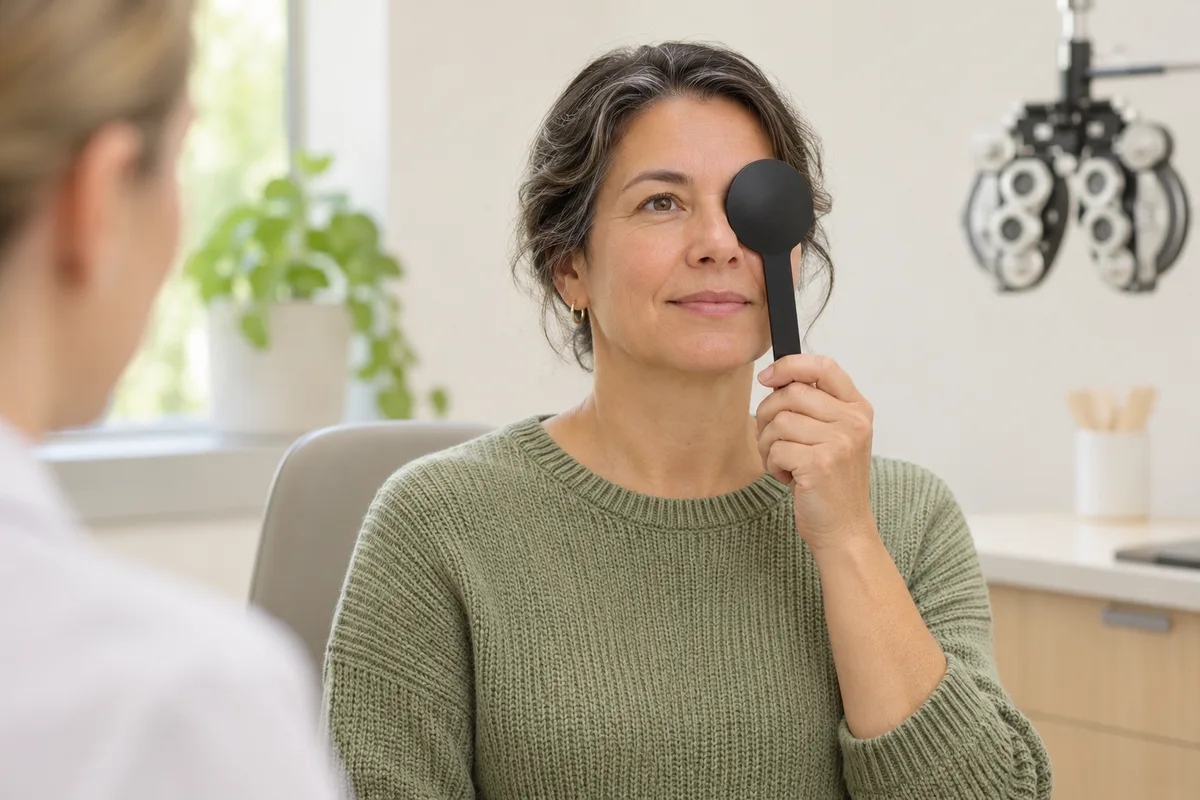
An eye care professional checks the best-corrected visual acuity of each eye and examines the structures of the eye. They may ask about childhood glasses, patching, and when you first noticed the difference between your eyes. Previous prescriptions or exam records can help establish the history.
A sudden decrease in vision needs urgent in-person evaluation. A longstanding difference is worth assessing too. The exam helps update optical correction and identify other problems that may be affecting vision.
What adult training studies found
A 2025 meta-analysis reported an average improvement in visual acuity in trials of perceptual learning and specific video game training. Approaches varied across the studies. In the separate randomized BRAVO trial, one particular home-based binocular game offered no advantage over a control game. That trial enrolled older children, teenagers, and adults.
If you are offered a training program, ask who was studied, what outcome improved, and how long the benefit was measured. Read more about binocular and digital amblyopia treatment.
Frequently asked questions
Could a recent change in one eye be amblyopia?
Amblyopia develops in childhood. An adult with a new decrease in vision needs an eye exam to identify the cause. A sudden decrease needs urgent care.
Can an adult's vision improve with amblyopia?
Updating the optical correction can help in some cases. Some training studies have reported improvement, and results vary by program and individual.
Sources
- Amblyopia (Lazy Eye). National Eye Institute
- A Systematic Review and Meta-Analysis of Perceptual Learning and Video Game Training for Adults with Monocular Amblyopia. Ophthalmology and Therapy, 2025
- Effectiveness of a Binocular Video Game vs Placebo Video Game for Improving Visual Functions in Older Children, Teenagers, and Adults With Amblyopia: A Randomized Clinical Trial. JAMA Ophthalmology, 2018
- Atropine Eye Drops for Amblyopia: What the Research Shows
In PEDIG trials, atropine drops in the stronger eye improved amblyopia about as much as patching, including weekend use. Side effects and who it may suit. - Binocular and Digital Amblyopia Treatment: What the Trials Show
Dichoptic games and videos for lazy eye: an iPad game fell short of patching, while two FDA-authorized devices showed gains over 12 to 16 weeks. - Patching for Amblyopia: What Trials Show About Glasses and Hours
Glasses come first. In PEDIG trials, 2 hours of daily patching matched 6 for moderate amblyopia, and 6 matched full-time patching for severe amblyopia. - Double Vision and When It Needs Urgent Care
How clinicians tell monocular from binocular double vision, which symptoms need urgent evaluation, and what to report at an exam. - Exotropia in Children and What an Eye Exam Can Show
How to recognize an outward eye turn in children, what an eye specialist checks, and when to discuss treatment. - Nystagmus in Children and When to Seek Urgent Care
How involuntary eye movements can look in a child, what to report at an eye exam, and when to seek urgent care.